
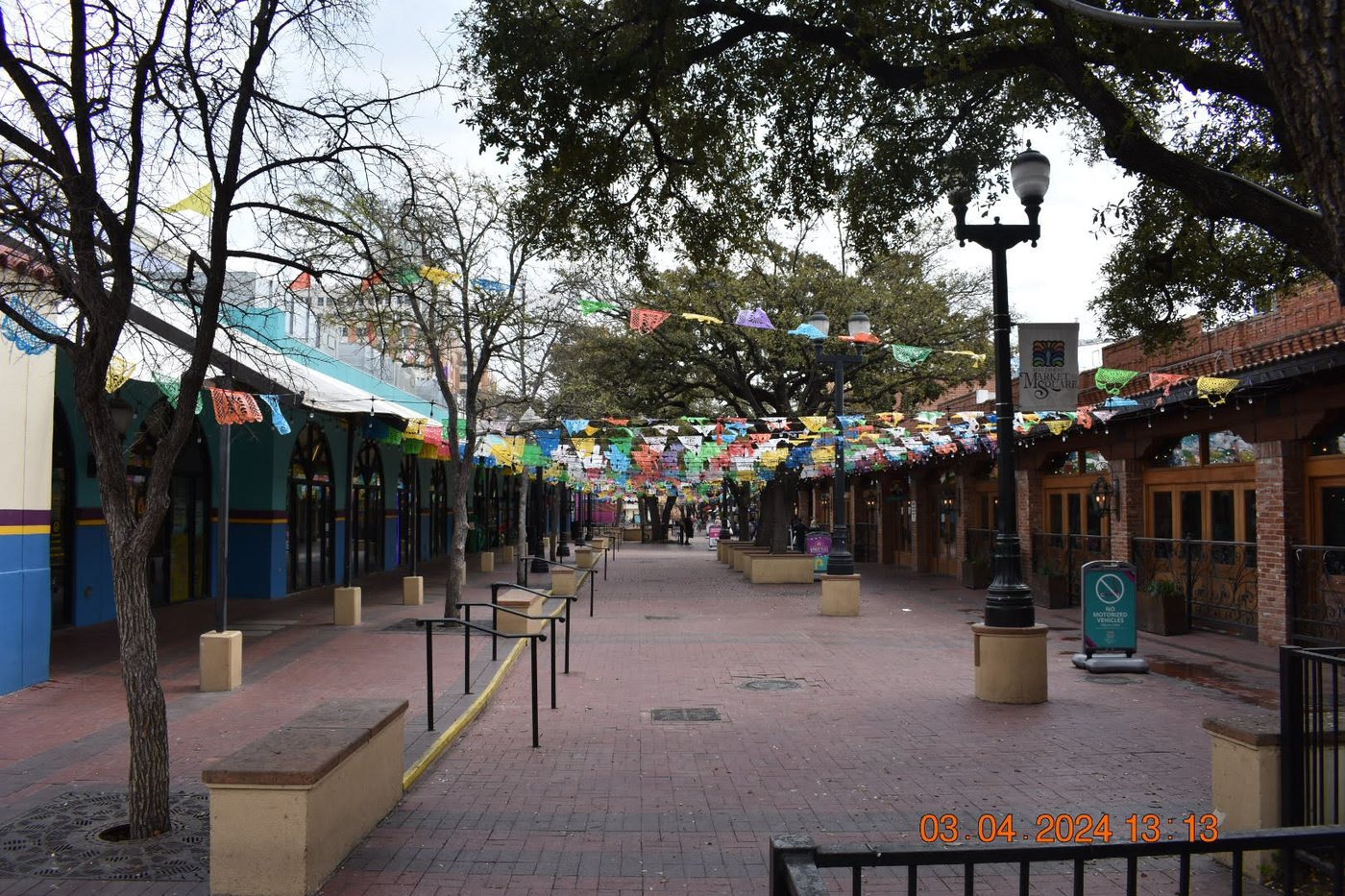
San Antonio’s Market Square is a commercial district with a public-market history, not a preserved eighteenth-century marketplace. Its shops and pedestrian spaces occupy the result of repeated moves, rebuilding and revitalization. The chronology explains why a place associated with longstanding traditions can have a substantially modern public-space arrangement.
Trade moved west from the older plazas
The city market’s history describes trading moving away from Main and Military Plazas toward the present area in the nineteenth century. By the 1890s, the market district had become an important location for food commerce. Produce trading, merchants and prepared-food sellers contributed to its activity.
The history includes the Chili Queens, whose food businesses formed part of San Antonio’s public culture. It also includes the less picturesque infrastructure of wholesale distribution. A market depends on deliveries, storage and customer access as well as the atmosphere experienced by a visitor.
A market district can lose its economic anchor
After wholesale activity shifted to a newer terminal, the old market area lost part of the trade that had supported it. The official history connects its later revitalization with efforts in the 1960s and the creation of the three-block pedestrian area in 1976.
The shift changed the relationship between commerce and public space. Where vehicles and wholesale logistics had been important, pedestrian movement and visitor-facing businesses became more prominent. This is why the current market should not be assumed to operate like a producer-only farmers’ market simply because the word market appears in its name.
Read the spaces between the shops
The useful architectural subject is the combination of enclosed shopping areas, open pedestrian routes and places where activity can spill outdoors. The experience changes with trading hours and events; a quiet morning and a programmed celebration are different uses of the same district.
Give individual businesses time rather than treating the entire area as a single vendor. If an item’s origin or production matters to you, ask the seller about that specific object. Regional imagery alone does not establish where something was made. A visit can then connect contemporary commerce with the district’s history without assuming that every product, building or public-space feature dates from the same period.
.jpg)