
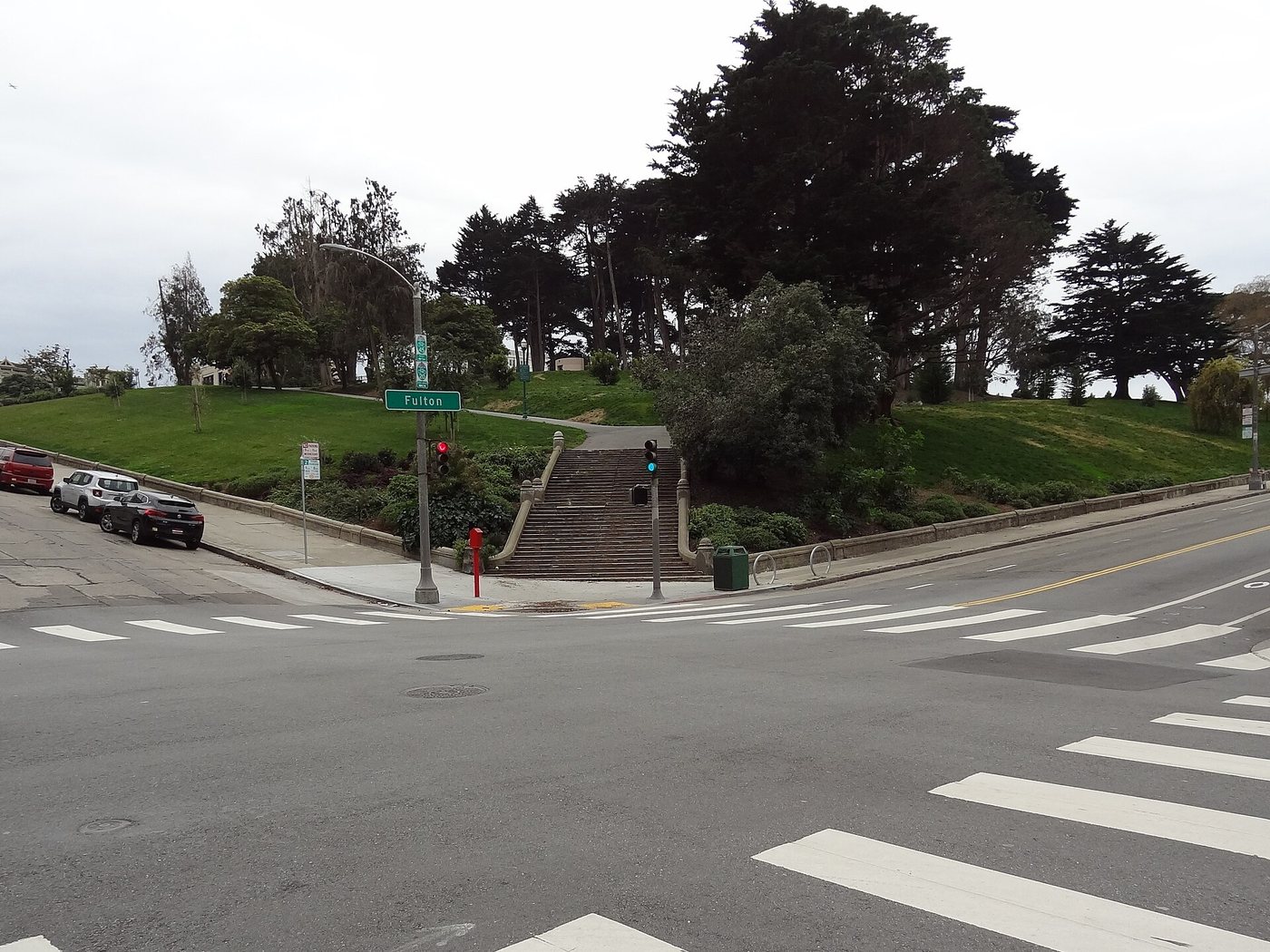
Alamo Square is frequently photographed for the row of houses along Steiner Street, with the larger city visible beyond. The park’s slope makes that composition possible. Yet the square is also a neighborhood landscape with paths, recreation areas and different views from different edges. Its relationship with the houses is important, but the houses and the public park are separate places.
A hill creates the view
The park’s raised ground allows a view across nearby roofs toward more distant buildings. The famous composition depends on several layers: lawn in the foreground, houses at the edge and the city behind them. It is a relationship produced by topography, not a single object that looks the same from every position.
Moving within the park changes those layers. From some areas the houses dominate; elsewhere trees, slopes and surrounding streets are more prominent. The park can therefore be understood as a three-dimensional landscape rather than merely the location of one camera angle.
Public ground beside private houses
The houses commonly called the Painted Ladies are private residences. Their visibility from a public park does not make their steps, doorways or interiors public. The street between the houses and the park is an important boundary between viewing architecture and entering someone’s domestic space.
The architectural row also gains much of its visual effect from repetition and variation. Similar heights and setbacks create a group, while details and colors distinguish individual buildings. The whole row can be read without assuming that every house has the same construction history.
More than a viewpoint
San Francisco Recreation and Parks identifies play and recreation uses within Alamo Square, including areas for dogs and tennis. These functions help explain why people use the park without any interest in photographing the houses. Paths and entrances serve a neighborhood as well as a visitor destination.
The site also belongs to the Hayes watershed, where springs and seepage form part of the ground’s history. That less visible environmental context complements the familiar architectural image. Alamo Square’s significance comes from the meeting of hill, park and residential streets, not from the houses alone.
.jpg)
.jpg)
,_Palace_of_Fine_Arts_--_2022_--_0906.jpg)