
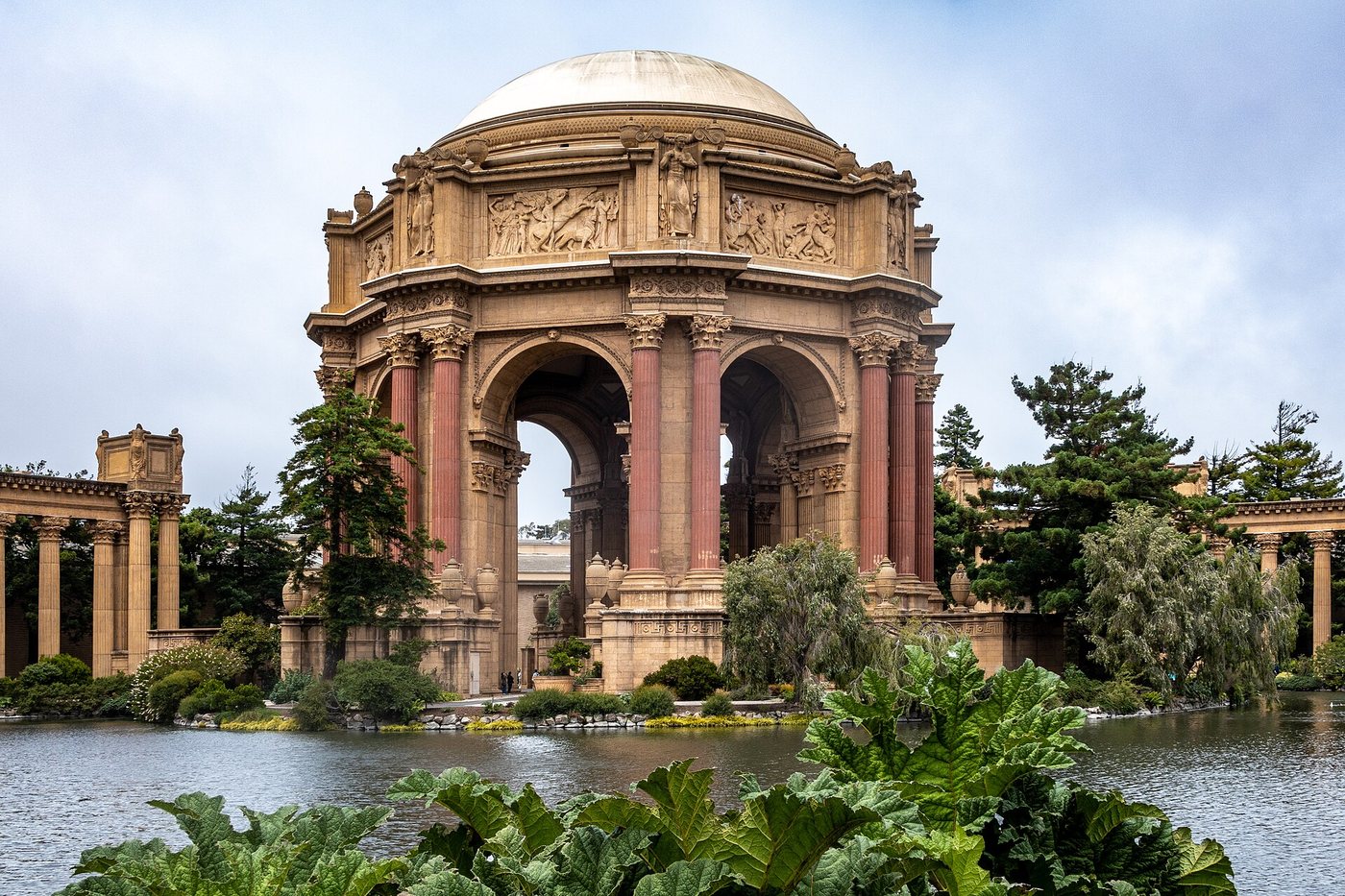
The Palace of Fine Arts appears to be a monumental ruin arranged around a lagoon, but it was designed to create that impression. Bernard Maybeck conceived it for San Francisco’s 1915 Panama-Pacific International Exposition. Its columns, rotunda and water setting gave the display of art a contemplative architectural frame. The structure visible today also reflects a later decision to remake a temporary building in more permanent form.
An exposition building with a different mood
World’s fairs often presented technological progress through novelty and spectacle. Maybeck’s design introduced a quieter, retrospective atmosphere. Classical forms suggested age and memory, while the lagoon separated parts of the composition and made reflections part of the experience.
The rotunda and colonnade were not simply a conventional front attached to exhibition rooms. They created an outdoor sequence in which architecture could be encountered across water and through open spaces. The surrounding landscape was essential to the intended effect.
Temporary construction became a preservation problem
Many exposition buildings were not designed for indefinite survival. Most were removed after the fair, while public affection helped preserve the Palace of Fine Arts. Keeping it in place, however, did not solve the material problem. Temporary construction deteriorated, and the site acquired a variety of uses in the decades that followed.
That history distinguishes survival of an idea from survival of original fabric. The familiar form remained important to the city even as the original structure became increasingly difficult to maintain. Preservation eventually required substantial reconstruction rather than simply repairing every original component.
A permanent version of the image
Public and private efforts supported rebuilding, with Walter S. Johnson providing major financial assistance. The reconstruction campaign in the 1960s gave the architectural composition a more durable future. The theater opened in 1970, adding another chapter to the site’s cultural use.
It is therefore inaccurate to describe every visible surface as unchanged material from 1915. The building’s historical significance includes the exposition design and the later campaign to retain its form. Both periods explain why it remains part of San Francisco’s landscape.
The lagoon and open colonnade can be understood independently of activities inside the theater or exhibition spaces. Their purpose is spatial: water, columns and the central dome organize views and movement. The Palace shows how a city can preserve a strongly valued architectural image even when the original temporary materials cannot carry it forward.
,_Palace_of_Fine_Arts_--_2022_--_0906.jpg)

.jpg)