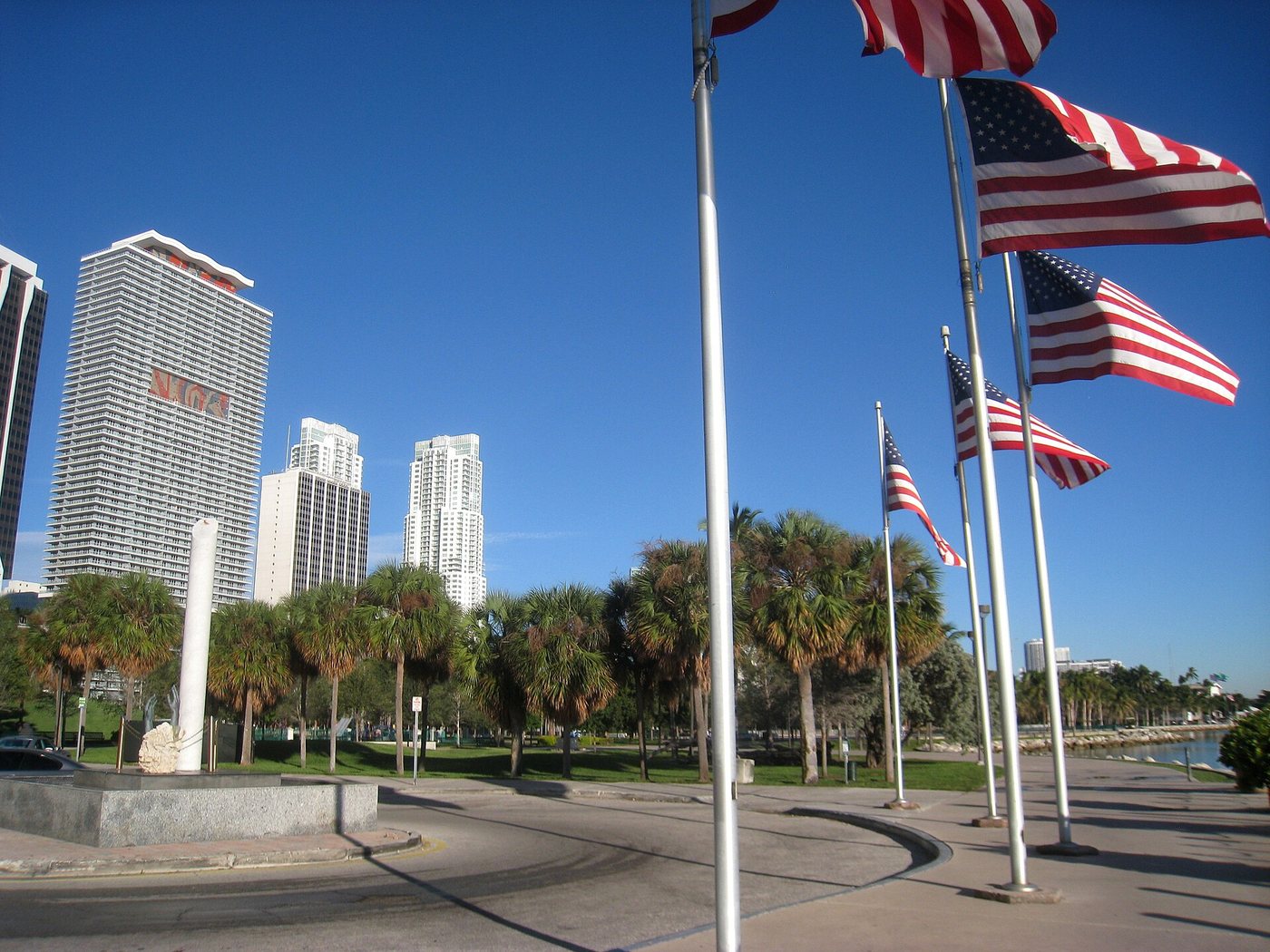
Bayfront Park is on the mainland side of Biscayne Bay, beside downtown Miami. It offers a different waterfront experience from Miami Beach: towers and major streets stand behind a public landscape of paths, open space and art. Its shoreline setting was constructed and redesigned, not preserved as an untouched natural edge.
A civic park on a made shoreline
The park’s management history places the development of the modern Bayfront Park in the 1920s on reclaimed waterfront land. Public gathering and performance became part of its identity, including band-shell activity later in that decade.
Reclamation changed the relationship between downtown and the bay. The park created room for public use along an edge that could otherwise have been occupied entirely by transport or private development. Its significance therefore includes access to a view and a location, not just the design of individual objects within it.
Noguchi treated the park as a whole
The city approved a redesign associated with sculptor Isamu Noguchi in 1980. The Noguchi Museum’s account connects Bayfront Park with his broader interest in sculpture as an environment people could inhabit. Slide Mantra, a sculptural slide developed for the 1986 Venice Biennale, became part of the park.
That approach blurs a familiar distinction between an artwork to look at and a landscape to move through. A sculptural form can shape bodily movement, while changes in ground and open space can operate at the scale of the whole park. The object and its setting are intended to inform one another.
Open space and events share the site
The management trust describes a 32-acre park with public art, green space and the Pepper Fountain. Large programmed events are one use of that landscape, while ordinary days allow a different experience of sitting, walking and looking across the bay.
Check current park information if a particular facility or event matters to the visit. Water features and individual areas can have maintenance or operating changes, and a photograph of a major event does not describe everyday access.
A short circuit should include both the bay-facing edge and the relationship to downtown. That comparison explains the park’s role as a threshold: it separates dense urban development from the water while also giving people a route between them. The public value lies in that connection as much as in any single skyline view.