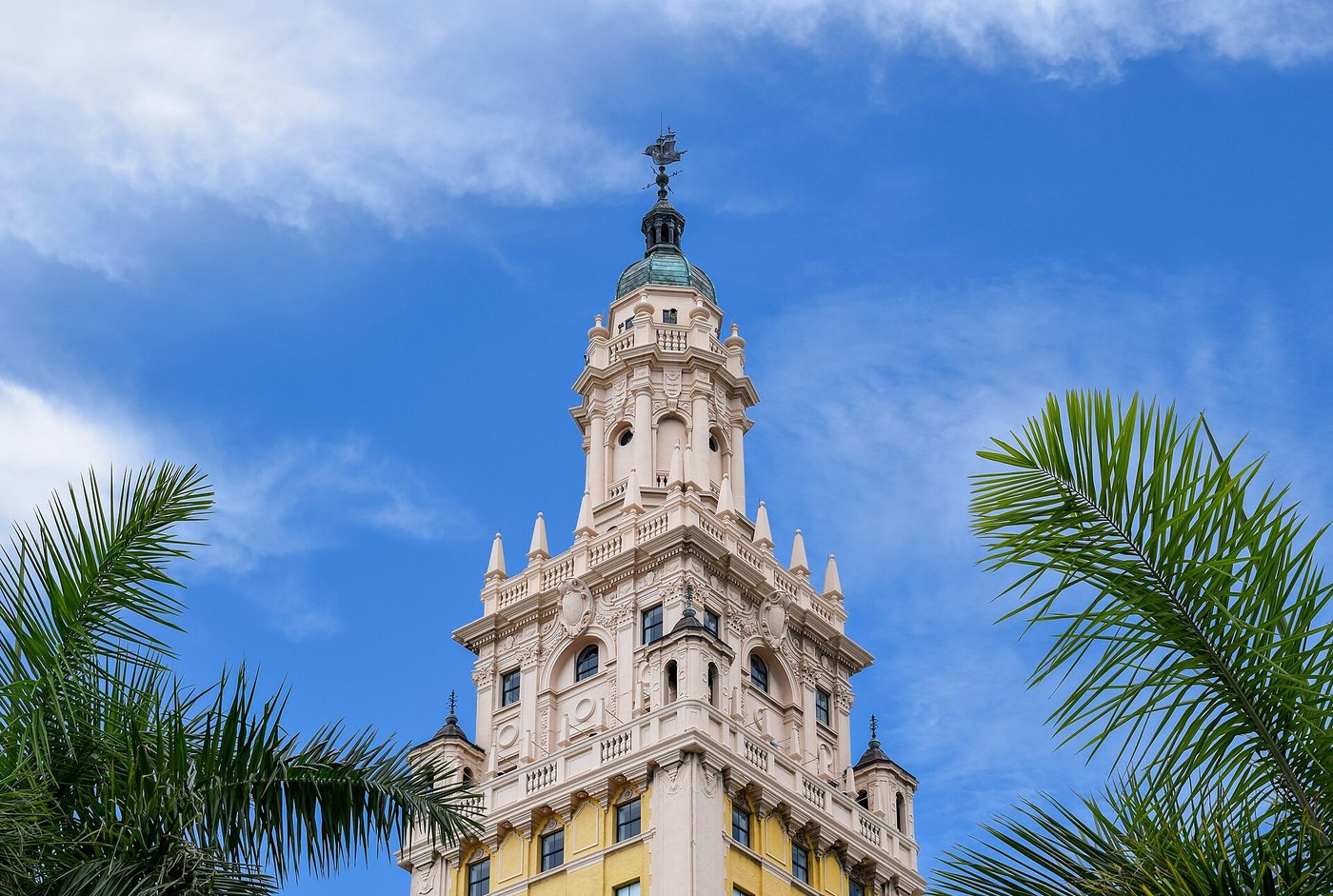
Freedom Tower is a relatively small presence among Miami’s later high-rises, but its historical role exceeds its height. The building began as a newspaper headquarters and later became closely associated with Cuban migration. Its successive uses explain why one distinctive tower carries several different meanings in the city.
A newspaper’s public address
Completed in 1925 for The Miami Daily News, the tower represented the ambitions of a rapidly growing city and its press. A newspaper building needed working space, but its exterior could also act as a public emblem. The tower made the institution visible beyond the rooms where news was produced.
This origin is worth separating from the building’s later name and associations. Its architecture was not originally commissioned as a refugee monument. A later use transformed how people remembered a structure already standing in downtown Miami.
The refugee center gave the building another meaning
From 1962 to 1974, the building served as the Cuban Refugee Center. Miami Dade College’s account describes assistance to large numbers of Cubans arriving in the United States. For those families, the building’s significance was connected with services, transition and the practical work of beginning again.
That social history cannot be read from the facade alone. A distinctive silhouette can help a place become a symbol, but the symbol acquires meaning through what happened there. The tower’s cultural importance depends on the connection between an identifiable address and the experiences of people who used it.
Preservation and museum use
After a period of deterioration, Cuban American community leaders helped preserve the building and donated it to Miami Dade College in 2005. It received National Historic Landmark recognition in 2008. The college reopened the tower in 2025 for its centennial with renewed galleries.
The sequence illustrates how preservation can protect both architecture and community memory. A building may be valued for its original design and for a later use that its first owners never anticipated. Museum interpretation can bring those histories together without making them identical.
For a visit, use the tower’s current museum information to confirm exhibitions and access. The most useful question is how the displays connect individual experiences with the wider changes in Miami. The exterior establishes the landmark; the interpretation explains why the building became important to people far beyond the newspaper that first occupied it.