Campus Martius occupies a central position in downtown Detroit, where major routes and public-space activity converge. Its modern landscape is compact relative to the buildings around it. That size is part of its role: it works as an outdoor room within the city rather than as a large park removed from ordinary downtown movement.
A center in the street plan
Downtown Detroit Partnership connects the site with the city’s rebuilding after the fire of 1805 and the planning associated with Augustus Woodward. The point of origin used in the street system gives the location a significance beyond its present landscaping.
The contemporary park represents a later effort to turn that centrality into a place where people stop. A junction can be important on a map while functioning mainly as a space to pass through. Seating, programming and pedestrian connections change the relationship between movement and occupation.
Seasonal use changes the same ground
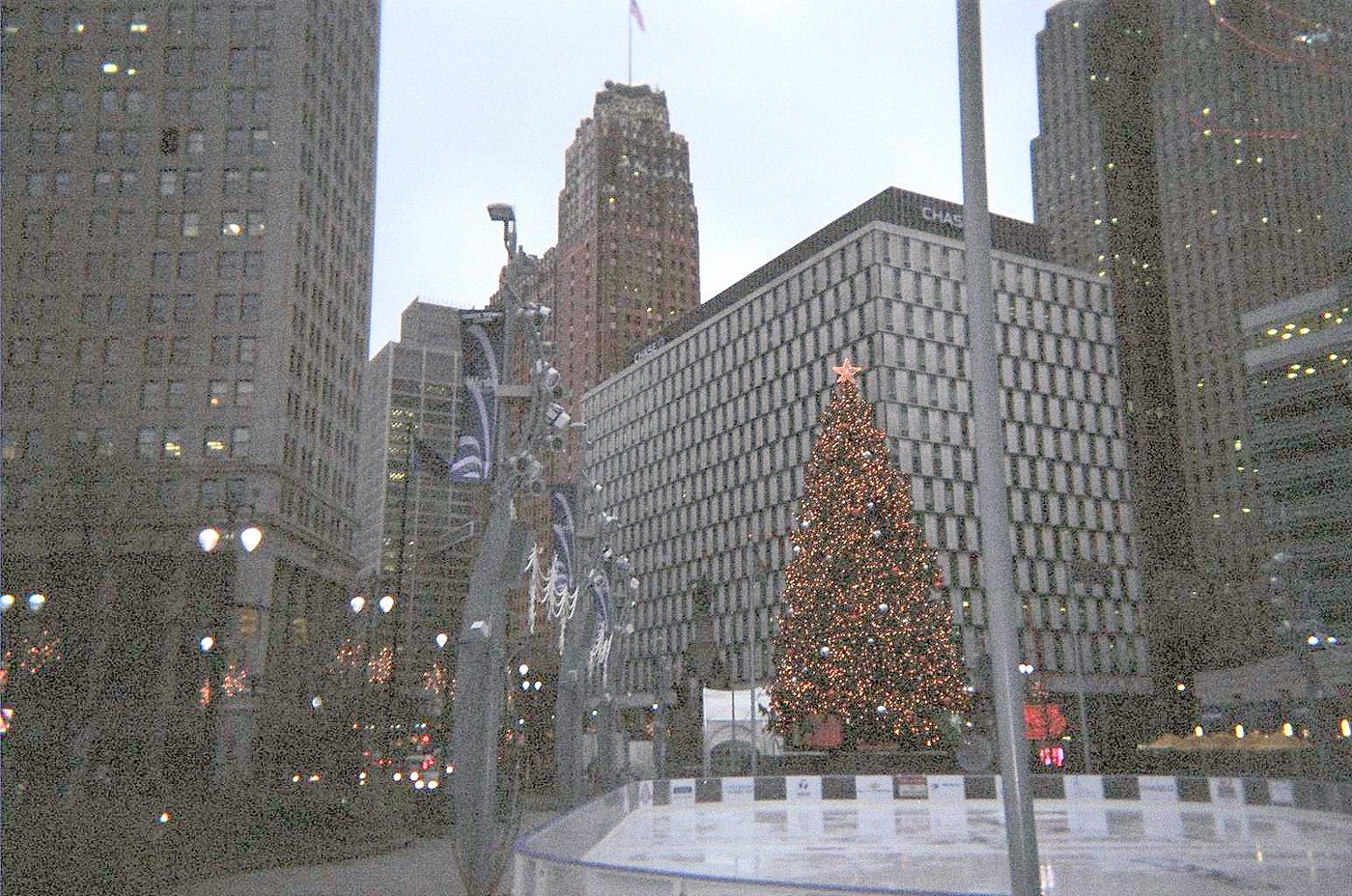
The partnership manages Campus Martius as an active public space with different seasonal activities. Its winter skating and warmer-weather arrangements use the central area in different ways. Those changes demonstrate that a small park can accommodate several identities without needing a separate permanent structure for each one.
The surrounding towers and street frontages help define the park’s enclosure. The landscape does not have to create all of its own boundaries; the city provides them. At the same time, crossings and entrances determine whether those edges feel connected or isolated by traffic.
Observe the ordinary interval
A major event reveals one kind of capacity, but an ordinary interval can be more useful for understanding the space. People eating, waiting, meeting or crossing show how the park supports daily downtown life. A seat at the edge provides a view of those relationships without requiring a long route.
Check the current park calendar if a specific seasonal activity is the reason for visiting. Otherwise, treat Campus Martius as a starting point for understanding central Detroit’s street geometry and public spaces. Its value is not only in what is installed at the center; it also lies in the connections it creates with the surrounding blocks.