Detroit’s Eastern Market is both a public market and a wider food-business district. Its covered sheds are the most obvious visitor destinations, but the surrounding commercial activity explains why the market occupies this part of the city. Different buildings support retail sales, distribution, preparation and business development. Reading those functions together gives the district more depth than a shopping itinerary alone.
Growth produced a market outside the old center
The market organization traces an informal market on the east side of downtown to the 1880s. The city formally designated Eastern Market in 1891 as Detroit’s growth placed pressure on the older central market. Permanent sheds followed, with additional space added as trade expanded.
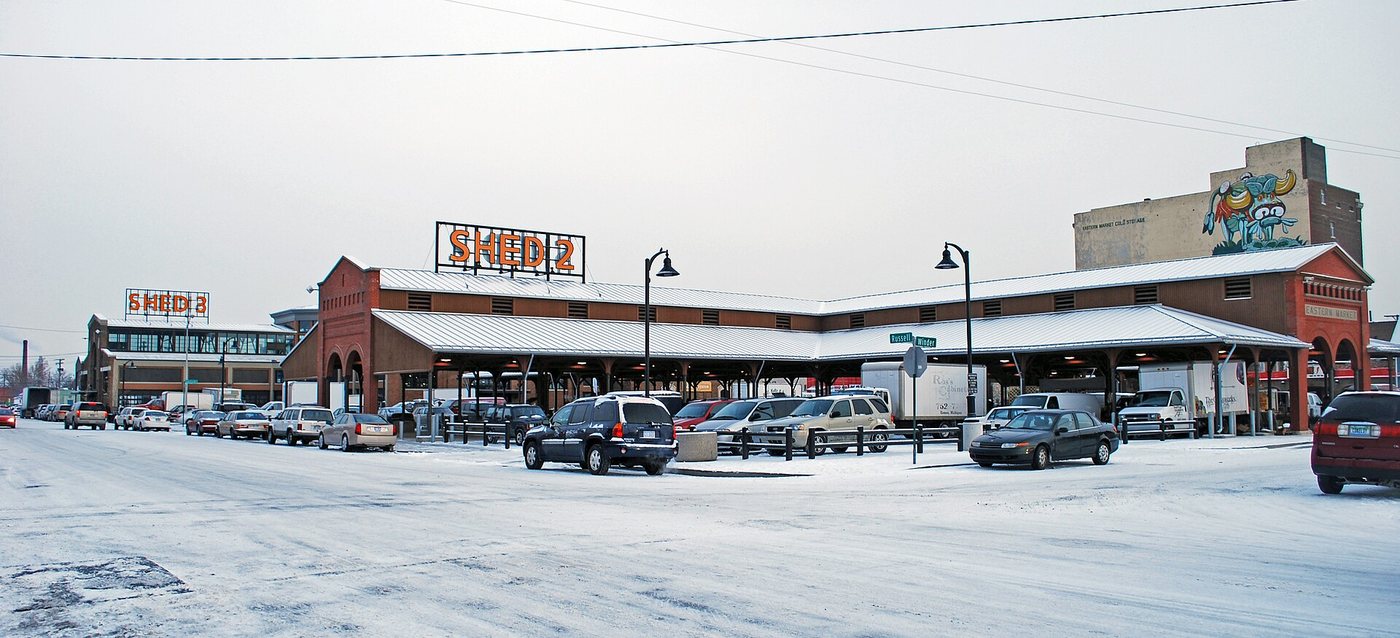
The sheds were infrastructure for repeated transactions. A roof protected goods and people, while open bays allowed stalls to be arranged and approached efficiently. The surrounding food businesses benefited from proximity to that flow of buyers, sellers and deliveries. The district developed as a cluster because related activities could support one another.
The sheds are not all the same age or type
Eastern Market’s history describes a sequence from open canopy structures to enclosed all-weather facilities. Those differences reflect changing requirements rather than a single architectural campaign. A market operating through different seasons needs a different envelope from a simple shelter used only in favorable conditions.
The present arrangement also contains losses and replacements. Shed 1 was demolished in 1967 for the freeway connector, while later shed projects added enclosed space and facilities for larger vehicles. The historic market has therefore survived through alteration, not by retaining every original component.
That makes comparison more useful than searching for one definitive market style. Structure, enclosure, doors and circulation each reveal what a particular building was expected to do.
Food businesses need space beyond the stall
Eastern Market’s contemporary programs include resources for food entrepreneurs and an incubator kitchen in Shed 5. A public stall is one point in a larger sequence that can include preparation, storage, production and distribution. Supporting those less visible stages allows a market district to contribute to business development as well as weekend retail activity.
The development corporation also works on commercial and mixed-use projects in the surrounding area. Its stated concern with businesses, residents and local ownership recognizes that a successful market can face pressure from redevelopment. Keeping a food district functional requires more than making its streets attractive to visitors.
A warehouse or loading area may look less inviting than a mural-covered wall, but it can be essential to the economic role of the place. The district should not be judged only by features that work well in photographs.
Markets operate on several calendars
The organization runs different market and community activities, and surrounding businesses maintain their own arrangements. Consult the current schedule for the type of visit you want. An open business district and a fully operating public market are not the same condition.
On a busy trading day, follow the movement of customers and deliveries without obstructing it. Begin with one shed, then cross into the surrounding streets to see how the covered trading areas relate to permanent businesses. A smaller number of attentive stops can explain the district better than trying to cover every stall.
Eastern Market’s continuity rests on use. Its sheds matter as historic structures, but they are most intelligible when connected with the changing food economy that has kept them necessary.