
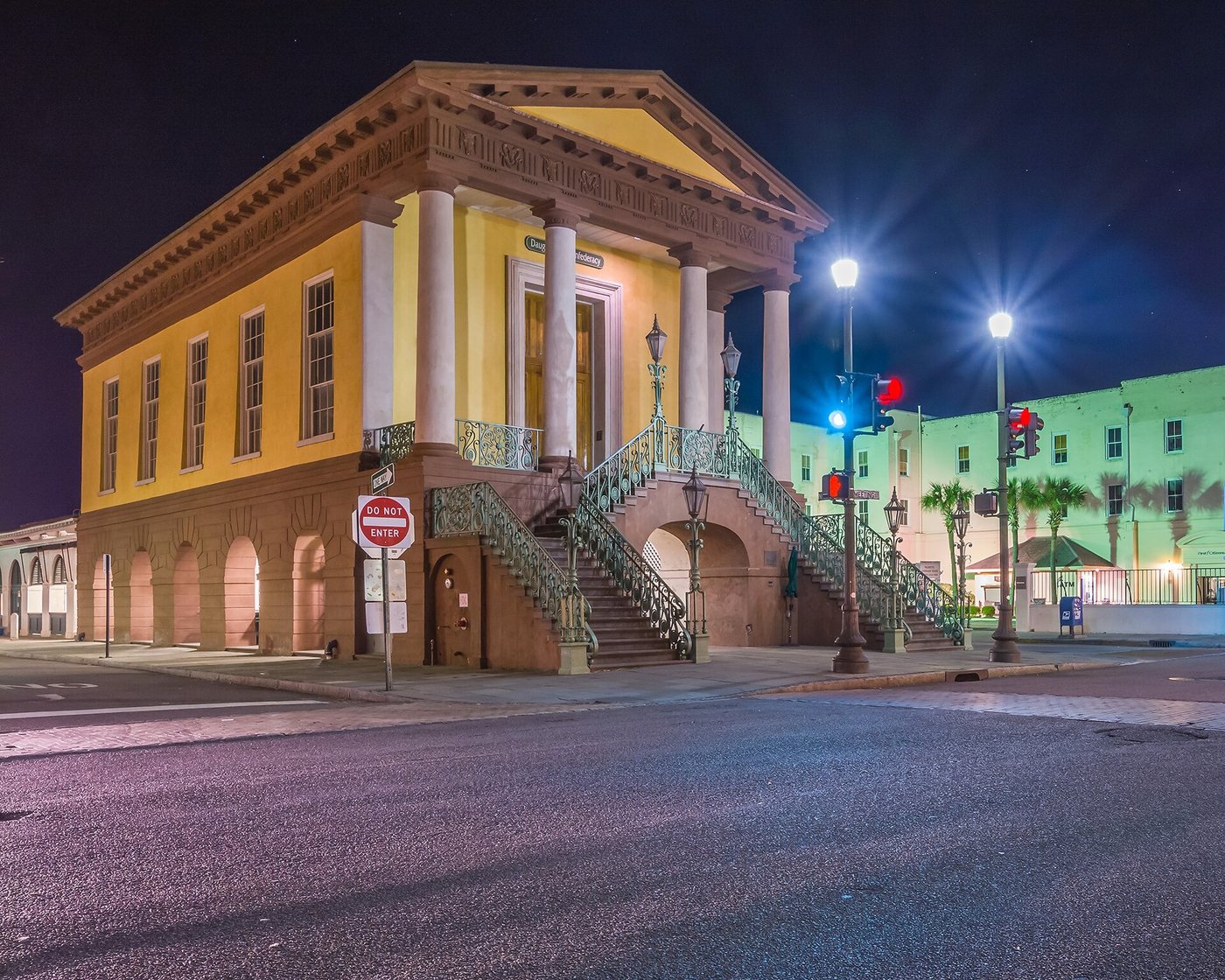
Charleston City Market is a linear complex rather than one enclosed marketplace. The prominent hall on Meeting Street announces the institution, while the lower sheds extend the trading space eastward. This difference between a civic front and repeatable working structures is the key to reading the site.
Land dedicated to market use
The market’s official history connects its beginnings with land conveyed by the Pinckney family in 1788 on the condition that it remain a public market. Sheds developed during the early nineteenth century to accommodate food trading. The more monumental Market Hall followed in 1841, designed by Edward Brickell White.
The hall’s Greek Revival treatment gave the market a formal architectural presence. Behind it, the lower structures provided a more economical way to extend space for vendors. The complex therefore expresses two related ambitions: representing an important civic institution and making room for ordinary transactions.
The sheds create a sequence
Moving through the market reveals repeated bays and a succession of selling areas rather than a single room. Cross streets and changes in enclosure interrupt the sequence. These interruptions connect the market to the surrounding city and make it possible to enter or leave at several points.
The commercial mix has changed from the early food market. The organization’s history identifies sweetgrass basket makers as an important presence from the later twentieth century. Contemporary craft and retail activity should be understood on its own terms, rather than assumed to reproduce the original market economy. Ask individual makers or sellers about materials and production when those details matter to a purchase.
Keep two Charleston institutions distinct
City Market and the Old Slave Mart Museum on Chalmers Street are different places. The latter interprets a documented auction site within Charleston’s domestic trade in enslaved people. Their names are easily confused, but substituting one for the other produces a false description of both.
The distinction does not detach City Market from the wider history of a city whose economy depended on slavery. It simply preserves the specific history of each site. A visit to the market can focus on its hall, sheds and present trade, while the museum supplies interpretation of a separate and deeply consequential commercial system.
For an architectural walk, begin with the hall’s street frontage and then follow enough of the sheds to understand the change in scale. The whole arrangement explains more than a close view of either the classical facade or a single stall.

.jpg)