
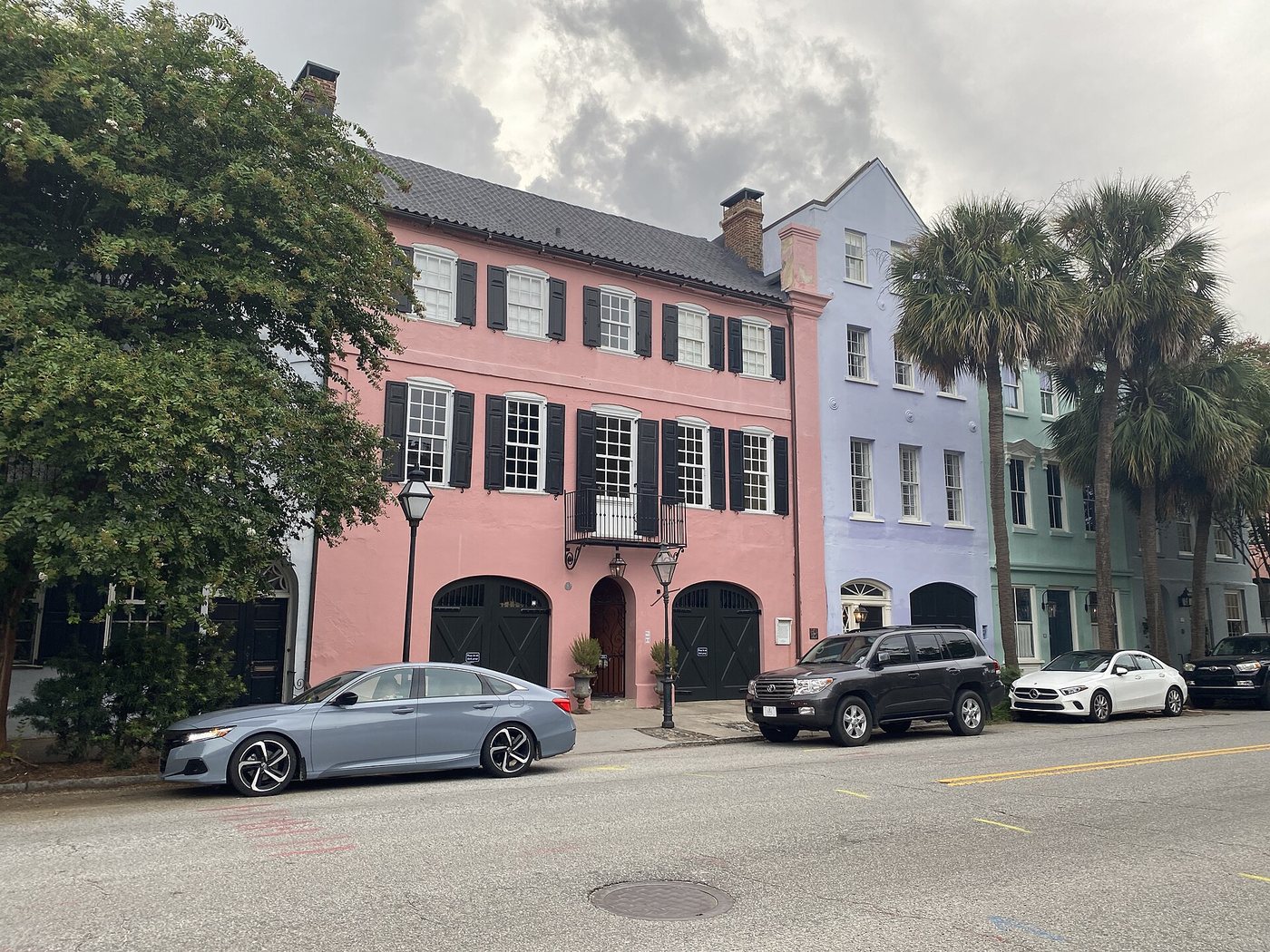
Rainbow Row is a useful lesson in the difference between a building’s age and the age of its best-known appearance. The pastel facades on East Bay Street belong to a preservation story that developed long after the buildings’ original commercial use. Color draws the eye, but the narrow frontages and stacked floors explain the older architecture.
Commerce below, living space above
The University of South Carolina’s encyclopedia describes the buildings as former premises of merchants, with stores and counting rooms on the ground floor and living quarters above. Their position near Charleston’s wharves connected them with the port economy.
That combined use helps explain the row’s form. A merchant did not need a freestanding suburban house beside a separate office building. Commercial and domestic activities could occupy different levels of the same narrow property. The resulting sequence of attached buildings created a continuous street edge while preserving individual addresses.
The familiar palette came with rehabilitation
Dorothy Haskell Porcher Legge acquired and began restoring 99–101 East Bay Street in 1931. The encyclopedia identifies her pastel treatment as a deliberately attention-getting preservation choice inspired by Caribbean colors, rather than a documented recovery of the original paint scheme. Other restorations followed over subsequent decades.
This history is more useful than the popular stories that the colors were devised for sailors to identify their lodgings or for people unable to read signs. The recognizable image emerged through rehabilitation and the effort to bring attention to neglected buildings. It is a historic image in its own right, but its history is largely twentieth-century.
Look past the paint without ignoring it
From the public sidewalk, compare window spacing, rooflines, entrances and the width of each frontage. Color emphasizes the divisions, while the close spacing makes the buildings read as a group. Neither the individual property nor the collective row fully explains the view by itself.
These are private properties, so the street is the appropriate place to appreciate the exterior. A short stop works best when it allows other pedestrians to pass. The row can then be connected with the nearby waterfront streets, where its former commercial geography becomes easier to imagine. Its preservation story demonstrates that a city’s celebrated appearance can be both old and consciously remade.


.jpg)