
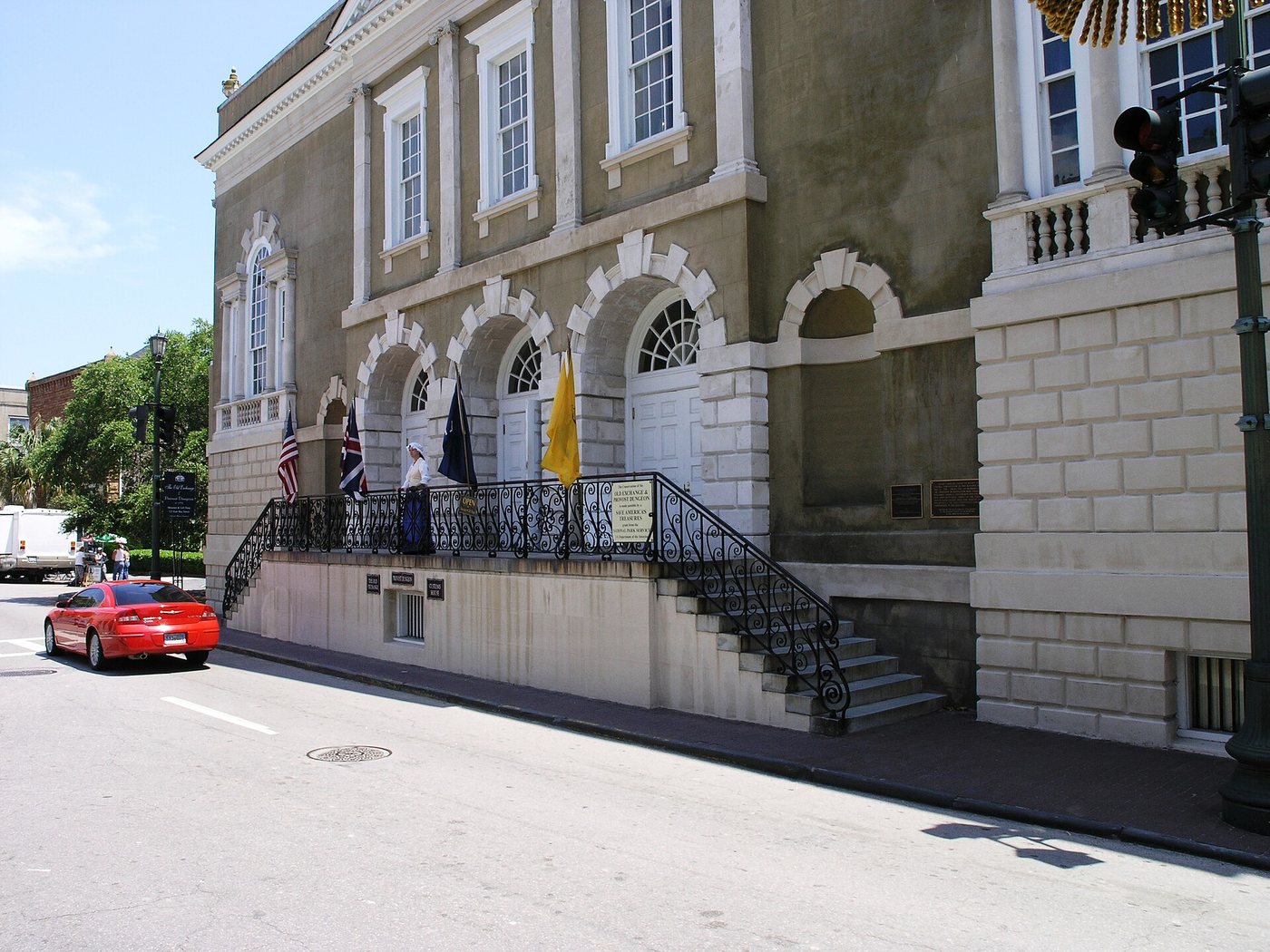
The Old Exchange stands at East Bay and Broad Streets as a formal civic building, but its history cannot be reduced to ceremonial rooms. Completed in 1771, it has served commercial, administrative, military and museum purposes. The contrast between its public architecture and the uses of its lower level is central to understanding the place.
Trade and authority shared a building
The institution’s history identifies the original exchange and customs functions. A port city needed places where commerce could be organized and regulated, and the building gave those activities an imposing public address. Later uses included a post office, city hall and military headquarters.
Its Georgian-Palladian composition communicated order and wealth. That architectural message is part of the evidence: formal symmetry can express authority regardless of the fairness of the transactions or decisions occurring within and around the building.
Political celebration and confinement
During the Revolutionary War, British forces used the lower floor as a military prison. The museum records prisoners of war, soldiers, civilians and enslaved people among those confined there. The term Provost Dungeon refers to that prison history, not to a separate medieval structure.
The building also hosted South Carolina’s ratification of the United States Constitution in 1788 and events during George Washington’s visit in 1791. Placing these uses beside the prison history reveals how the same architecture could accommodate very different experiences of power. A ceremonial gathering for one group does not describe the building’s meaning for everyone.
The exchange and the trade in people
The museum identifies the Exchange area as a major site of public auctions of enslaved people between the Revolution and the Civil War. The city’s Old Slave Mart history explains that an 1856 ordinance subsequently prohibited public sales and helped shift trading into private premises elsewhere.
This connection belongs within the building’s commercial history. It should not be omitted in favor of a story concerned only with constitutional milestones and distinguished visitors. The language of liberty and the practice of enslavement coexisted in the city, and the site makes that contradiction concrete.
An earlier city edge survives below
The museum also interprets a surviving section of the Half-Moon Battery, completed in 1701 and excavated beneath the Exchange in 1965. The building thus sits over evidence of an earlier defensive landscape. Its historical layers extend below the floors as well as through successive uses of the rooms.
For a visit, allow the museum’s interpretation to connect the levels rather than selecting only the prison or the grand interior. Current visitor arrangements are available from the institution. The building is most informative when commerce, public ceremony, coercion and archaeology remain in the same account.

.jpg)