
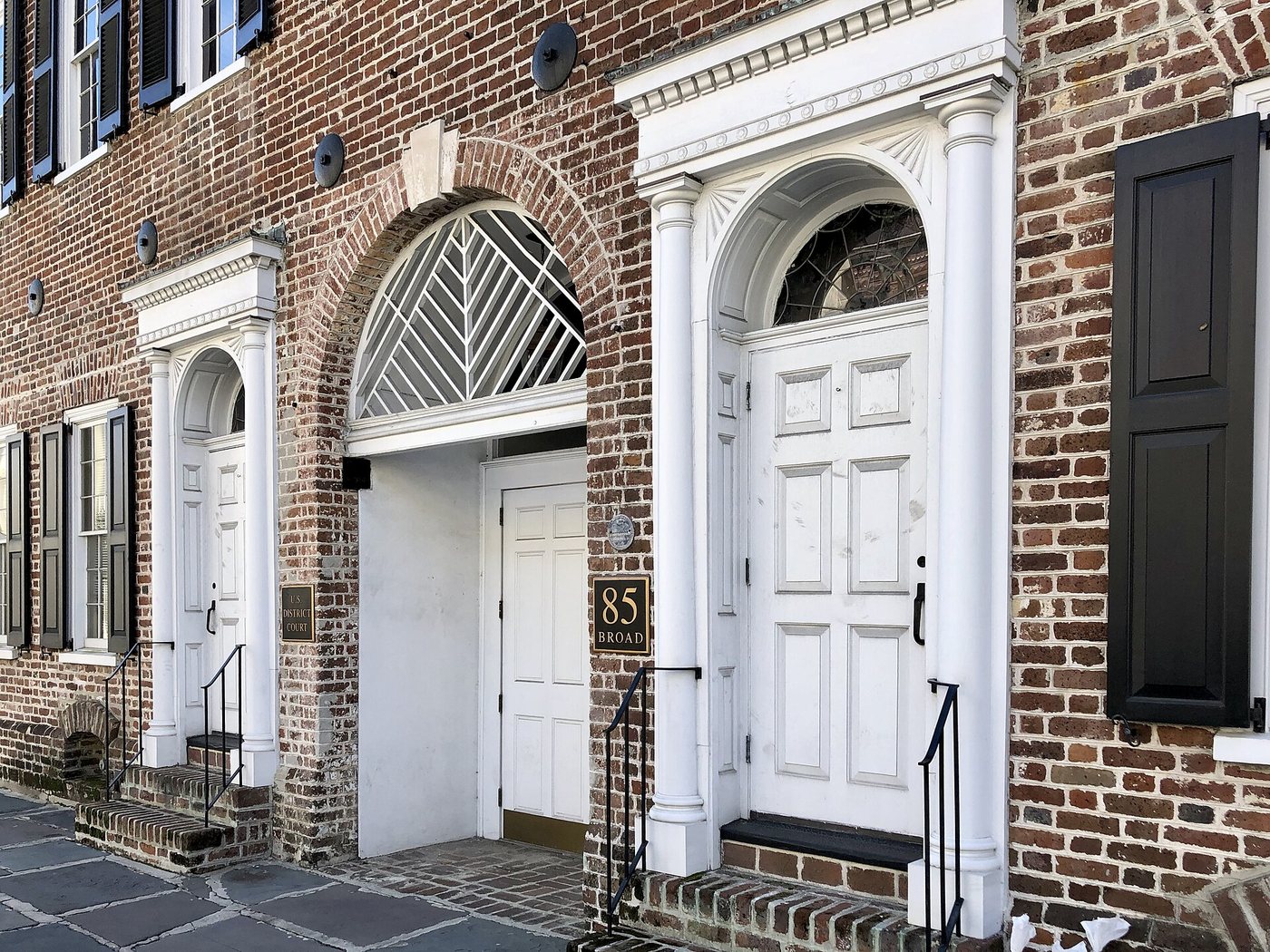
The name French Quarter is a useful way to orient a walk in Charleston, but it should not be treated as a promise of uniformly French architecture. A small area around Church, Queen and neighboring streets contains buildings from different periods and with very different purposes. The strongest route connects those differences instead of searching for one style that explains them all.
The Huguenot church is one part of the name
The French Huguenot Church gives the district a direct connection with French Protestant history. Its present Gothic Revival building dates to the 1840s and was designed by Edward Brickell White. The pointed architectural language belongs to a nineteenth-century revival, not to an unchanged building erected by the first Huguenot arrivals.
That distinction between congregation and structure is useful across Charleston. An institution can be older than its current walls, and rebuilding can express the tastes and circumstances of a later generation. Nearby church towers and entrances form a religious streetscape without sharing one denomination or construction date.
Dock Street Theatre began again inside a hotel
The Dock Street Theatre’s name reaches back to an eighteenth-century theater, but much of the visible building originated as the Planter’s Hotel around 1809. The National Park Service explains that the hotel itself incorporated earlier structures. Its porch, lobby and stair retained elements of the hospitality use even after the property changed.
During a 1930s Works Progress Administration project, the city restored the building and added a stage and auditorium behind it. The resulting theater adopted the older theatrical name. This is adaptive reuse with a historical reference, not an intact eighteenth-century playhouse.
The building’s changing brickwork and the relationship between its street-facing portion and rear performance spaces help explain that process. The facade serves as a recognizable address, while the larger volume required for theater activity extends behind. A photograph of the balcony alone cannot reveal the full plan.
The neighborhood also contains the history of enslavement
The Old Slave Mart Museum on Chalmers Street interprets Charleston’s domestic trade in enslaved people. The surviving building formed part of a larger complex that included confinement and service spaces. The city’s account connects its development with an 1856 ordinance that moved public sales into private auction premises.
This institution belongs within an architectural walk, not as an unrelated historical footnote. Streets and buildings accommodated coerced movement and commercial exploitation as well as worship, entertainment and domestic life. The polished appearance of a preserved neighborhood does not tell the visitor which activities produced wealth or controlled access to its spaces.
The Old Slave Mart and Charleston City Market are different sites. Their similar names should not be used interchangeably. Understanding the distinction allows each to be interpreted accurately without erasing the broader role of slavery in the city.
Keep the route compact and the histories distinct
A walk connecting the Huguenot church, Dock Street Theatre and Chalmers Street can reveal several building types within a short distance. Use public streets to make the connections and current institutional information for interiors. Worship, performances and museum interpretation follow separate schedules and access arrangements.
The route works because it compares unlike places. A church organizes a congregation, a theater organizes an audience, and an auction building embodied a violent commercial system. Their proximity shows how varied activities occupied the same urban fabric.
That approach also leaves room for the ordinary buildings between landmarks. They establish the scale and continuity of the streets. The French Quarter becomes easier to understand as a piece of Charleston with overlapping institutions and changing uses, rather than as a themed district whose name supplies a complete history.

.jpg)