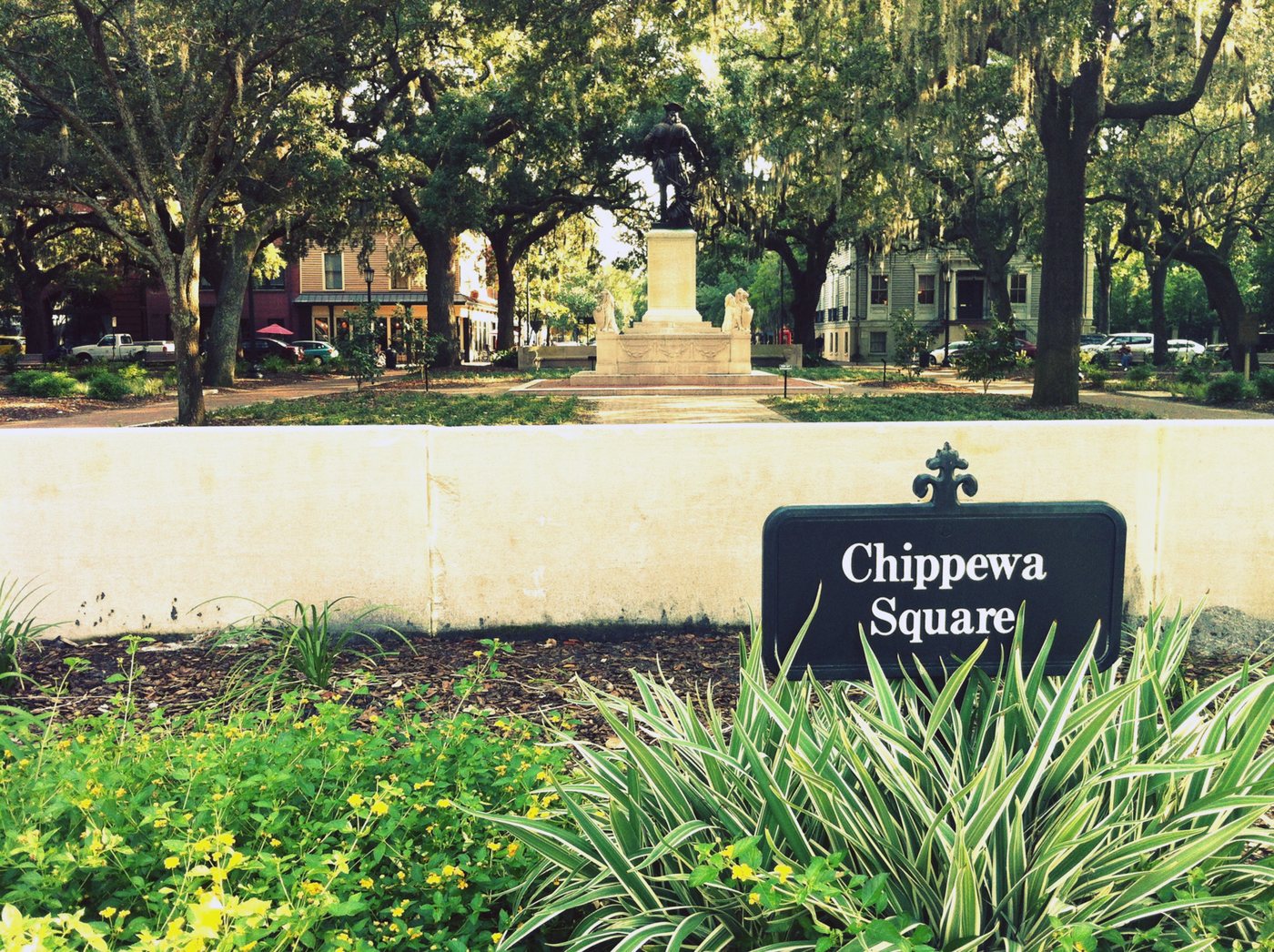
Chippewa Square is one of the places where Savannah’s repeated square-and-street pattern becomes easy to understand at walking speed. Its central planting and monument are only part of the composition. The streets around it and the buildings facing it show how a square serves as a shared address for several different activities.
The square and its monument are different ages
The city’s historical guide dates Chippewa Square to 1815, when Brown Ward was laid out. The Oglethorpe monument at its center arrived much later, in 1910. Sculptor Daniel Chester French and architect Henry Bacon created the commemorative work.
That gap matters. The statue does not mark the moment when the square itself was made, and its presence should not cause Chippewa to be confused with Savannah’s separate Oglethorpe Square. The monument is a later interpretation of the city’s founding figure placed within an already established public space.
The edges give the center its purpose
The Savannah Theatre and First Baptist Church are among the institutions associated with the square’s perimeter. They represent different kinds of gathering: entertainment, worship and the informal public use of the square itself. A planted center can support all of those without belonging exclusively to any one building.
Walk around the perimeter before crossing through the center. From the edge, the statue’s position can be compared with the paths and surrounding entrances. From inside, the square frames partial views of buildings rather than presenting them as isolated objects. This alternating experience is characteristic of Savannah’s ward pattern.
A small space within a repeated plan
The National Park Service’s explanation of Savannah’s plan describes a square at the center of each ward, with residential lots and larger public lots arranged around it. Chippewa belongs to the later expansion of that system. The repeated idea created a network of public spaces rather than a single park expected to serve the whole town.
A short visit can therefore pair Chippewa with one neighboring square. Compare the center, the edges and the way streets approach each space. The differences become more visible when the underlying plan stays similar. Chippewa’s value is not just that it contains a recognizable monument; it shows how later buildings and memorials can occupy a durable urban framework without erasing its basic organization.