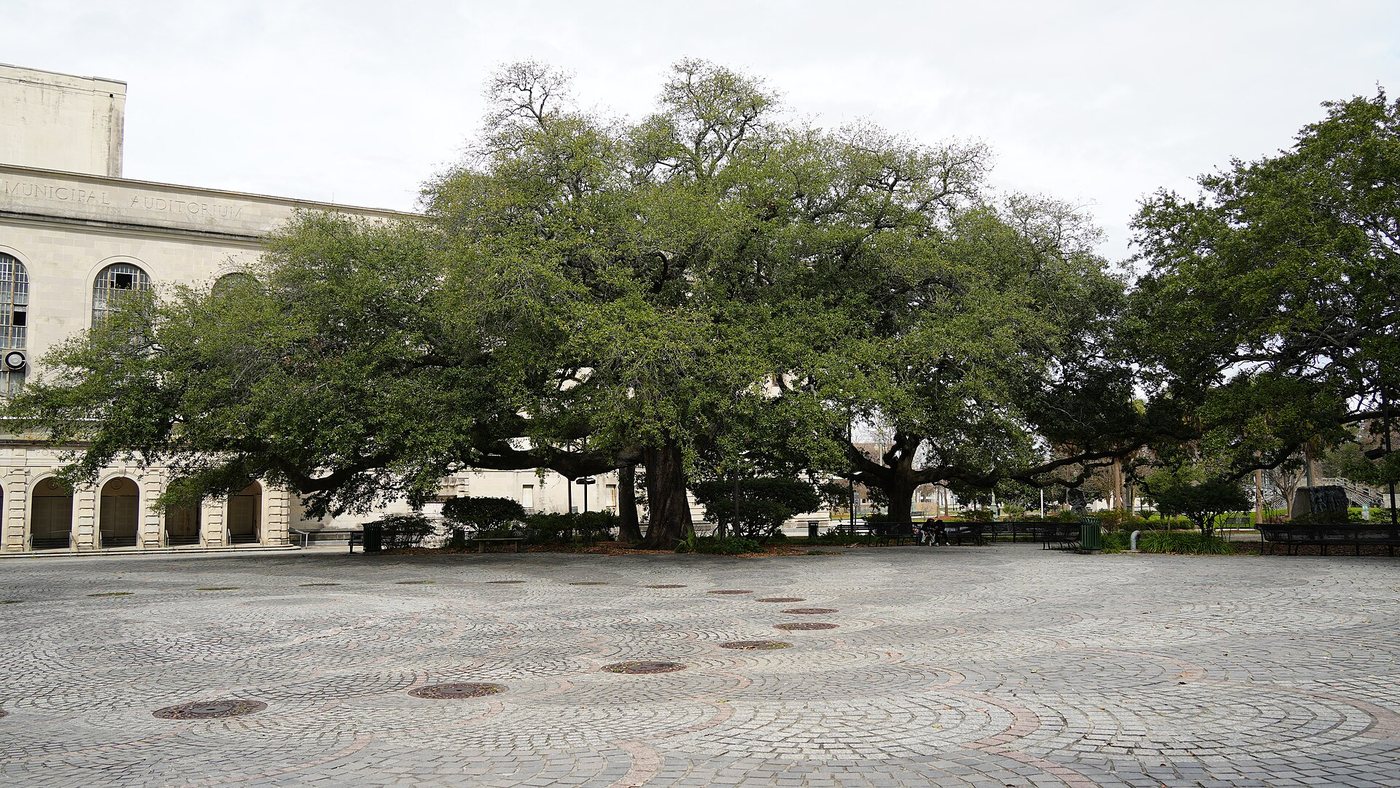
Congo Square lies within Louis Armstrong Park, across North Rampart Street from the French Quarter. Its significance does not depend on a monumental building. The important history concerns people gathering, trading, dancing and making music, often under the constraints of enslavement. Reading the place requires attention to those activities and to the limits of what surviving accounts can tell us.
Gathering under unequal conditions
The New Orleans Jazz Museum identifies the square as a gathering place where Africans, many of them enslaved, sustained music, dance and cultural traditions across generations. Sunday gatherings allowed forms of social exchange that were severely restricted elsewhere. A temporary opportunity to gather should not be confused with freedom from slavery or equal rights in the surrounding city.
National Park Service research describes a marketplace as well as a musical setting, with enslaved people, free people of color and other city residents participating in exchanges. This was not a concert hall with a fixed separation between performers and spectators. Music, movement, commerce and social relationships shared the same ground.
A history larger than one origin story
The square is often described as a birthplace of jazz. That phrase recognizes its importance but can flatten a more complicated musical history. The National Park Service’s account of early jazz places African and Caribbean traditions alongside brass bands, ragtime, dance music and the activities of musicians across New Orleans. Congo Square is a crucial part of that history, rather than a single moment when a finished musical form appeared.
It is also worth asking whose participation a historical account makes visible. A National Park Service study of New Orleans jazzwomen notes how descriptions of Congo Square have often assumed male musicians even when the evidence does not justify excluding women. Anonymous participants and incompletely documented lives belong in the story, too.
What to notice at the site
Read the commemorative signs before relying on the surrounding park’s name to explain the ground. Louis Armstrong Park and Congo Square refer to related but different historical subjects. The restoration of the Congo Square name by the City Council in 2011 was itself an act of public memory.
If a gathering is taking place, allow the participants to define it. The site remains a place of cultural activity, and a present-day performance is not automatically a reconstruction of an eighteenth- or nineteenth-century event. A useful visit can consist of a short period of reading and observation, followed by listening to or learning about the musical traditions discussed by the city’s museums. That approach gives the square more meaning than treating it as a quick photographic stop.