
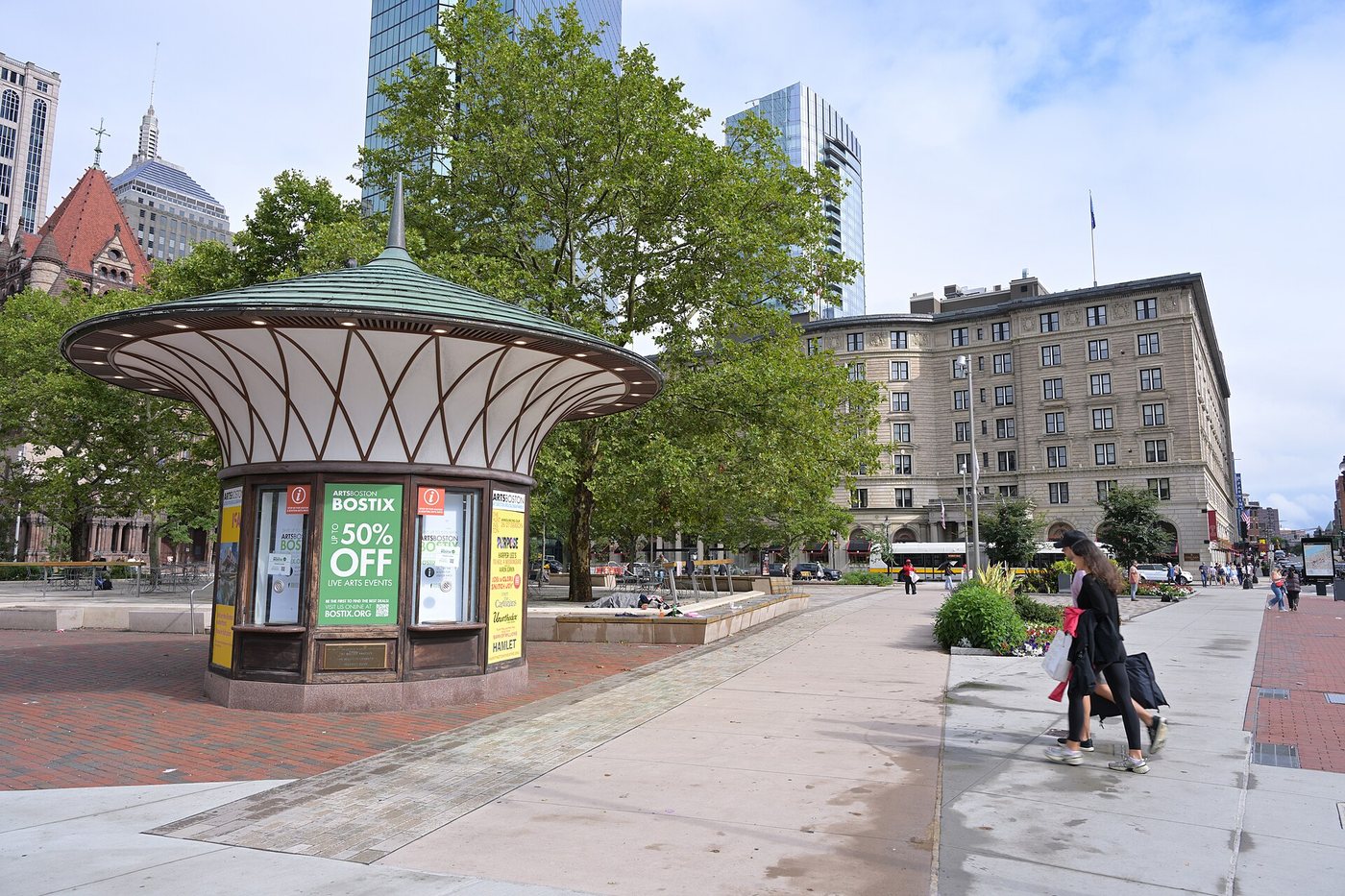
Copley Square works as a place to compare buildings because its open ground gives several very different facades room to be seen together. Trinity Church and the Boston Public Library face the square with masonry, arches and carefully organized entrances. A tall glass office tower introduces another scale and another way of handling light. The square makes these differences visible without requiring the buildings to share a style.
Trinity’s mass and materials
Henry Hobson Richardson’s Trinity Church was completed in 1877. Its central tower and broad roof forms give the building a compact, almost pyramidal composition. Rounded arches and contrasting stone colors are central to its appearance. Rough granite surfaces and darker brownstone trim produce depth and pattern without relying on an entirely smooth facade.
The church occupies a site surrounded by streets, so Richardson had to consider views from several directions. The building’s identity does not depend solely on one flat front. Its tower organizes the whole composition, while the surrounding streets allow the side elevations to remain visible.
A different language across the square
The library’s McKim Building opened in 1895. Its Renaissance references, horizontal organization and repeated upper windows offer a different expression of institutional importance. Where the church gathers its mass around a tower, the library establishes a long civic frontage. Both use stone and arches, but similar materials do not produce the same architectural effect.
The glass tower nearby changes the comparison again. Its reflective surface can carry an image of the church while its height exceeds the scale of the older buildings. Reflection creates a visual relationship, but it should not be mistaken for continuity of construction or purpose. One building accommodates worship, another library services, and another office activity.
Public ground that also changes
Copley Square is not simply the empty space left between monuments. Its paths, planting and seating affect where people pause and how they cross between surrounding streets. A recent city redesign reorganized parts of the landscape, including a raised grove and gathering areas. Such changes show that a historic architectural setting can contain a contemporary public-space project.
The Back Bay itself was created through nineteenth-century filling of tidal land. The apparent solidity of its masonry buildings therefore rests on an engineered transformation of the ground. Copley Square brings that larger history into focus: the land, the landmark buildings and the public landscape belong to different stages of Boston’s development.


_-_%22North_End_Nights%22.jpg)