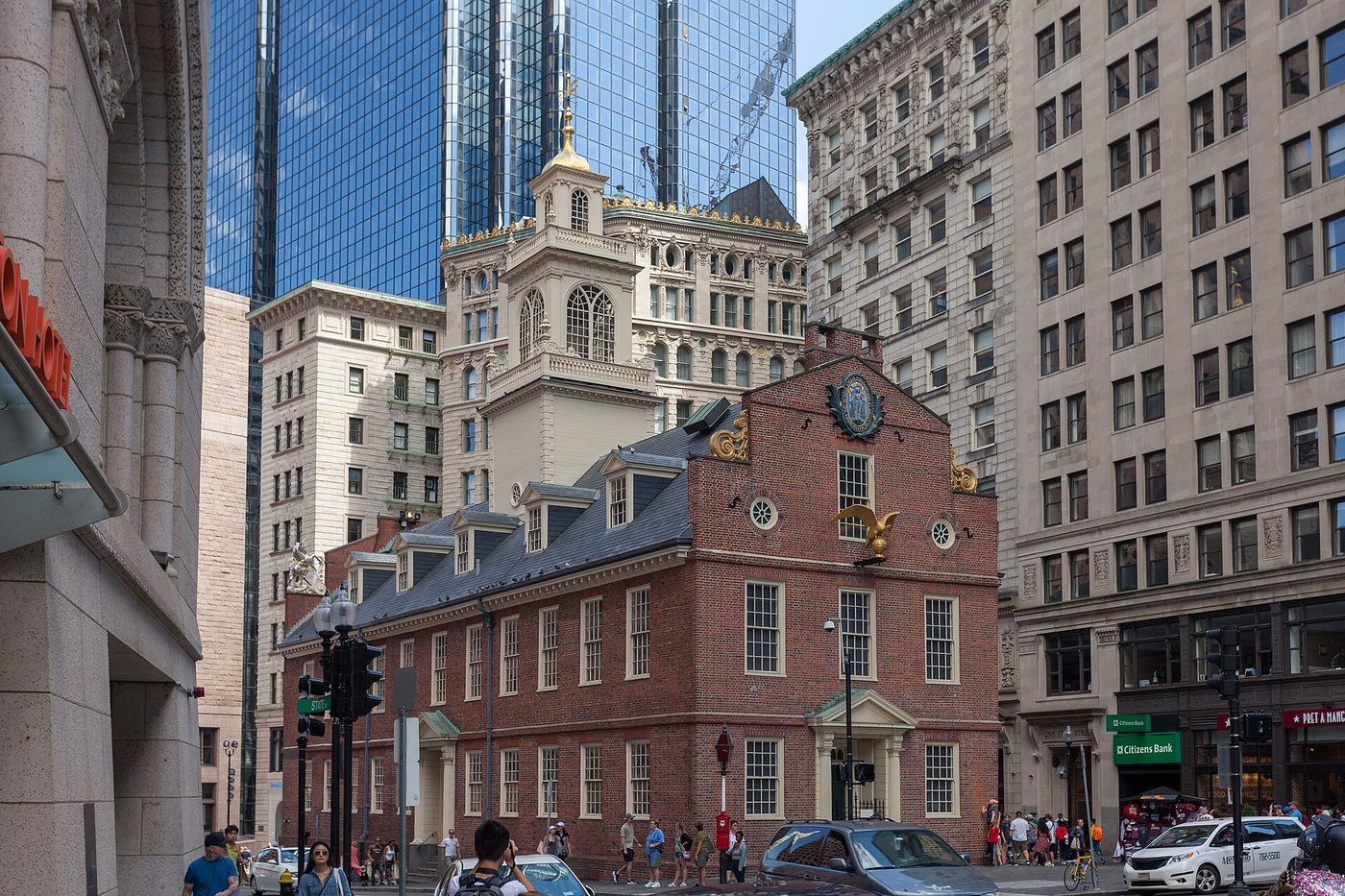
The Old State House survives at a scale very different from the office buildings around it. That contrast can make it appear like a small object preserved in place, but it was once a major center of political and commercial activity. Its rooms accommodated several kinds of authority, and the streets outside became settings for events whose meanings were contested almost immediately.
Government above a place of exchange
The brick building was constructed in 1713 after an earlier wooden town house burned. Colonial government and courts occupied the building, while merchants used the lower level as an exchange. The arrangement brought commerce and government into close physical proximity. This was a public building within a working port city, not a monument isolated from ordinary transactions.
Its exterior communicated royal authority. The lion and unicorn associated with the British monarchy were especially visible symbols. The building’s later revolutionary associations should not obscure the fact that it originally served the government against which the revolution developed.
Two events outside the walls
On March 5, 1770, British soldiers fired into a crowd near the building in the event remembered as the Boston Massacre. The surrounding street was part of the event, not merely a viewpoint from which to admire the facade. Accounts and images helped transform a deadly confrontation into a powerful political symbol.
On July 18, 1776, the Declaration of Independence was publicly read from the balcony. The same building that had embodied colonial government became a setting for declaring a break with it. Its architectural continuity therefore contains a profound change in political meaning: the walls remained while the authority they represented was challenged and replaced.
A building with several later lives
Massachusetts continued to use the building as its state house until 1798. Boston subsequently used it as City Hall between 1830 and 1841. Changes associated with that period include Isaiah Rogers’s spiral staircase. A clock installed in 1831 also belongs to the nineteenth-century civic building rather than its original colonial phase.
These alterations matter because a historic interior is rarely the product of a single construction date. An early building can contain later stairs, finishes and systems that are themselves historically significant. Presenting every feature as “colonial” would flatten that chronology.
The building also intersects with the history of abolitionism. In 1835, William Lloyd Garrison sought protection here during an attack by a hostile crowd. This later episode complicates a narrative that ends with independence: conflicts over liberty and rights continued in the same city and around the same civic institutions.
Seeing scale as evidence
The surrounding towers make the Old State House’s survival particularly legible. Its small footprint and prominent roofline record a different urban scale, while nearby streets maintain its relationship with the city around it. Museum interpretation provides context for the rooms and events, but the exterior already raises a useful historical question: how can one building serve successive governments without retaining the same meaning?