
The McKim Building at Boston Public Library turns the journey toward a book into a sequence of architectural spaces. From Copley Square, an arched entrance leads to a vestibule, staircase, galleries and reading rooms. A courtyard brings outdoor light into the middle of the building. These changes of scale were part of a library conceived as both a working institution and a place where the public could encounter art.
A library with a civic address
Charles Follen McKim designed the building, which opened in 1895. Its Renaissance references gave the library the visual gravity of a palace, but the intended public was much broader than a private household. Boston had already established its public library before commissioning this building; the new home gave an expanding institution a prominent place in the developing Back Bay.
The inscription above the entrance, “Free to All,” expresses the building’s public ambition. That claim is most meaningfully understood through ordinary uses: reading, consulting collections, asking for assistance and spending time in a shared interior. The architectural grandeur was attached to these activities rather than replacing them. A decorated room can still be a place where someone is trying to finish a difficult piece of work.
Why Bates Hall feels different
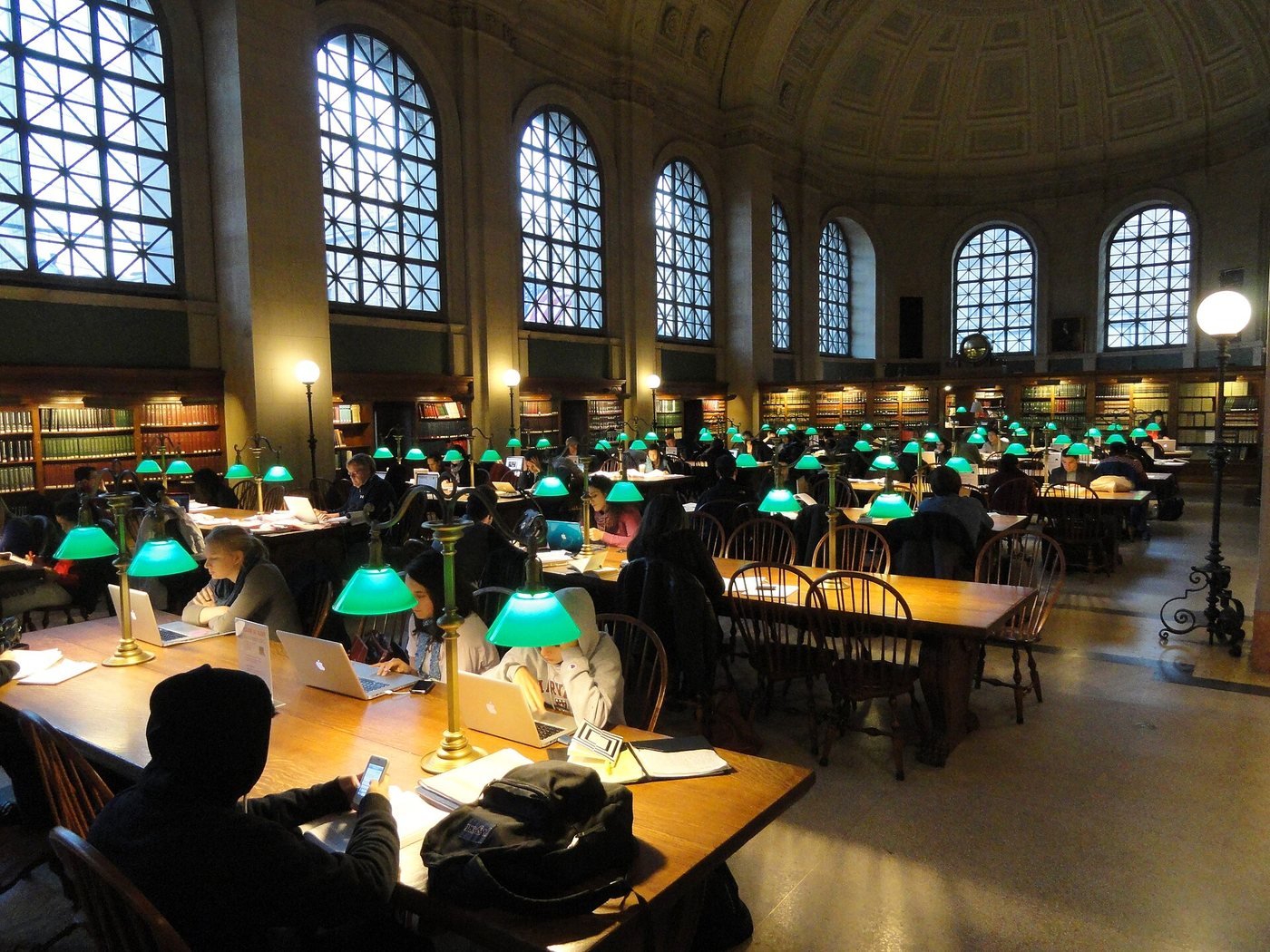
Bates Hall is a long reading room under a barrel-vaulted ceiling about fifty feet high. Its repeated windows, tables and bookcases establish a steady rhythm, while the vault gathers the room into one large volume. The hall is named for Joshua Bates, a major early benefactor. His support came with an interest in a library that would offer a warm, well-lit room and free access.
The arrangement balances individual concentration with collective space. Readers have their own positions at tables, but they remain within a single visible hall. Green-shaded lamps provide a smaller scale of light beneath the high ceiling. Original furniture and restored fittings help preserve this relationship between the monumental room and the practical surface on which a book is opened.
Bates Hall is also a useful reminder that a historic library is not simply an exhibition of old furnishings. Quiet behavior matters because the room retains a reading function. Photography, when permitted, should not turn occupied tables into a stage set or require other readers to interrupt their work.
Murals made for particular rooms
The building’s art was commissioned for specific architectural settings. Pierre Puvis de Chavannes created a mural cycle associated with the main staircase and the fields of knowledge. The canvases were painted in France and subsequently installed in Boston. Their pale colors and broad compositions work with the stone surfaces rather than behaving like small framed paintings placed on an otherwise neutral wall.
Edwin Austin Abbey and John Singer Sargent contributed other major cycles. Their subjects and pictorial approaches differ, so the library does not present a single decorative voice. Moving between rooms changes the relationship of image, light and architecture. The murals are evidence of the institution’s cultural aspirations at the end of the nineteenth century, including the historical and religious narratives that its patrons chose to elevate.
An interior that has been maintained and changed
The courtyard provides an alternative to the enclosed reading rooms. Arcades define its edges, while the open center allows sky, weather and planting to become part of the library experience. Its fountain and sculpture belong to a designed composition, not a leftover service yard.
The McKim Building now operates beside the later Boylston Street building. Their different dates and spatial arrangements reflect successive ideas about library service. Restoration has also shaped what survives: cleaning, conservation, lighting and repairs all influence the appearance of a supposedly timeless interior. Because restoration work can affect individual rooms, the library’s own access information is the appropriate place to establish which spaces are available on a particular day.

_-_%22North_End_Nights%22.jpg)