
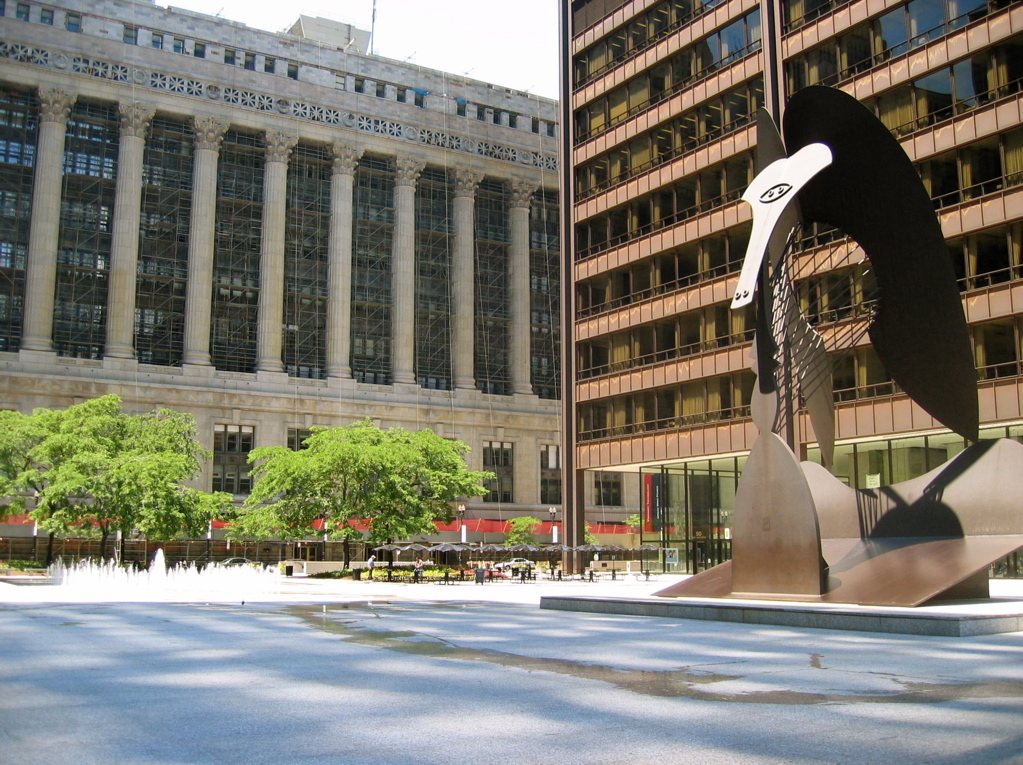
Daley Plaza is an open space attached to the business of government. Its best-known object is the large untitled sculpture by Pablo Picasso, dedicated in 1967. The work stands in relation to the Daley Center rather than in an isolated sculpture garden, making the plaza a useful place to consider how public art and civic architecture shape one another.
An object without a single prescribed reading
The Public Building Commission’s history identifies the sculpture as a central feature of the plaza. Its abstract form has invited many comparisons, but a visitor does not need to settle on one subject before looking closely. Different positions reveal openings, planes and changes in the silhouette that a frontal photograph can hide.
Start at a distance to see its relationship with the tower behind it. Then move along the public plaza and notice how the form changes against the sky and surrounding buildings. An object can appear heavy from one angle and surprisingly open from another. Its scale becomes clearer when people pass nearby.
The work and the architecture also share a visual conversation through their surfaces and color. That relationship helps connect an unconventional sculpture to a restrained civic setting. Public art need not imitate a building to belong with it.
The plaza is a working space
An open paved area supports uses that a tightly planted garden cannot accommodate as easily: circulation, assemblies and temporary events. The sculpture provides a recognizable focus, while the rest of the space has to remain available for people moving through or gathering.
The Public Building Commission publishes programming associated with the plaza. Check its current information if a particular event matters, because the open space can look and operate differently from one day to another. The civic building has separate entry and security arrangements; access to the plaza does not imply unrestricted access to offices or court facilities.
A short visit is enough to compare the sculpture from several sides and see how the building frames it. The point is not to solve the artwork as a riddle, but to observe how an unfamiliar form became a recognizable part of Chicago’s public life.


.jpg)
.jpg)