
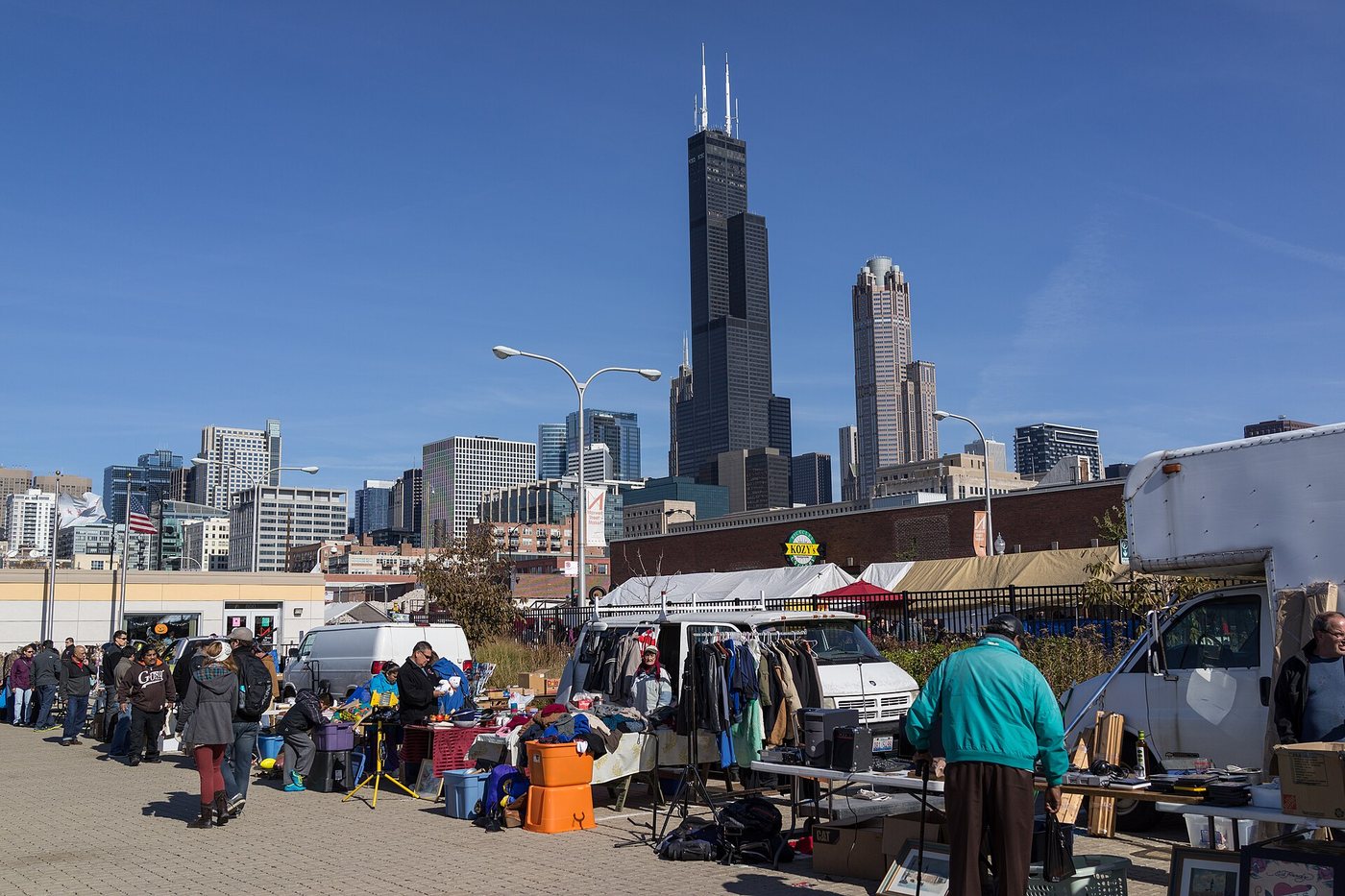
Maxwell Street Market is a reminder that a market can survive in memory and practice even when its location and scale change. Its history includes immigrant commerce, secondhand goods, food and the development of Chicago blues. A present-day visit should begin by separating that long history from the arrangements of the current market season.
A street economy before an official institution
The Maxwell Street Foundation traces the market to informal trade in a district shaped by immigration. Eastern European Jewish merchants and shoppers were central to its development. The city formally recognized a public market on Maxwell Street in 1912, but that ordinance organized an existing pattern of exchange rather than inventing commerce on an empty street.
Street markets offer a different setting from enclosed stores. Sellers can operate with less permanent space, goods may be displayed directly beside the route of passing customers, and bargaining or browsing becomes part of public life. Those characteristics help explain why markets often serve people arriving in a city with limited resources.
The district’s history later included African American migrants and musicians whose performances helped shape the sound associated with Chicago blues. Food businesses and traders from other communities added further layers. It is more accurate to describe successive and overlapping contributions than to assign the market one fixed cultural identity for its entire history.
A name can travel
The market has occupied different sites as the surrounding district changed. Redevelopment and institutional expansion altered its historic setting, and a current event with the Maxwell Street name is not a reconstruction of the market at its largest extent. Old photographs can show a density of stalls and activity that should not be promised to someone visiting today.
This difference is useful rather than disappointing. It encourages questions about how cities value informal commerce, whose businesses survive redevelopment and what preservation means when much of the original streetscape has gone. Protecting a building and sustaining a trading community are related but distinct tasks.
Check the city’s current market calendar before planning a trip around it; an assumption of weekly operation may be wrong. For historical context, the Maxwell Street Foundation’s timeline and market account explain how the institution developed. Reading those alongside a present-day visit allows the market’s changing scale to become part of the story rather than a detail hidden behind a familiar name.
.jpg)

