
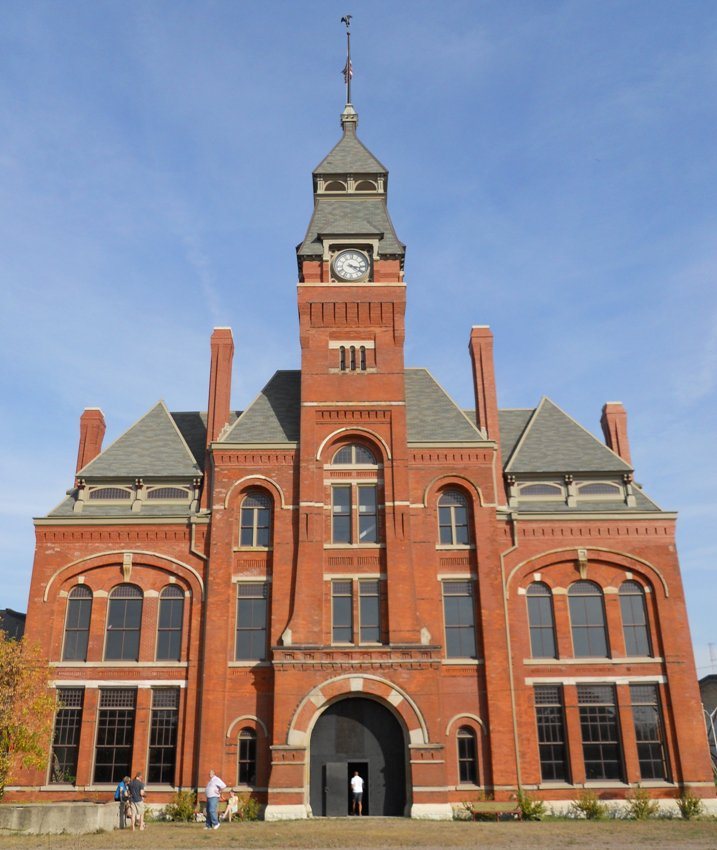
Pullman is a neighborhood where an orderly streetscape cannot be separated from the conditions under which it was built. The company town housed workers making railway sleeping cars, and its design attracted attention as an alternative to crowded industrial districts. Yet the same employer influenced both work and housing. Understanding Pullman requires looking at those relationships together, rather than judging the experiment only by the appearance of its buildings.
A town organized around an employer
George Pullman’s company produced and operated sleeping cars associated with comfortable long-distance railway travel. The planned community supported the manufacturing operation, with homes and civic-looking buildings arranged near the works. The surviving district includes the former administration building and car works site, Hotel Florence, Arcade Park and Greenstone Church.
These places had different roles within the town, but their proximity made the connection between domestic life and employment unusually direct. A worker did not leave the employer’s influence entirely behind at the factory gate. The town’s attractive environment and the company’s control were two aspects of the same arrangement.
When walking among the houses, compare their scale and position rather than assuming that a planned community meant identical living conditions for everyone. A coherent design can still express differences in occupation, status and income. The facade is evidence, but it needs to be interpreted alongside records of work and tenancy.
The conflict of 1894
The economic downturn following the Panic of 1893 reduced demand for railway cars. Workers experienced wage cuts while housing costs remained a source of grievance. Attempts to negotiate failed, and a strike began at the Pullman factories in May 1894. The dispute then expanded beyond the town when the American Railway Union supported a boycott of Pullman cars.
This sequence matters. The local strike concerned conditions at the company, while the national boycott involved railway workers handling its cars across a much wider network. A dispute over one employer became a confrontation with implications for transportation, federal authority and the power of organized labor.
The National Park Service’s account also makes clear that the American Railway Union restricted membership to white workers. A story about labor solidarity should therefore include the boundaries of that solidarity. The movement’s achievements and exclusions are both part of the historical record.
The strike and boycott ended in defeat for the workers, but investigations sharply criticized George Pullman’s policies and refusal to arbitrate. That outcome complicates an easy division into success and failure. The company retained power, while the reputation of the model town was damaged. Architecture that had been presented as evidence of social improvement became part of a debate over paternalism and control.
Factory workers and porters are related histories, not the same job
Pullman’s manufacturing employees should not be confused with the porters who worked aboard sleeping cars. The company’s name connected both groups, but their work, conditions and paths of organization differed. The National Park Service interprets the district through labor and civil-rights history as well as design and industry.
The A. Philip Randolph Pullman Porter Museum, within the wider district, addresses African American labor history. Its presence helps extend the story beyond the factory and the 1894 strike. Railway service work linked the company to communities across the country, not only to residents of the planned town.
Keeping those distinctions clear makes the neighborhood more understandable. A building associated with manufacturing cannot by itself represent every person who worked for the company. Different institutions and sources illuminate different parts of the history.
The neighborhood continued after the experiment
Pullman is not an empty set of company-town buildings preserved for visitors. Most of its homes are privately occupied. The National Park Service works with partners across a landscape that includes several forms of ownership and use. A national historical park designation does not turn the whole neighborhood into unrestricted museum space.
This continuing residential life is important to the interpretation. Buildings survive through maintenance, adaptation and the work of later residents, not only through the intentions of their first developer. A restored facade can reflect twentieth- or twenty-first-century preservation efforts as well as nineteenth-century planning.
Begin with the park’s current visitor information and interpretation, then use the public streets to connect the major sites. Do not enter residential gardens or assume that every historic-looking building is open. The most useful question is not whether the town looks harmonious, but how its spatial order related to economic power—and how later generations have chosen to preserve and explain that relationship.
.jpg)

.jpg)