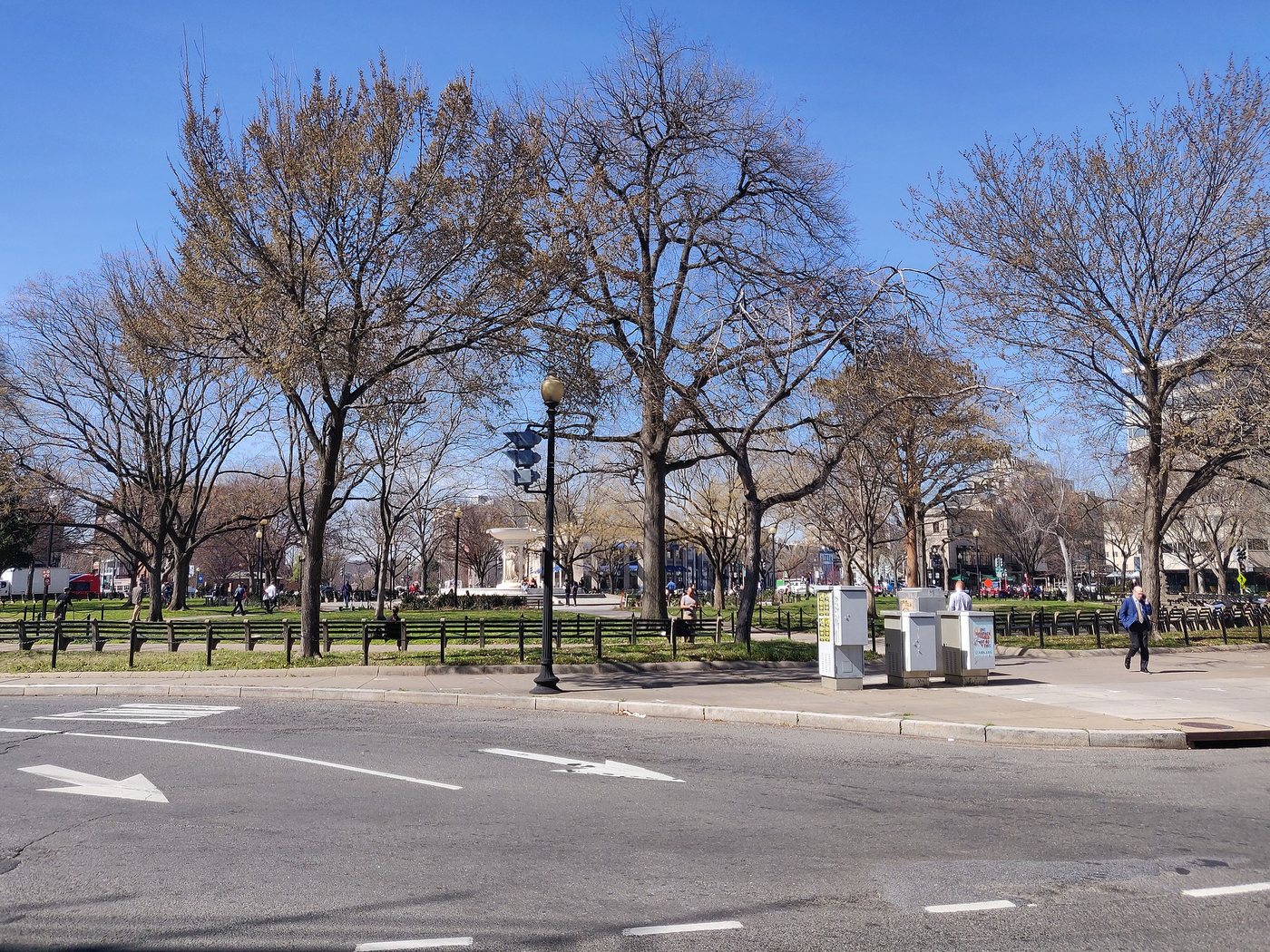
Dupont Circle’s fountain commemorates Rear Admiral Samuel Francis Du Pont, but the space around it also functions as a neighborhood meeting place. Its circular form gathers paths, seating and surrounding streets around a central object. That combination gives the memorial a daily life that extends beyond the person it honors.
A memorial replaced by another memorial
The present fountain was completed in 1921. It replaced an earlier bronze statue of Du Pont, dedicated in 1884 and later moved to Wilmington, Delaware, following a request from his family. The change replaced a standing military figure with an allegorical composition while retaining the commemorative purpose.
Architect Henry Bacon and sculptor Daniel Chester French collaborated on the fountain. Both also worked on the Lincoln Memorial, but the scale and setting here are quite different. Dupont’s memorial is encountered within a busy urban circle rather than at the end of a long ceremonial axis.
Sea, wind and stars
Three figures support the fountain’s upper bowl and represent the sea, wind and stars. Their subjects connect the memorial with navigation and naval life without depicting a particular battle. Attributes such as a boat, sail and marine creatures help make the symbolism legible.
The composition works in the round. Moving around it changes the visible figure and the relationship between sculpture and basin. There is no single facade that contains the entire explanation, which suits an object approached from several paths.
A circle used at human scale
The central memorial provides a recognizable meeting point, while the surrounding public space allows people to pause without entering a building or making a purchase. Seating and paths translate a traffic-defined circle into a place that can be occupied.
The nearby streets remain part of the experience. Crossing into the circle creates a transition from movement around its edge to slower activity inside. The fountain’s water operation can vary with maintenance and season, but the sculpture and spatial arrangement remain understandable even when it is dry. Its significance comes from the relationship between commemoration and ordinary use, not solely from the appearance of flowing water.