
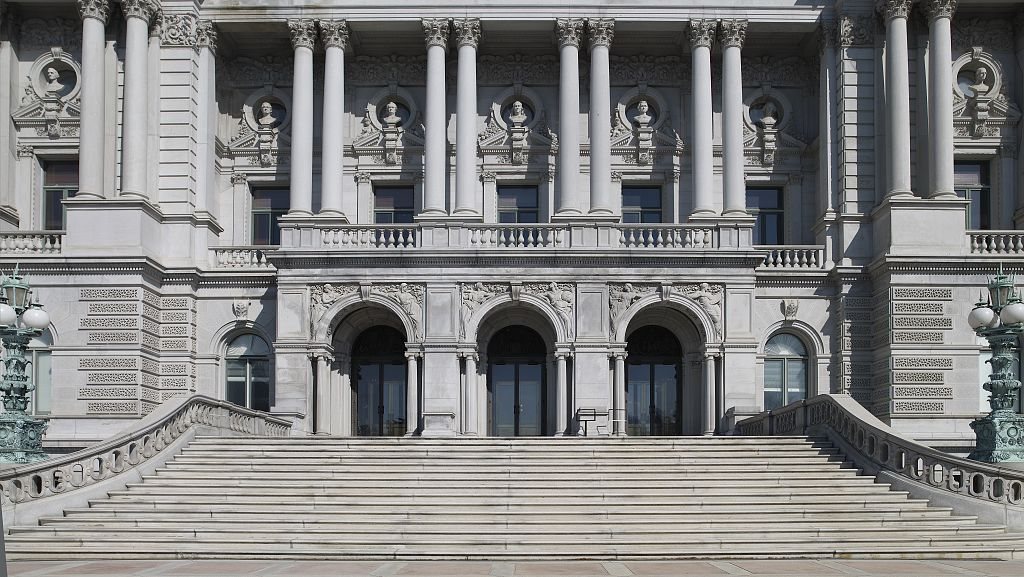
The Library of Congress’s Thomas Jefferson Building opened in 1897, giving the institution a separate monumental home beyond its earlier rooms in the Capitol. Its Great Hall is filled with sculpture, inscriptions, mosaics and painted decoration. The abundance is not accidental: the building presents knowledge as something worthy of public celebration, while also revealing the cultural assumptions of the people who commissioned it.
A larger home for a growing collection
Librarian Ainsworth Rand Spofford advocated a new building as the collections expanded. Architects John L. Smithmeyer and Paul J. Pelz developed the design, with construction later supervised under a different administrative arrangement that included engineer Bernard Green. The building was the product of a long institutional effort, not simply one architect’s finished drawing.
Its Italian Renaissance references provided a language of palaces, arcades and richly treated surfaces. Yet modern technology was also part of the statement. The library did not intend its historical references to imply that it belonged only to the past.
Electricity made visible
The Great Hall’s electric lighting was a conspicuous sign of modernity when the building opened. Exposed bulbs and torch-like fixtures celebrated a technology that transformed large public interiors. Electric light allowed the library to present itself as both culturally established and scientifically current.
Materials carry a similar message. Aluminum leaf appears in the ceiling decoration, a detail easily mistaken for a more familiar precious metal. The choice reflects a period when aluminum had a different technological and cultural significance from the everyday material it later became.
Small figures describe contemporary work
Philip Martiny’s sculpted children along the staircases represent occupations and pursuits. Their tools identify activities such as gardening, printing, medicine and scientific investigation. A figure with a specimen box or printing equipment brings the late-nineteenth-century world of work into a setting otherwise full of classical references.
These details connect an abstract celebration of knowledge with specific practices. Books are one part of that world, but the program also includes observation, making and technical skill. The building’s imagery suggests a broad relationship between learning and activity.
The inscriptions and selected names likewise form an argument about culture. They were chosen by people within a particular historical setting, including Spofford and Harvard president Charles W. Eliot. Their presence should not be read as a neutral or complete catalogue of human achievement. The decorative program records what its selectors considered authoritative.
The ceremonial interior and the research library
The Great Hall organizes public movement through the building, while the reading rooms support different activities and access arrangements. Seeing the architecture does not automatically confer access to every research space. That distinction protects the library’s working role and helps visitors understand why routes and permissions differ.
Restoration has also shaped the interior now visible. Later office use and changing institutional needs affected the building, and conservation work recovered decorative features and improved their presentation. The apparent unity of the Great Hall is therefore partly the result of sustained maintenance and restoration.
The building can be approached as an architectural account of how a national library wanted to represent itself in 1897. Its technology, materials and imagery all contribute to that account. The continuing research institution gives those historic ambitions a present-day purpose beyond the spectacle of the rooms.
-1.jpg)