
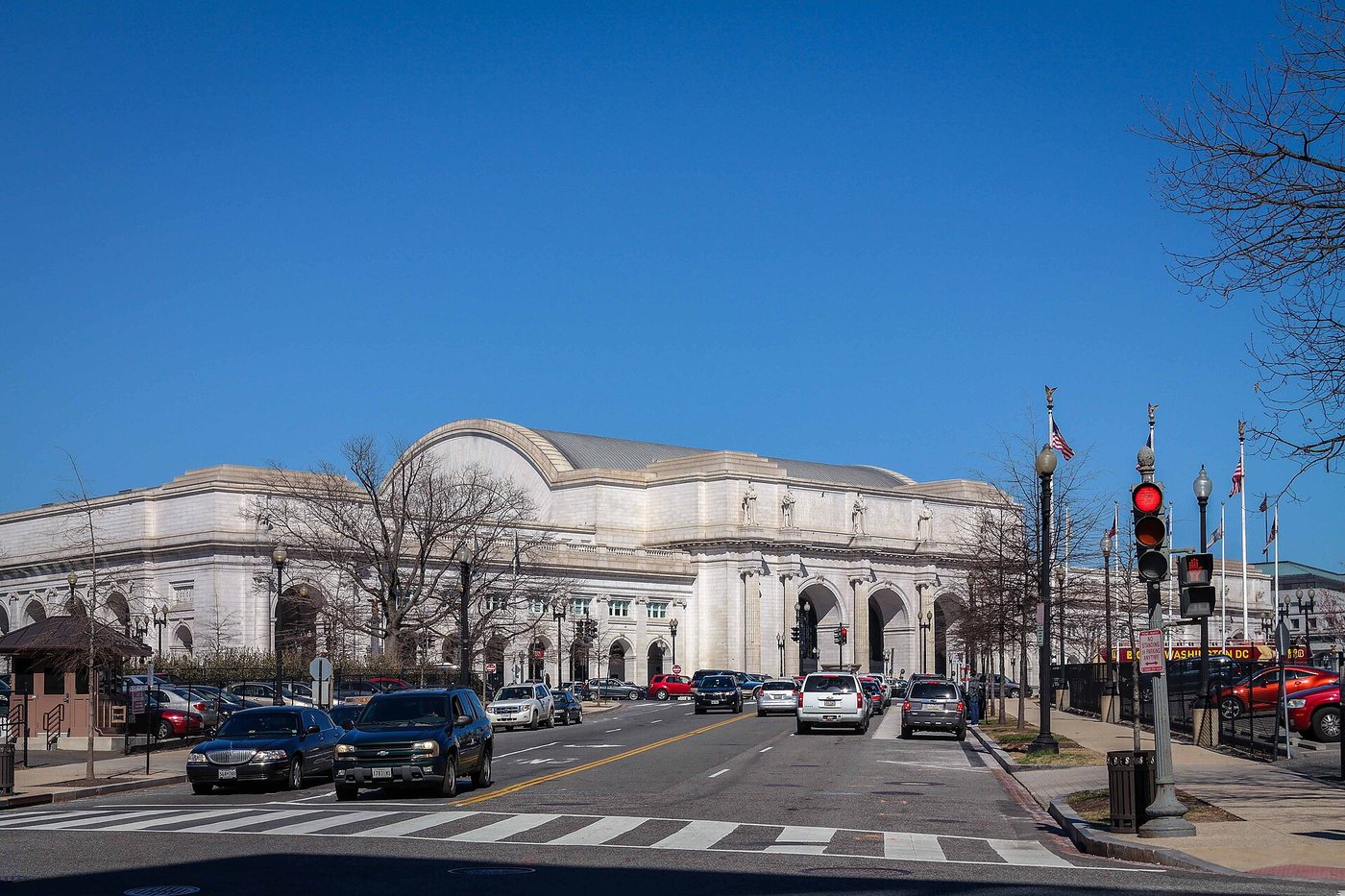
Washington’s Union Station was designed to make arrival in the capital feel consequential. Its broad facade and large interior spaces give rail travel a civic setting, but the station’s history also includes declining passenger traffic, an unsuccessful visitor-center conversion and a return to transport-led use. The architecture has survived through changes in what people expected the building to do.
A new railway entrance to Washington
Daniel Burnham designed the station, which began receiving trains in October 1907 and was completed in 1908. The project consolidated a major part of the capital’s railway activity in a monumental building near the Capitol. Its name expressed the joining of rail operations at a shared terminal rather than the identity of a single railway company.
The large entrance and waiting spaces performed a practical task as well as a symbolic one. Passengers needed to move between the city, ticketing and trains, often with luggage and limited time. High ceilings and broad rooms gave that movement a legible spatial framework, even when crowds made the experience less orderly than the architecture suggests.
Traffic rose, then the original model weakened
The station handled intense demand during the Second World War. In the decades afterward, changing travel patterns reduced the role of intercity passenger rail. A building designed for one scale of traffic had to find a viable future under different conditions.
The National Visitor Center project of the 1970s attempted to give the station a new role, but it did not provide a durable solution. The episode is a reminder that a prestigious public use is not enough on its own: circulation, maintenance, revenue and the building’s relationship with its transport function all have to work together.
Restoration depended on renewed use
The Union Station Redevelopment Act of 1981 established a framework for rehabilitation, and the Union Station Redevelopment Corporation followed in 1983. Restoration was tied to the station’s continued life as a transport hub with other activities around it.
That history helps explain why the building contains both monumental public rooms and more ordinary commercial and operational spaces. They are parts of a functioning complex rather than contradictions to be removed from a pure architectural monument.
For someone arriving by train, the station is infrastructure first. For someone entering to study the building, the concourse and facade may be the main focus. Both uses depend on maintaining clear routes and respecting areas reserved for passengers and operations. Union Station’s long-term survival has required preserving its architecture while keeping a reason for large numbers of people to use it.
-1.jpg)