
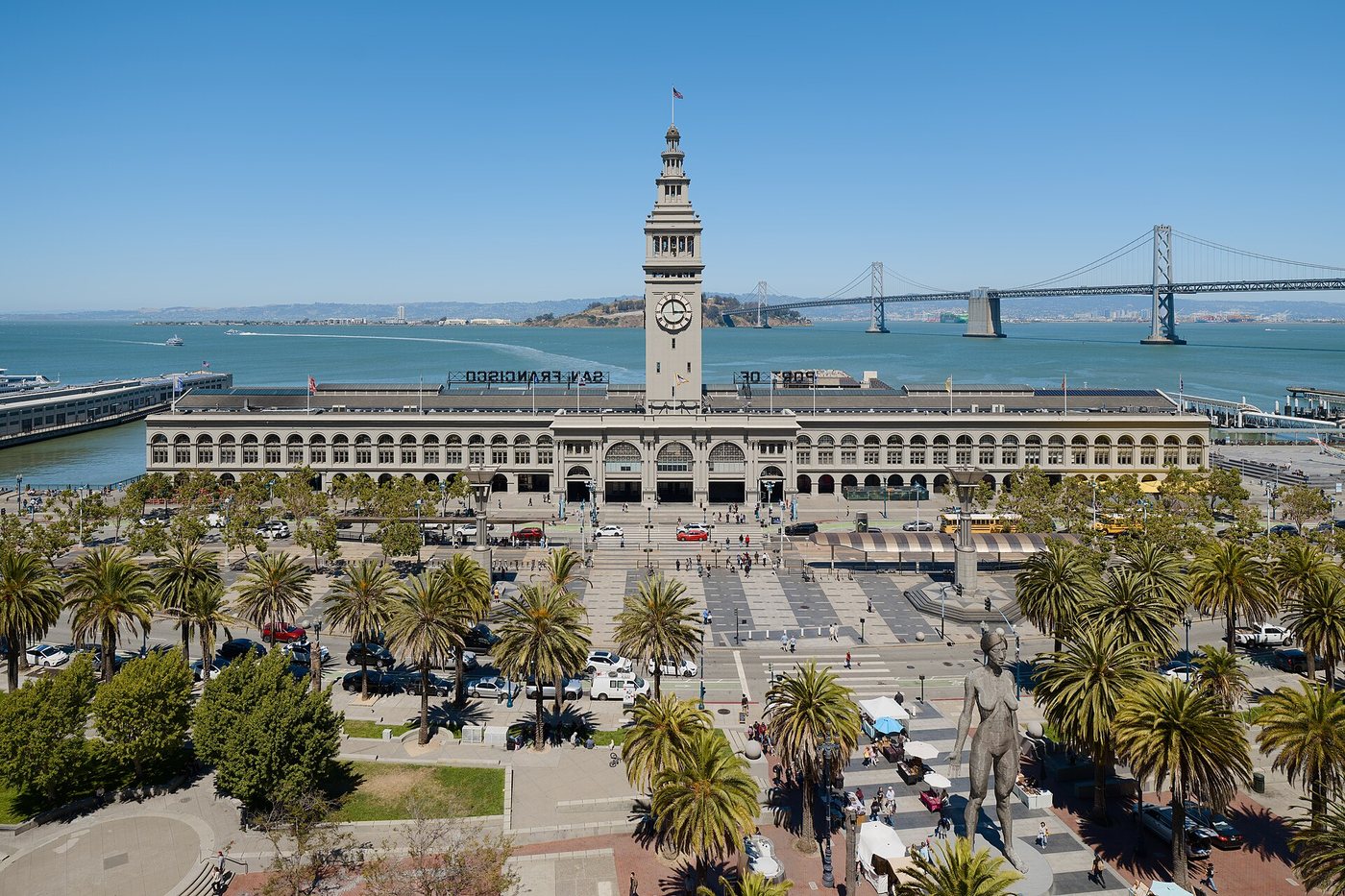
The Ferry Building stands at the waterfront end of Market Street, where its clock tower marks a meeting between city streets and bay transport. Opened in 1898, the building was once central to daily arrival in San Francisco. Its later conversion into a marketplace did not invent a public role; it reworked a building whose relationship with movement had already changed several times.
Arrival by water
Before the major bridges opened in the 1930s, ferries carried large numbers of passengers to the city. The terminal concentrated that movement at a recognizable address. Its tower could be seen from the water and along Market Street, giving a transport building an important place in the city’s visual geography.
The Bay Bridge, Golden Gate Bridge and wider use of cars reduced dependence on ferry commuting. A building designed around intense passenger movement consequently faced a different future. In 1955, office conversion subdivided much of its historic interior.
A freeway changed the setting
The elevated Embarcadero Freeway stood between the building and much of the city-facing approach. Its presence altered the experience of the waterfront even though the Ferry Building itself remained in place. The 1989 Loma Prieta earthquake damaged the freeway, and its subsequent removal opened the way for a different relationship between the street and the bay.
This sequence shows why preserving a building is not only a matter of its walls. Roads and structures around it can make an entrance welcoming, difficult to reach or visually obscured. The later waterfront project changed the setting in which the landmark could function.
A nave adapted for food retail
The restored building reopened in 2003. Its long, skylit central space became the organizing spine of the marketplace, with individual businesses arranged along it. The architectural volume gives the interior coherence while allowing different vendors to operate within it.
The indoor marketplace and the outdoor Ferry Plaza Farmers Market are related experiences but distinct operations. Foodwise organizes the farmers market, whose schedule and producers should be understood separately from the permanent shops. A quiet indoor visit and a busy market day can therefore offer very different impressions of the same building.
Ferries continue to give the waterfront a transport role. The food marketplace adds reasons to arrive and remain, but it does not fully replace the site’s connection with the bay. The building’s history is a succession of overlapping uses: terminal, subdivided offices and a restored public interior with food trade at its center.

.jpg)

