
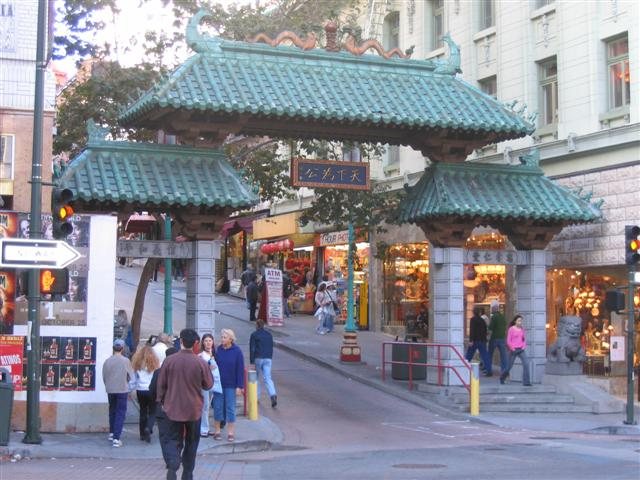
San Francisco’s Chinatown is a residential and commercial neighborhood whose visible architecture was profoundly shaped by the 1906 earthquake and fire. Its familiar rooflines are not evidence of a district transported unchanged from China. They belong to a local history of rebuilding under pressure, in which Chinese residents and merchants resisted displacement and developed ways to secure their place in the city.
Disaster did not erase the claim to place
The earthquake and subsequent fire destroyed much of Chinatown. Some city leaders treated the destruction as an opportunity to relocate the Chinese community away from valuable central land, including proposals involving the southeastern waterfront. The disaster therefore created a political struggle over rebuilding as well as an immediate need for shelter.
Chinese residents faced discriminatory treatment in relief and displacement arrangements. The National Park Service’s account of the disaster documents the segregation and instability of refugee accommodation. These experiences belong alongside the more familiar story of San Francisco’s physical reconstruction.
Relocation did not proceed as its advocates intended. Community resistance, commercial interests and diplomatic pressure contributed to Chinatown’s return to its established location. Rebuilding was thus an assertion of continuity in a place where that continuity had been challenged.
A new architectural image
Merchants adopted buildings with conspicuous Chinese-inspired motifs as part of reconstruction. The Sing Chong and Sing Fat buildings near Grant Avenue and California Street are significant examples. Their decorative roofs and details helped establish an image that became associated with the district.
These buildings combined local construction practices with selected visual references. The ornamental roof forms were not simply reproductions of the functions those forms might have had elsewhere. They helped create a recognizable commercial and cultural identity within San Francisco’s particular urban setting.
The strategy deserves a more careful reading than either “authentic China” or mere theatrical scenery. The architecture responded to a hostile political environment and the economic possibilities of attracting visitors. Merchants made choices within those constraints, and the resulting buildings became part of the neighborhood’s own history.
The district is larger than its visitor-facing image
Distinctive facades are only one layer of Chinatown. Housing, shops, associations, religious institutions and services support everyday life. A street photographed for its rooflines may also be a route to work, a place to buy food or the address of a household.
That overlap changes how the neighborhood should be approached. Commercial display does not make every interior public, and an alley is not automatically a stage for visitors. The continuity of community life depends on uses that may be less visually conspicuous than landmark architecture.
Historic research also requires attention to dates. A building erected after 1906 can stand within a community with a much older history. Conversely, an old-looking decorative feature is not sufficient evidence that it survived the earthquake. The physical district and the community’s continuity operate on related but different timelines.
What rebuilding explains
Chinatown shows how architecture can participate in a struggle over the right to remain in a city. Its reconstruction involved economic calculation and public image, but it also sustained homes, institutions and networks under discriminatory conditions.
The most useful historical question is therefore not whether the neighborhood looks exactly like somewhere else. It is why these particular forms were adopted here, after this disaster, by people facing these pressures. That question connects the visible street with the political and social history that made its survival possible.

.jpg)
.jpg)
