
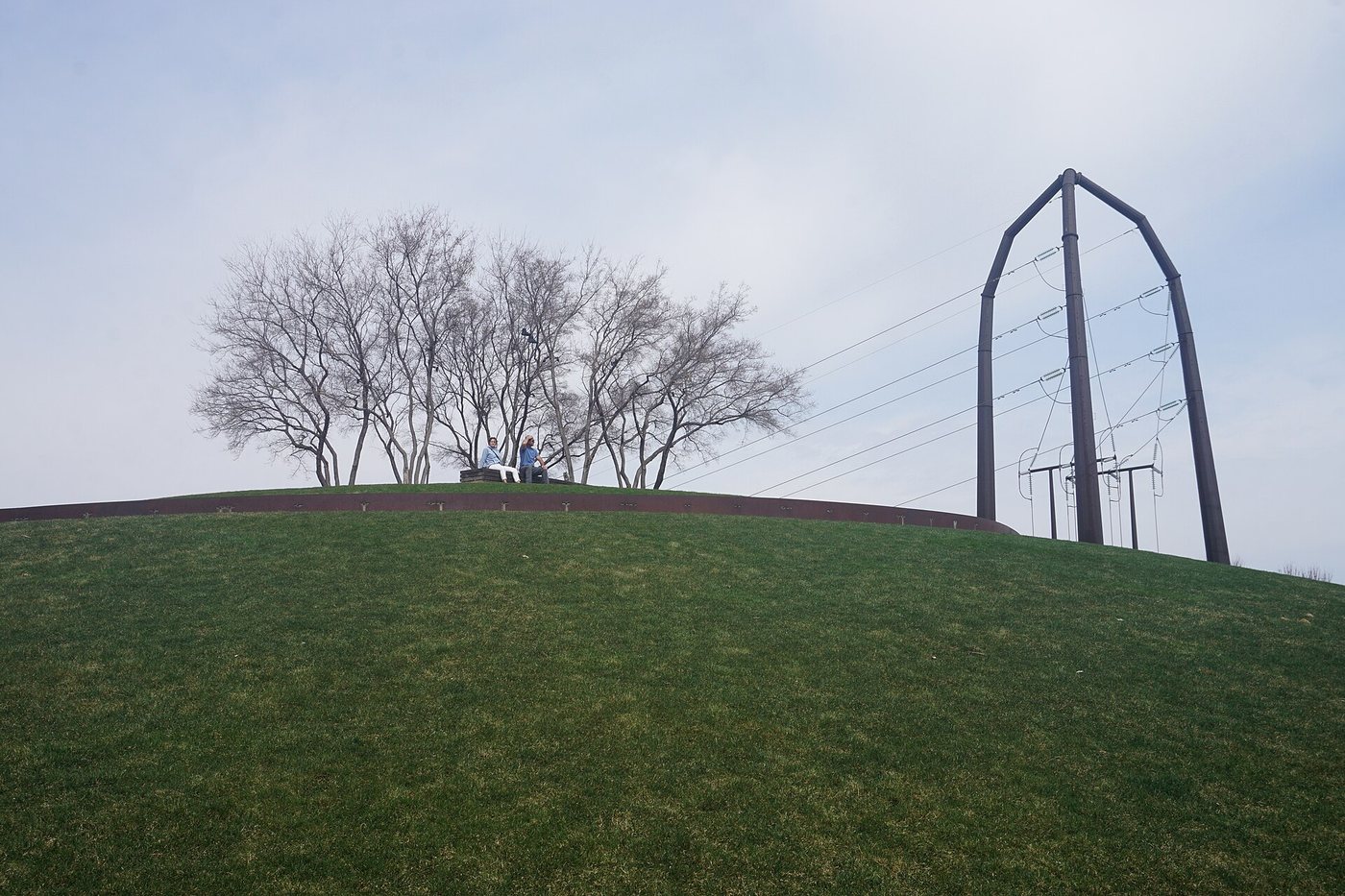
Gold Medal Park is organized around a climb that turns gradually rather than heading directly uphill. Its observation mound and spiral walkway create a sequence of changing views within Minneapolis’s Mill District. The park offers a useful example of how a simple landform can organize movement, outlook and open space.
A mound made for looking outward
The park’s central mound is a designed landscape feature. Its spiral route stretches the approach and changes the direction in which a visitor faces while ascending. Instead of presenting one fixed view at the end of a straight path, the design repeatedly brings different edges of the surroundings into sight.
This is a sculptural observation mound, not a claim to preserve an ancient burial earthwork. Keeping that distinction clear matters when discussing a form that can carry very different meanings in other landscapes. Here, its role is explained by the contemporary park’s design and its relationship to the city around it.
Trees and open ground
The Gold Medal Park Conservancy describes a 7.5-acre landscape with more than 200 mature trees. The mound is only one component of that composition. Open lawn supplies visual space around it, while trees establish shade and a different scale closer to the ground.
The contrast gives visitors several ways to occupy the park. An elevated position offers orientation; a lower seat can provide a more enclosed place to pause. A successful visit need not consist of reaching the highest point and leaving. The change between those experiences is part of the landscape’s design.
A publicly enjoyed place with private stewardship
The McGuire family created and funded the park, and the conservancy now supports its care. That history distinguishes it from a park developed entirely through a municipal parks department. Stewardship is relevant because lawns, paths, lighting and trees require continuing attention after an initial design is completed.
For a short stop, follow the established path, spend time at more than one level and consider how the mound changes the apparent height of surrounding buildings. The park’s subject is not a distant wilderness view. It is the relationship between a shaped patch of green ground and the dense urban district immediately beyond it.

.jpg)

.jpg)