
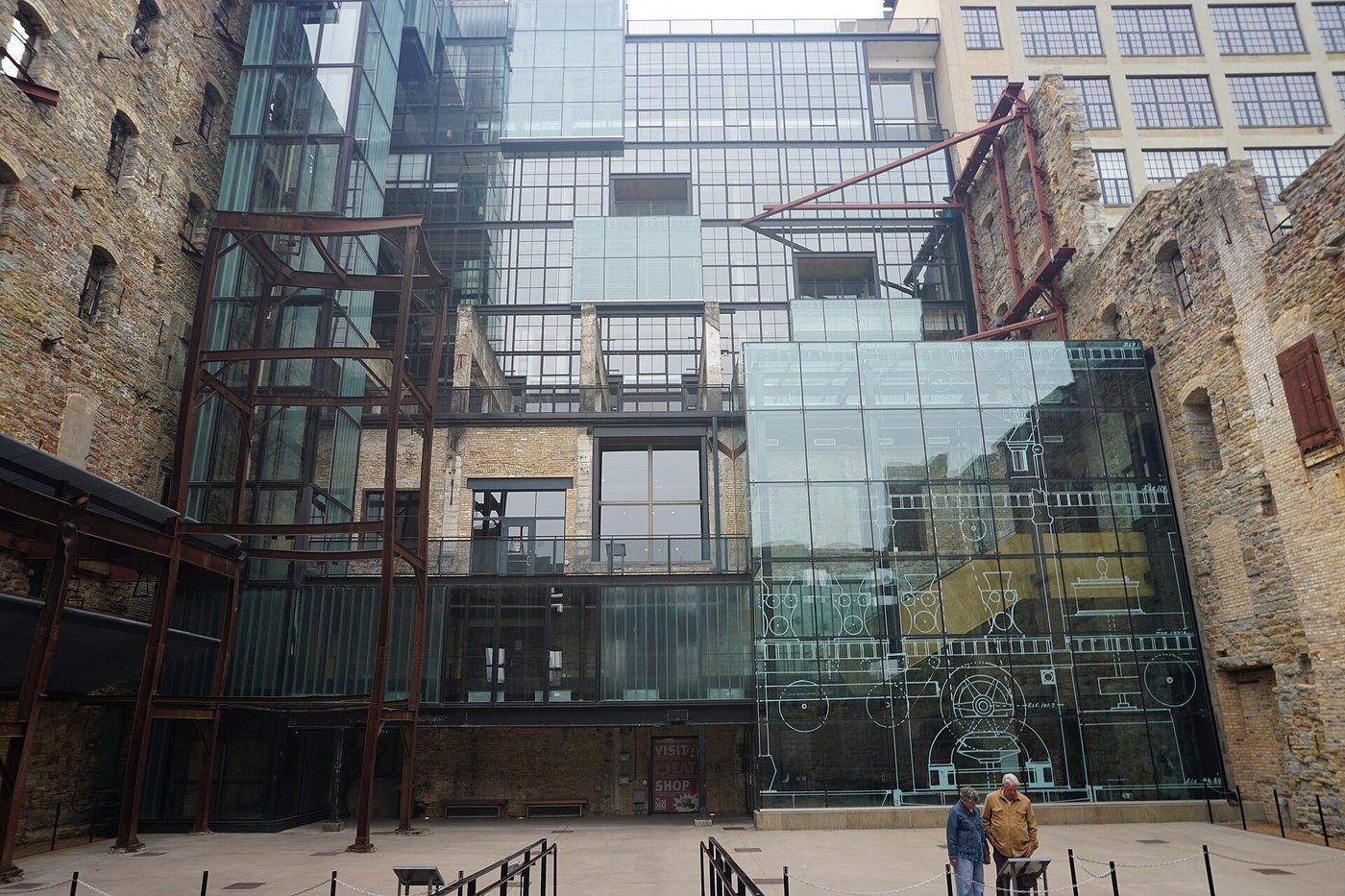
Mill City Museum makes its building part of the evidence. New construction sits within the damaged Washburn A Mill complex, allowing visitors to distinguish a working industrial structure, a later ruin and a contemporary museum. Its subject is larger than flour: it connects river power, grain transportation, labor, industrial risk and the changing use of the Minneapolis waterfront.
A production system tied to the river
The original Washburn A Mill began operating in 1874. Its location combined access to St. Anthony Falls with railway connections to grain-producing areas and markets. The river supplied energy, but water alone did not create a milling center. Grain had to arrive, workers had to operate the machinery, and finished flour had to leave for customers elsewhere.
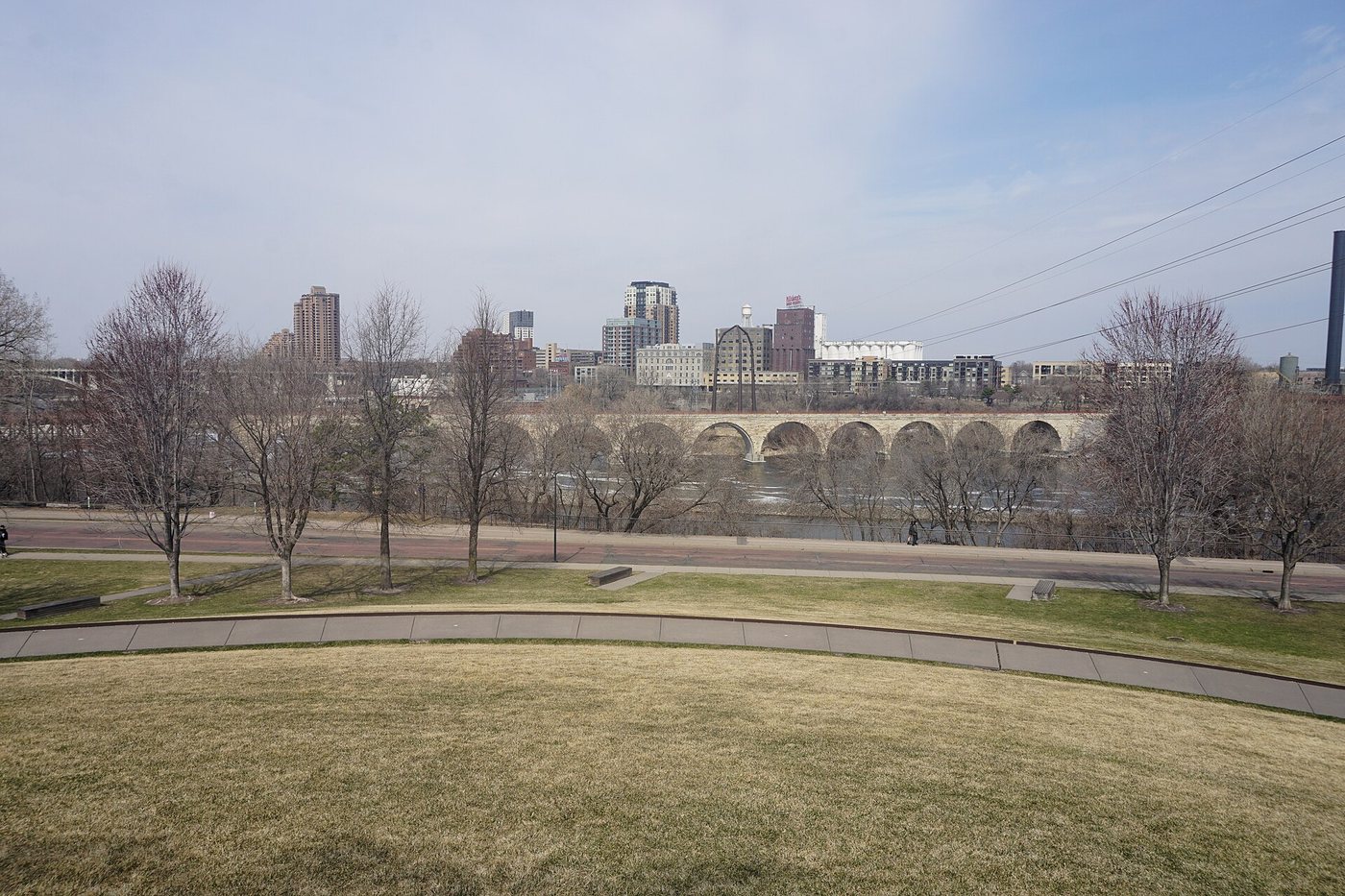
This relationship gives the museum’s riverfront position meaning. The surrounding landscape is not simply a backdrop for a historic factory. It was part of the production system, connecting the building to power and transportation. Looking outward from the mill helps make that larger geography intelligible.
Industrial flour milling also changed the scale of an everyday food. A bag of flour can conceal an extensive chain of farms, handling equipment, machinery and distribution. The museum’s focus on one building makes it possible to trace those connections through a concrete place instead of treating industrialization as an abstract economic trend.
Three destructive episodes, different consequences
In 1878, airborne flour dust ignited in a catastrophic explosion that killed 18 people and destroyed the original mill and other nearby property. The rebuilt A Mill was completed in 1880. The disaster is a reminder that a familiar food can become hazardous when processed at industrial scale: fine particles suspended in air behave differently from flour stored in a container.
A fire in 1928 damaged the mill’s largely wooden interior. Replacement concrete floors and columns were intended to reduce the spread of future fires. The response changed the structure as well as restoring production. Safety measures therefore became part of the building’s material history.
The mill closed in 1965 as the industry’s economic and technological conditions changed. Another fire in 1991 struck the disused complex, leaving damaged limestone walls and concrete remains. These episodes should not be confused: the museum occupies the later rebuilt mill, not a building left exactly as it stood after the 1878 explosion.
Preserving an incomplete building
After the 1991 fire, the city cleared debris and stabilized the walls. The Minnesota Historical Society subsequently developed the museum, which opened in 2003. Architect Thomas Meyer’s design incorporated the surviving structures alongside new glass and steel, with an open-air ruin courtyard as a prominent element.
Preserving a ruin presents a different problem from restoring a complete room. The walls must remain structurally secure, while their incompleteness is part of what the visitor is intended to understand. Rebuilding every missing surface would tell a different story. Here, the encounter between old masonry and newer construction makes the sequence of damage and adaptation visible.
The courtyard also changes the meaning of an exterior wall. A surface once enclosing industrial work can become an object examined from a museum space. That shift does not erase its earlier purpose, but it requires interpretation to connect the surviving fabric with machinery, workers and production that are no longer present.
Following process rather than collecting relics
The museum’s Flour Tower experience uses the building’s vertical organization to explain work inside the mill. The press material describes a multistory presentation rather than a conventional display case. This approach suits an industry in which movement through equipment and between floors mattered as much as any isolated object.
For a visit, keep three questions separate: how the mill operated, what happened to the building, and how the museum presents those events. A machine or photograph may answer the first; a damaged wall may answer the second; the arrangement of an exhibit shapes the third. Together they make Mill City a study of both industrial history and the ways a city chooses to preserve it.

.jpg)
.jpg)
