
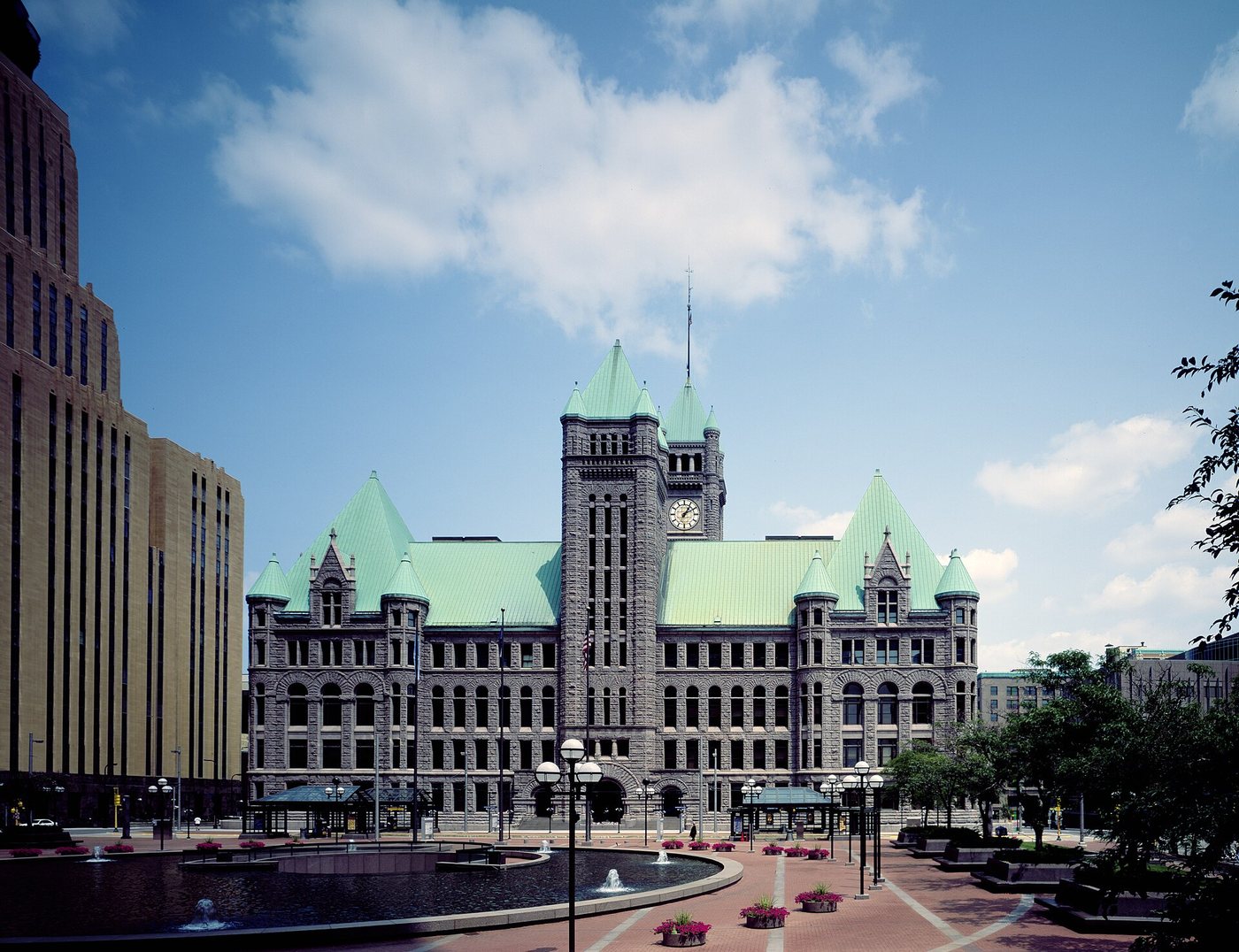
The long name matters: this is Minneapolis City Hall and Hennepin County Courthouse, also known as the Municipal Building. City and county government are different institutions. Their decision to share a prominent building gives the architecture a more specific meaning than a general display of civic grandeur.
Two governments under one roof
The Municipal Building Commission traces construction from 1887 to 1906. Earlier city and county premises had become inadequate as Minneapolis grew, and representatives of both governments participated in planning a replacement. A state statute established the independent commission in 1904 to care for the shared property. That continuing arrangement links the building’s history to ordinary maintenance, operations and preservation.
A shared address does not mean that every city or county service is available at the same counter. For an appointment, identify the responsible office and its current location before treating the landmark as your destination. For an architectural visit, the shared name is a reminder that the building was conceived as working infrastructure for several kinds of public business.
Weight outside, height inside
The Richardsonian Romanesque design uses large arches and substantial stone surfaces. Granite came from Ortonville, Minnesota. From the sidewalk, the contrast between the broad masonry walls and the clock tower makes the building legible at two distances: the entrances address pedestrians, while the tower establishes a marker above surrounding streets.
Inside, the five-story rotunda changes the experience from solidity to vertical openness. Stained glass and balconies draw attention upward. The marble Father of Waters statue, installed in 1904, brings a personification of the Mississippi into the center of a government building. It connects civic identity to the river without turning the building into a riverfront site.
The clock and bells also carry the building’s presence beyond its walls. A public clock provides a shared reference point even for people who never enter. Consider how that role differs from the private time displayed on a phone: the tower makes time part of the streetscape.
Choose the right kind of visit
The commission publishes visitor information and a self-guided tour. Use those resources to distinguish publicly accessible architectural spaces from offices or areas requiring an appointment. A historic interior can remain a place of employment, meetings and security procedures.
Begin with the exterior proportions, then examine the rotunda if access permits. The relationship between the two is more revealing than collecting isolated decorative details. A heavy-looking shell contains a shared interior landmark that helps people orient themselves within a large and administratively complex building.
.jpg)
.jpg)