
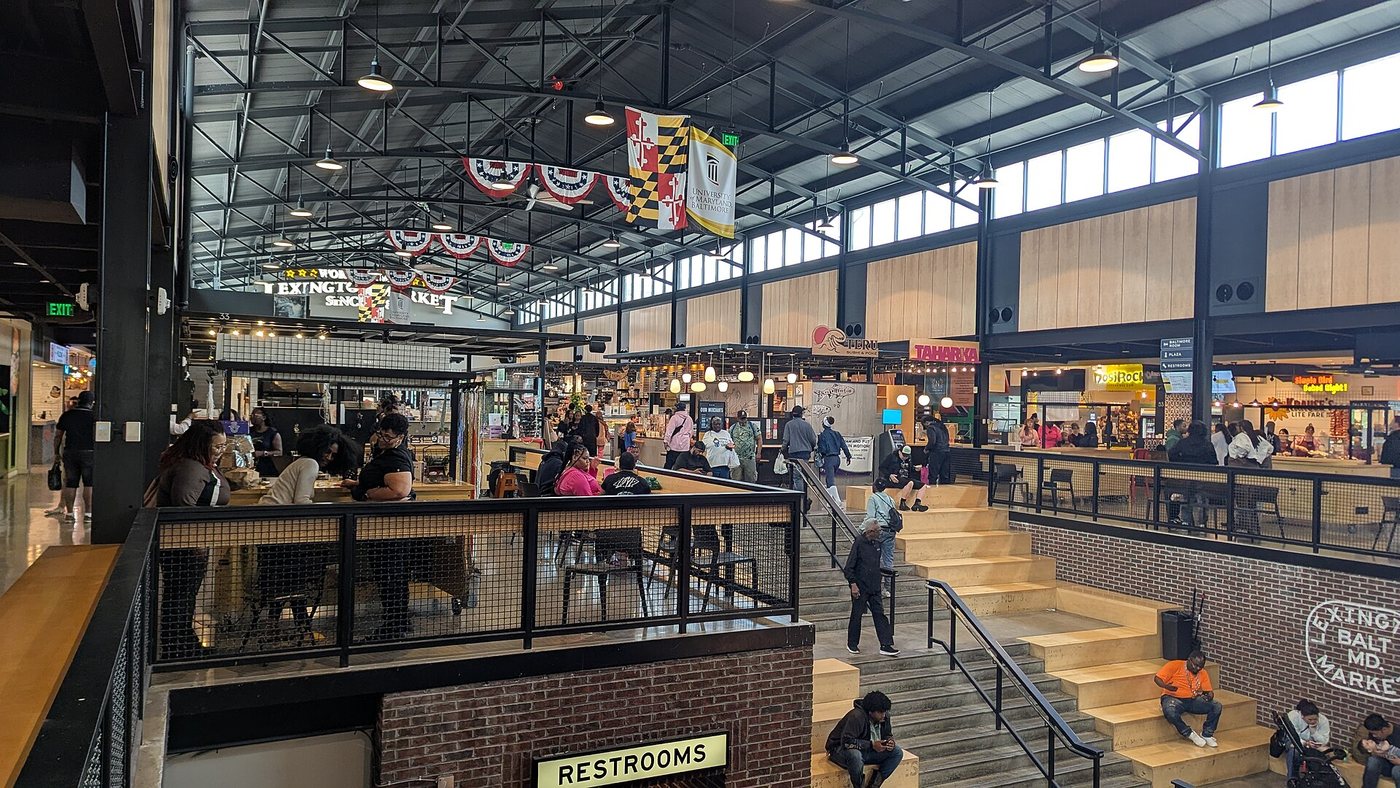
Lexington Market is often described through its age, but the building a visitor enters is only one stage in a much longer institution. The market traces its history to 1782. Its present setting demonstrates how continuity can depend on rebuilding and adaptation rather than retaining one unchanged hall.
The market is a network of businesses
Lexington belongs to Baltimore’s city-owned public-market system. Its merchants include fresh-food sellers, specialty businesses and prepared-food counters. These uses overlap, but they serve different needs: a household shopping for ingredients is making a different visit from someone choosing lunch.
The current hall has upper and lower market levels and an adjoining plaza. The operator identifies an elevator between the levels and a ramp integrated into the plaza. These connections are part of how the market works as a public place, not merely secondary details to be considered after a menu has been chosen.
The building provides a shared address and circulation system, while each merchant operates an individual business. Hours and offerings can therefore differ. Use the current merchant directory for a specific purchase rather than assuming that the opening hours of the building apply identically to every counter.
Long history does not mean a frozen tenant list
The market’s historical photographs show different structures and trading arrangements. Compare those images with the current hall to distinguish the continuity of the institution from the continuity of a particular facade, stall or family business.
New traders can join an old market without making its history irrelevant. The useful question is how the institution maintains space for food access, small businesses and public use while responding to changes in customers and the surrounding city.
The mix also extends beyond food sales. The Baltimore Museum of Art operates a market branch offering public programs. Its presence makes visible another possible role for a market: providing an everyday setting where cultural activity can meet people outside a conventional museum building.
Make a first circuit before choosing
On an initial visit, orient yourself to both levels and the plaza, then compare the counters relevant to your plans. Establish ordering and collection arrangements with the individual business. A small amount of orientation can prevent a group from queuing separately without a clear place to meet afterward.
For a historical visit, the market’s own tours and Baltimore Heritage partnership provide a way to connect the current building with its predecessors. For an ordinary shopping trip, current stall information matters more than a claim to antiquity. Both approaches take the institution seriously by recognizing that it still has work to do.
.jpg)

