
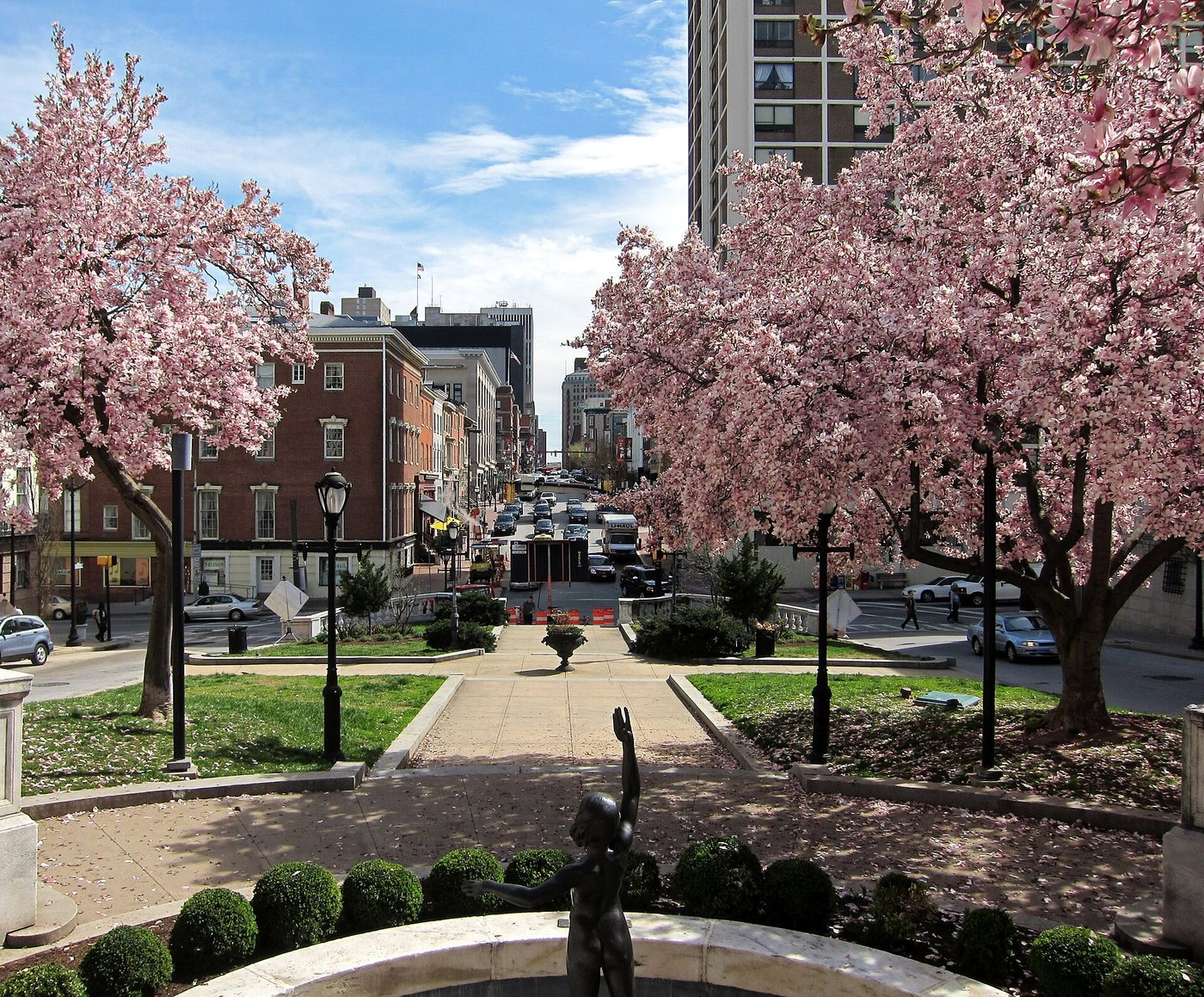
Baltimore’s Washington Monument provides a powerful orientation point, but Mount Vernon Place is larger than the column at its center. Four surrounding park squares create a sequence of greenery, paths, sculpture and building frontages. The contrast between a tall memorial and these smaller spaces is the key to understanding the ensemble.
A monument helped redirect urban development
The Mount Vernon Place Conservancy traces the project to citizens organizing in 1809 to honor George Washington. The chosen site lay on John Eager Howard’s Belvidere estate, beyond the dense city of that period. Building a major monument there contributed to the development of a new urban focus.
This history reverses a common assumption about landmarks. The monument was not simply inserted into a fully formed neighborhood as a finishing touch. It helped establish an address and a setting around which later buildings and civic activities could gather.
The surrounding squares give the column room to be seen from several directions. At the same time, their paths and planting divide the large composition into spaces that can be occupied at a much smaller scale. A person sitting with a book experiences a different aspect of the place from someone approaching along a long street view.
Four spaces, several ways to use them
Walk around the ensemble using the designated crossings, comparing the edges of each square. Changes in building frontage, shade and seating can make nearby spaces feel different even when they belong to the same overall plan.
The conservancy’s park information describes both everyday use and public programming, including concerts and seasonal events. These uses occupy the landscape temporarily. A performance audience, a lunch break and a quiet passage across a square each produce a different pattern without changing the monument itself.
The fountains and sculpture belong to the designed landscape. They can be examined without entering water features or treating commemorative objects as play equipment. The park’s ordinary rules help preserve a setting used by many people for different purposes.
Keep the neighborhood in the view
Allow time to look outward from the squares as well as inward toward the column. The surrounding cultural and residential buildings complete the experience of a civic place. Their doors, windows and street-level activity prevent the ensemble from functioning only as an isolated memorial.
A monument visit and a neighborhood walk can be combined, but check current arrangements before planning an interior visit or climb. The outdoor spaces already explain the central idea: a large commemorative object becomes part of urban life through the smaller, usable places around it.


.jpg)