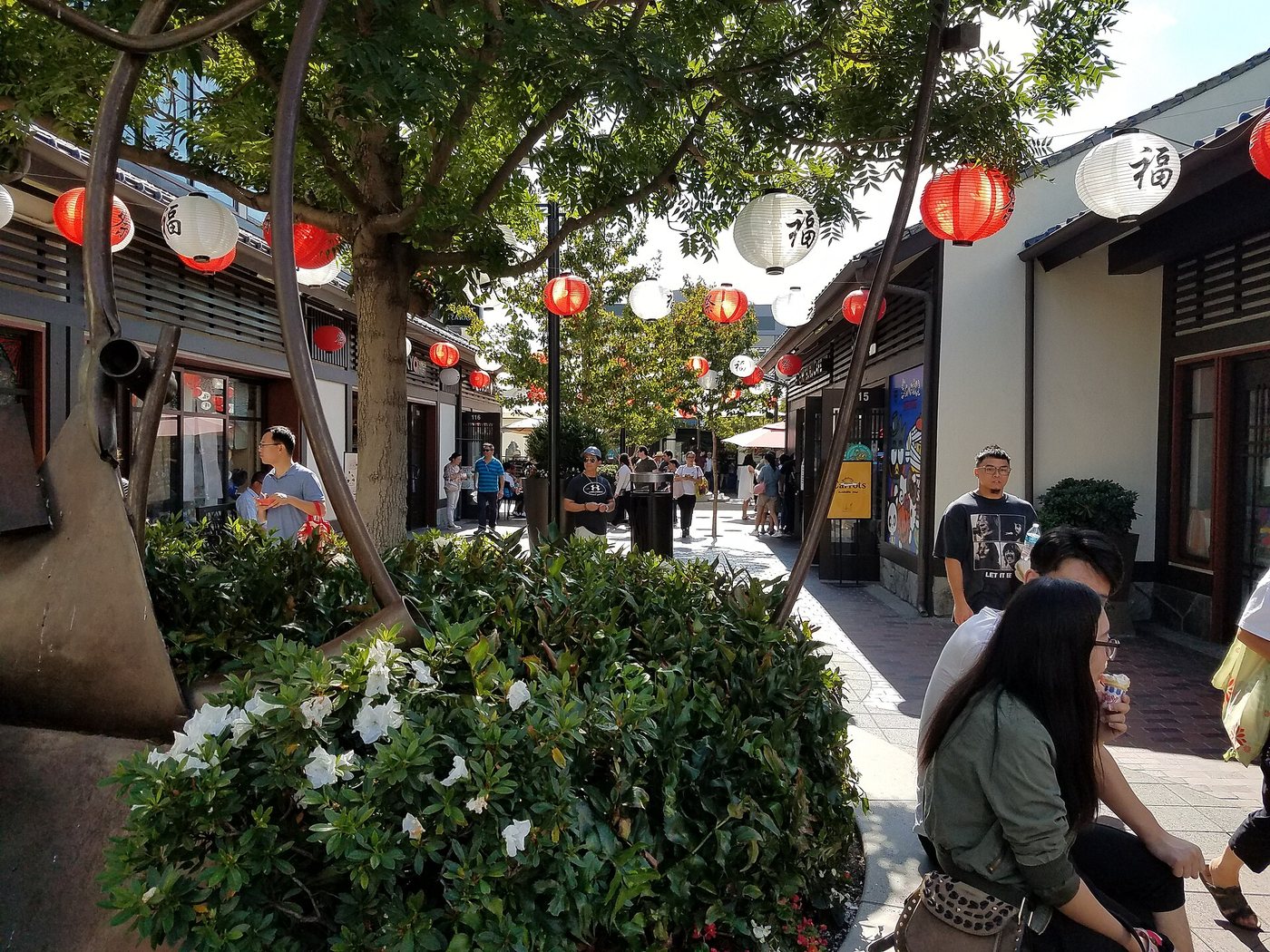
Little Tokyo is not simply a group of Japanese-themed shops in downtown Los Angeles. Its history includes immigration, institutions, wartime incarceration, postwar return and the loss of land to major redevelopment projects. Surviving buildings provide anchors for that history, but the spaces where buildings disappeared are also part of the account.
A neighborhood formed around work and institutions
Japanese businesses appeared in the area in the late nineteenth century. The National Park Service identifies Hamanosuke Shigeta’s restaurant on East First Street in 1885 as an early establishment. Lodging, services and shops supported workers whose employment extended beyond the neighborhood, including agricultural labor.
As households and institutions developed, Little Tokyo became more than a temporary stopping place. Religious buildings, associations and businesses helped sustain community life. The streets connected people with work and accommodation while also providing places to organize and gather.
The physical district reflected these overlapping functions. A commercial building could contain a shop below and rooms above. An institutional building might provide religious services alongside social support. Such uses are less easily captured in a single photograph than a decorative facade, but they explain why the neighborhood mattered.
Forced removal broke ordinary continuity
In 1942, the federal government forcibly removed people of Japanese ancestry from the West Coast and incarcerated them. Little Tokyo’s residents lost access to homes, businesses and institutions. The neighborhood’s wartime transformation was therefore not an ordinary change in commercial tenants; it resulted from state action against a racialized population.
The Union Church building was among the sites connected with the removal process. Buildings that had supported community life became associated with its disruption. That reversal is important to their interpretation, because the same walls can carry very different meanings at different moments.
Bronzeville was another community, not an empty interval
During the war, African Americans arriving for defense-related work and other opportunities established a substantial community in the area, which became known as Bronzeville. Housing shortages and racial discrimination shaped that settlement. The district did not stand vacant while Japanese Americans were confined elsewhere.
Recognizing Bronzeville does not diminish the history of forced removal. It makes the wartime city more understandable by showing how different discriminatory systems affected different communities. The same neighborhood could be a place of dispossession for one population and a constrained place of opportunity for another.
Return did not restore every lost space
Japanese Americans returned after the war and rebuilt community institutions and businesses, but the district continued to face pressure. Construction of the Parker Center police headquarters in the 1950s removed a substantial part of Little Tokyo’s commercial and residential area. Later development brought further changes to the neighborhood’s scale and boundaries.
This sequence makes a simple story of destruction followed by complete recovery inaccurate. Return occurred within a city that was still taking and reorganizing land. Community continuity depended on repeated adaptation and organizing, not on restoration of every prewar condition.
Historic buildings carry several phases
The former Hompa Hongwanji Buddhist Temple, completed in 1925, became the first home of the Japanese American National Museum in 1992. Its reuse connects a community religious institution with a later institution devoted to historical interpretation. The museum subsequently expanded into another building, adding another phase rather than erasing the earlier one.
Little Tokyo’s historic district recognizes surviving resources, but a district boundary cannot contain the whole social history. Former streets, demolished buildings and displaced households require documentary interpretation as well as preservation of what remains.
The neighborhood is most informative when approached through those successive pressures. Shops and cultural spaces are part of an active community, while the buildings around them record both persistence and loss. The history explains why maintaining institutions and places to live remains as significant as preserving architectural details.