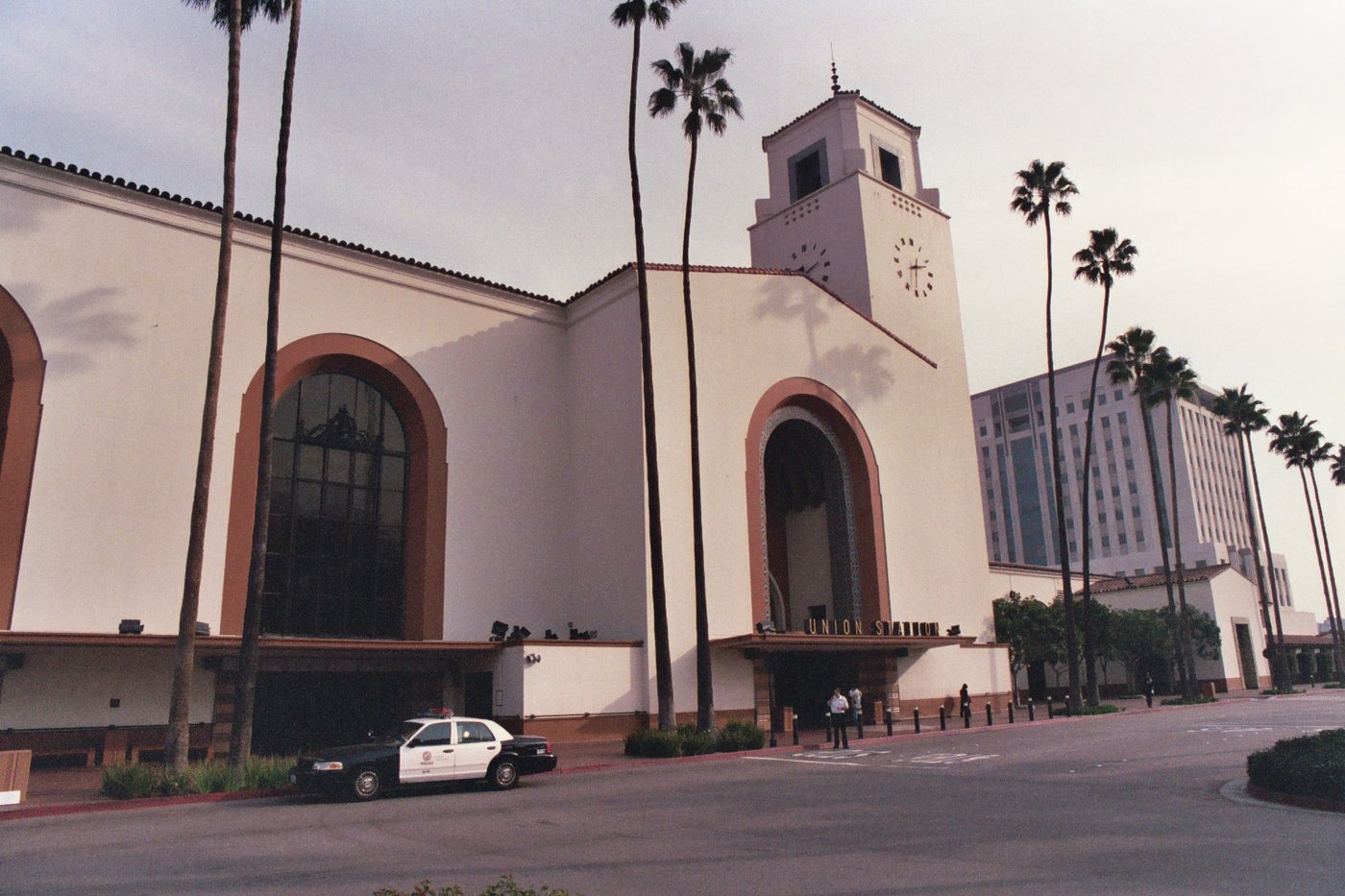
Los Angeles Union Station opened in 1939 as a shared passenger terminal for three major railroads. Its architecture combines a large waiting room, courtyards and a relatively low, spreading composition. The building is important as a transport landmark, but the site also holds the history of the Chinatown displaced to make way for it. Both stories are necessary to understand what the station represents.
Three railroads at one terminal
The station was commissioned in 1933 by Southern Pacific, Union Pacific and the Atchison, Topeka and Santa Fe Railway. Consolidating their terminals created a common point of arrival. John and Donald Parkinson designed a building that combined Spanish Colonial and Mission references with Art Deco elements.
That mixture gave the station a regional image without abandoning the scale required for major passenger traffic. Courtyards and lower exterior forms distinguish it from the tall urban terminals associated with some eastern cities. Inside, the waiting room provides a more concentrated monumental space.
Construction required displacement
The station occupies part of Los Angeles’s original Chinatown, a neighborhood of homes, businesses and associations with roots in the nineteenth century. Its removal was not incidental ground clearance on an unused site. People and institutions had to leave established places as the railway project proceeded.
Research by the Huntington-USC Institute on California and the West, the Chinese Historical Society of Southern California and other partners has reconstructed aspects of that earlier community through maps, photographs, oral histories and artifacts. This evidence makes it possible to relate the present station to streets and buildings no longer visible.
The history does not require choosing between appreciation of the architecture and recognition of its cost. A building can be architecturally significant while its construction also forms part of a story of racialized displacement. Holding those facts together gives the site a more complete meaning.
Wartime demand and later change
During the Second World War, the station handled intense troop movement. Its large spaces supported a scale of use very different from a quiet architectural visit. After the war, increasing reliance on cars and aviation changed passenger patterns, although the station continued to serve rail travel.
Later transit uses and cultural activities have added to its role. The original waiting spaces remain recognizable, but the station is not preserved solely as a monument to a vanished transport era. It continues to mediate between people, services and routes.
Read the rooms and the ground beneath them
The waiting room and courtyards reveal how the architects organized arrival, pause and onward movement. The history of Chinatown reveals what occupied the ground before that sequence existed. These are different kinds of evidence, and each corrects the limits of the other.
The station’s own historical interpretation has addressed this earlier community, including a temporary exhibition held in 2023–2024. That exhibition’s dates should not be confused with a permanent display. The underlying research remains valuable because it restores people and places to a site whose present architecture otherwise appears to tell a complete story on its own.