El Pueblo de Los Angeles is associated with the city’s founding in 1781, but the buildings around the plaza do not all date from that event. The historic area contains later houses, commercial structures, religious buildings and civic facilities, alongside twentieth-century preservation and interpretation. It is a layered district whose story includes several communities and changing ideas about how Los Angeles should present its past.
A founding date is not a construction date
The Spanish pueblo was established within a region with an existing Indigenous history. The colonial founding marks a new political and settlement framework, not the beginning of human life in the area. Keeping that distinction clear prevents the plaza’s interpretation from turning earlier communities into an empty prelude.
The surviving district developed through later decades under Spanish, Mexican and United States rule. Individual buildings have their own dates and uses. A house or church near the plaza may be associated with early Los Angeles without being an original structure from 1781.
Olvera Street was also a preservation project
Olvera Street’s marketplace opened in 1930 after a campaign associated with Christine Sterling. The restoration of the Avila Adobe helped anchor that effort. The street’s commercial presentation therefore belongs partly to the twentieth century, even when it draws on earlier Mexican and Californian histories.
This does not make the place historically meaningless. It means the marketplace should be understood both as a setting for cultural activity and as a particular interpretation of the past. Preservation selected buildings, emphasized certain stories and created a visitor destination within a changing downtown.
Other buildings widen the account
The Plaza Firehouse, built in 1884, represents municipal services rather than domestic life or marketplace trade. Italian Hall, built in the early twentieth century, records another community’s institutional presence. Such buildings complicate the idea that the district has only one cultural or chronological identity.
The wider area also connects with Chinese American history and the transformation of nearby Chinatown. Museums and interpretation within El Pueblo offer ways to examine these overlapping histories without expecting one building to explain the entire district.
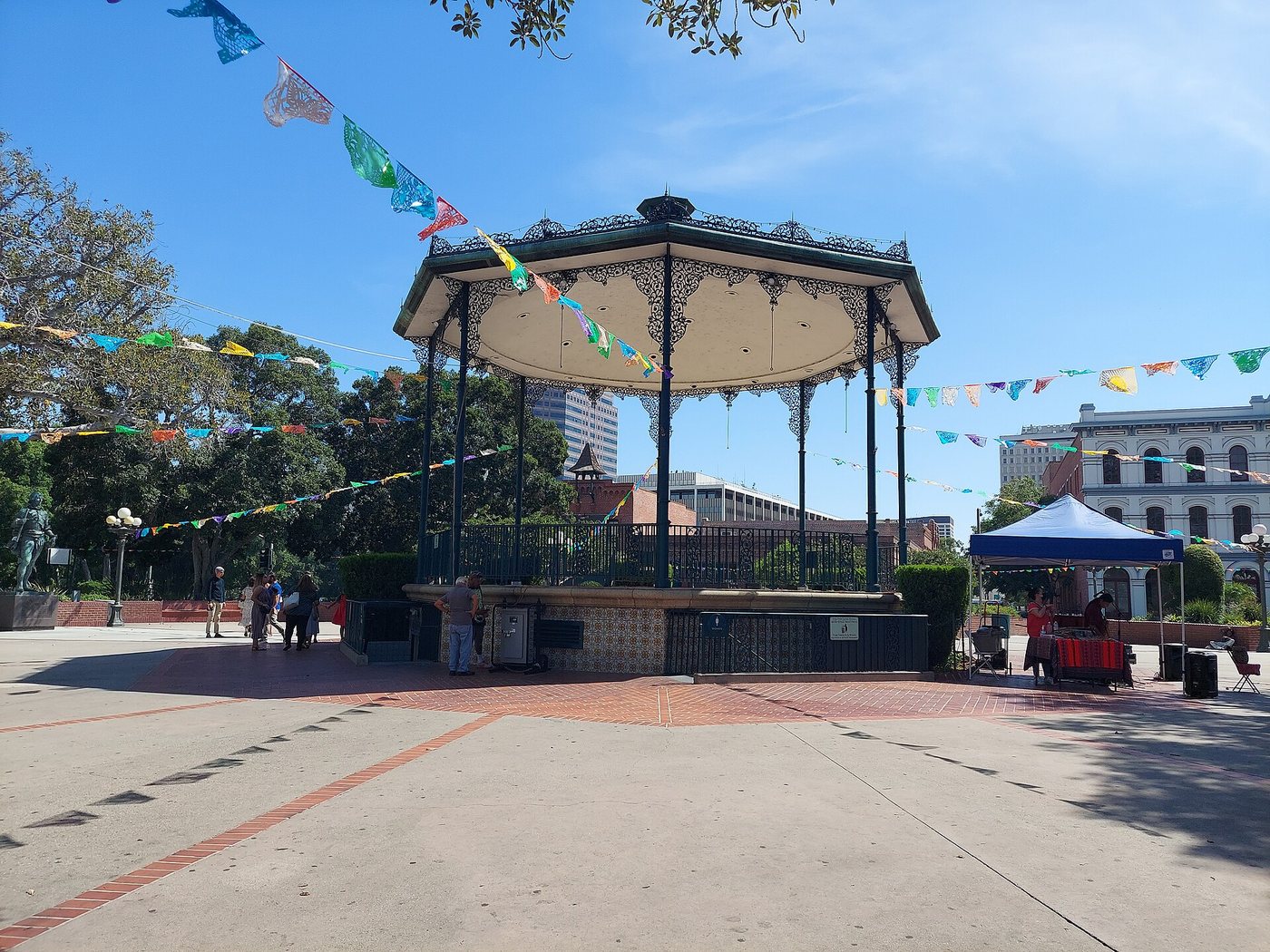
The plaza remains the spatial anchor: open ground around which different activities and buildings can be related. Its value lies in those relationships as much as in any one restored facade. Reading El Pueblo through dates, functions and communities produces a more accurate picture than treating the whole area as a reconstruction of a single founding day.