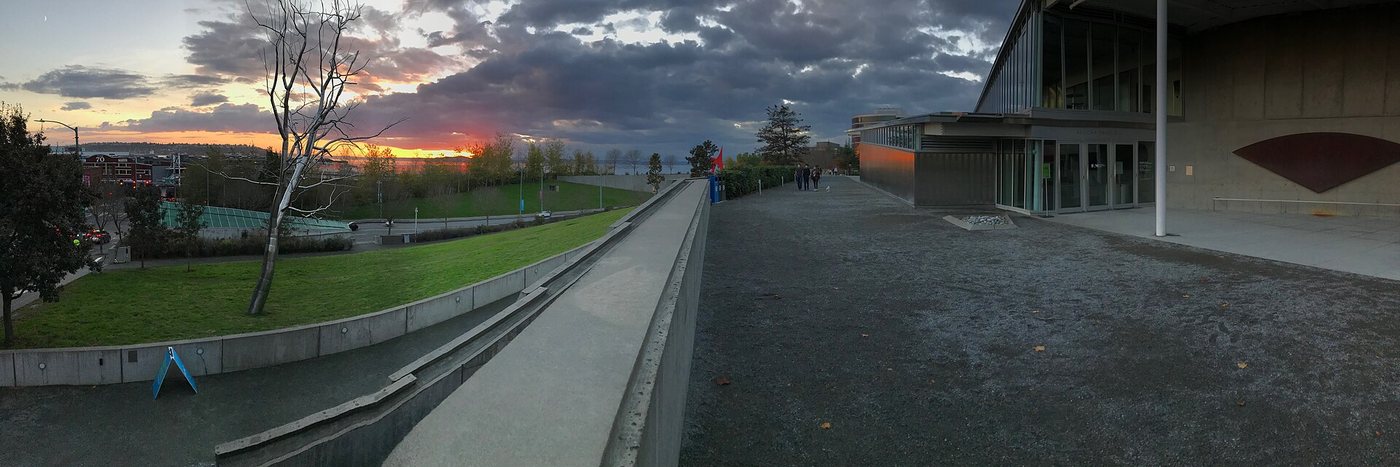
Olympic Sculpture Park opened in 2007 on a former industrial site near Seattle’s waterfront. Its design had to connect land divided by a road and railway while providing places for large works of art. The resulting landscape crosses those barriers rather than pretending they do not exist. Movement through the park is therefore part of both its engineering and its experience of sculpture.
A site assembled and repaired
Seattle Art Museum and the Trust for Public Land acquired the property in 1999. Industrial contamination required environmental work before the site could become a public park. The transformation involved changing the condition of the ground, not merely installing art on an available lawn.
Designers Marion Weiss and Michael Manfredi developed a route that links the city-facing upper ground with the water. Its folded sequence crosses existing infrastructure and joins portions of the site that would otherwise feel separate. The road and railway remain active elements in the landscape’s surroundings.
The route changes the view of each work
Sculptures occupy different positions along the descending route and open areas. Their placement affects whether they are seen against buildings, planting, sky or water. The same work can appear differently as a person approaches, passes and looks back.
Seattle Art Museum’s account of the installation process describes collaboration among designers, artists, curators and other staff. Siting was therefore part of the project’s artistic work, not an afterthought once the paths were complete. Alexander Calder’s The Eagle is one prominent example of a work whose scale participates in the larger landscape.
Art, landscape and infrastructure remain distinct
The park’s design creates continuity, but it does not make every part interchangeable. Some areas support movement, others offer space to stop, and individual artworks have their own conservation requirements. Public access to the landscape does not imply that every sculpture is intended to be climbed or handled.
The project also provides a useful alternative to the idea that a waterfront park must begin with a clear, uninterrupted strip of land. Here, connection was constructed over obstacles and through a contaminated former industrial site. The sculptures occupy that new connection, while the route itself explains how difficult urban ground can become usable public space.