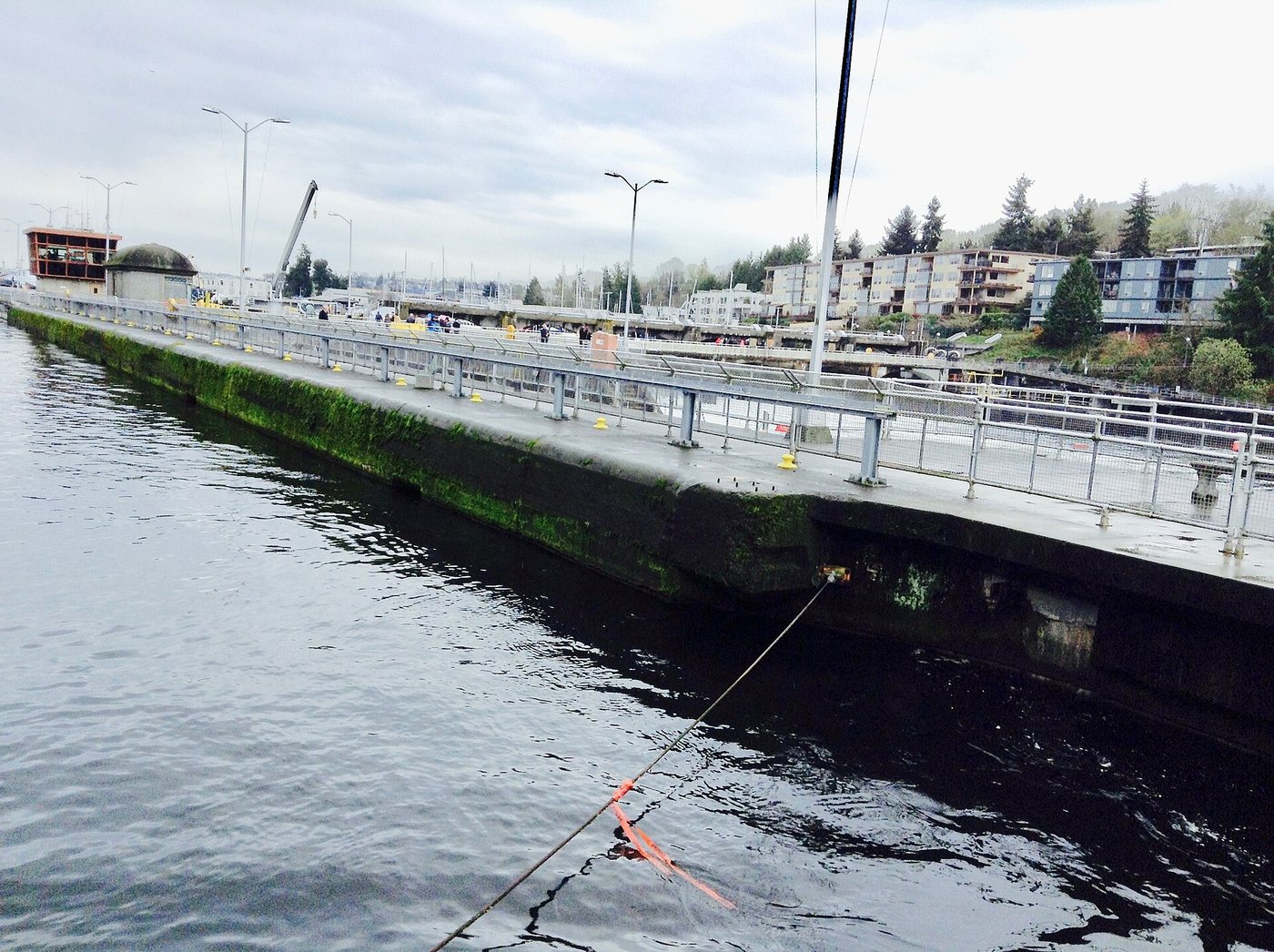
The Hiram M. Chittenden Locks, commonly called the Ballard Locks, connect the Lake Washington Ship Canal with Puget Sound. Their purpose is not simply to open and close a gateway for boats. They maintain different water levels, limit saltwater intrusion and provide routes for migrating fish. Watching the site makes sense when those separate functions are understood together.
Boats cross a difference in level
The inland freshwater system stands above the tidal water of Puget Sound. A lock chamber allows a vessel to move between them without draining the higher water directly into the lower. Gates close around the boat, water enters or leaves the chamber, and the boat rises or falls with the surface before the opposite gate opens.
The change in level varies with tides, so the movement is not always identical. What remains constant is the principle: the boat floats throughout the process while the chamber’s water level is adjusted. No mechanical platform has to lift the hull.
The locks began operating in the period around 1916–1917, with formal dedication in 1917. They belong to the larger ship-canal project that connected Seattle’s inland waters with the sea. The canal and locks together changed the geography of navigation and water management.
Water quality is another engineering problem
Opening a route between salt and fresh water creates more than a height difference. Saltwater can move into the inland system, so the project includes measures to limit that intrusion. Maintaining the freshwater environment is part of operation, alongside moving vessels and controlling lake levels.
This helps explain why the locks cannot be understood as a simple pair of doors. Their gates, chambers, drainage and operating procedures form a system. A visible boat passage is only one episode within continuous management of water.
Fish need another route
Migrating salmon and other fish must pass between the sea and the inland watershed. The fish ladder provides a sequence of smaller changes in water level, allowing upstream movement without negotiating the full difference at once. The Army Corps of Engineers describes twenty-one steps, or weirs, in the present ladder.
The ladder was substantially improved in 1976, and further research and modifications have continued. Fish passage is not a problem solved permanently by the existence of one structure. Scientists and resource managers study migration behavior, survival and conditions through the wider system.
A viewing room can make fish movement visible when fish are present, but seasonal timing and actual numbers vary. Seeing no fish during a brief visit does not mean the ladder has no function. Conversely, observing fish at the locks does not establish that all will reach their spawning grounds.
One site, several kinds of movement
The locks bring together boats, tides, freshwater flows and animal migration, each with different requirements. Public paths and viewing areas allow these systems to be observed while operations continue. Barriers and temporary restrictions belong to a working facility.
The most revealing comparison is between a vessel waiting for its chamber to change level and fish moving through a stepped passage. Both need to cross the same boundary, but the mechanisms are different. The site’s importance lies in coordinating those movements while maintaining the inland water system.