
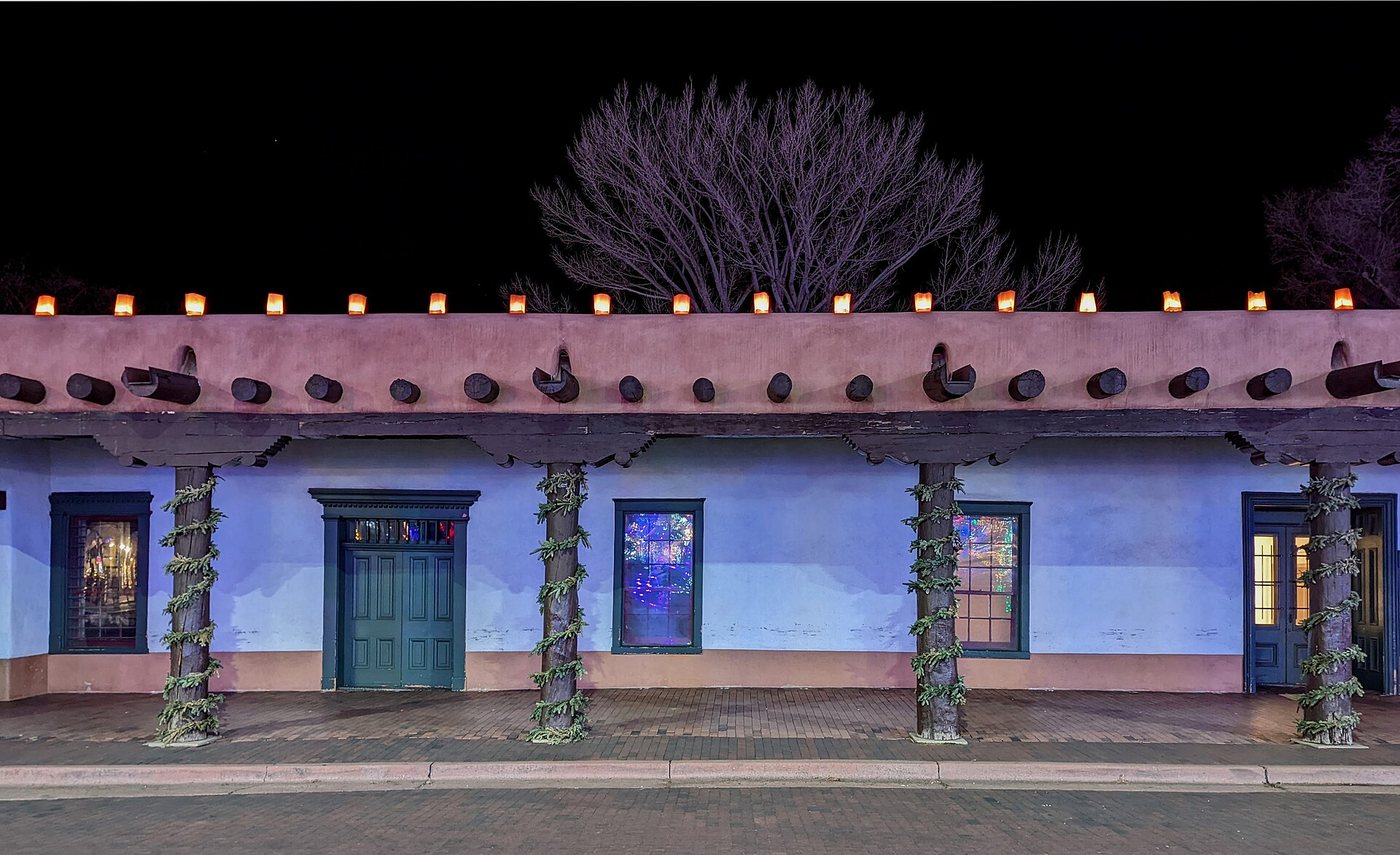
The Palace of the Governors forms a horizontal edge to Santa Fe Plaza. Its adobe walls and sheltered frontage encourage a slower kind of looking than a tower or dome would. To understand the building, follow changes in use and construction as well as the continuity of its position beside the city’s central public space.
Government and resistance
The palace began in the early seventeenth century as part of the Spanish colonial government center. It stood at the northern end of the long Camino Real connection with Mexico. Residence, administration and defense were intertwined in a building whose purpose extended beyond the modern meaning of a ceremonial palace.
The Pueblo Revolt of 1680 disrupted that government. After Spanish occupants were expelled, Pueblo people occupied and altered the complex. Spanish reconquest brought another transformation. Later Mexican and United States administrations used the building, so a list of successive flags tells only part of the story: each change also affected the authority exercised inside it.
The facade has a history of its own
The portico familiar today is not an untouched survival of 1610. The National Park Service describes a Victorian-era frontage installed in 1878 and changes in 1913 that replaced it with a Spanish Colonial Revival treatment. The building ceased serving as the governor’s residence in 1908.
These facts are worth holding in mind while examining the long roofline and repeated supports. Restoration often aims to make a building communicate a selected period more clearly. It can preserve important material while also removing later features. The resulting appearance is therefore evidence of both the original building and the preservation choices made about it.
Look for the difference between an overall visual effect and a construction claim. A facade can feel coherent without every part being contemporary. Adobe, timber, plaster and replacement finishes each have their own maintenance histories, which are not always legible from a photograph.
A twentieth-century political address
The building also played a role in the campaign for women’s suffrage. National Park Service interpretation identifies it as a headquarters for the Congressional Union in 1915 and connects that work with Nina Otero-Warren’s organizing in Spanish and English. This episode complicates the idea that the palace’s meaningful history ended when governors moved out.
A former seat of government could become a place for people demanding changes to political participation. Including that later use makes the building a more useful historical subject than describing it only as a relic of Spanish rule.
Pair the exterior with interpretation
Start outside with the palace’s relationship to the plaza: a long protected boundary against a comparatively open center. Then use museum interpretation to distinguish surviving fabric, reconstructed elements and successive occupants. Those are separate kinds of evidence.
The exterior alone cannot explain all the violence, negotiation and administrative work associated with the building. Its value lies partly in prompting those questions. When planning an interior visit, use the museum’s current arrangements rather than assuming that every doorway along the frontage is an entrance to the same exhibition.

.jpg)

.jpg)