
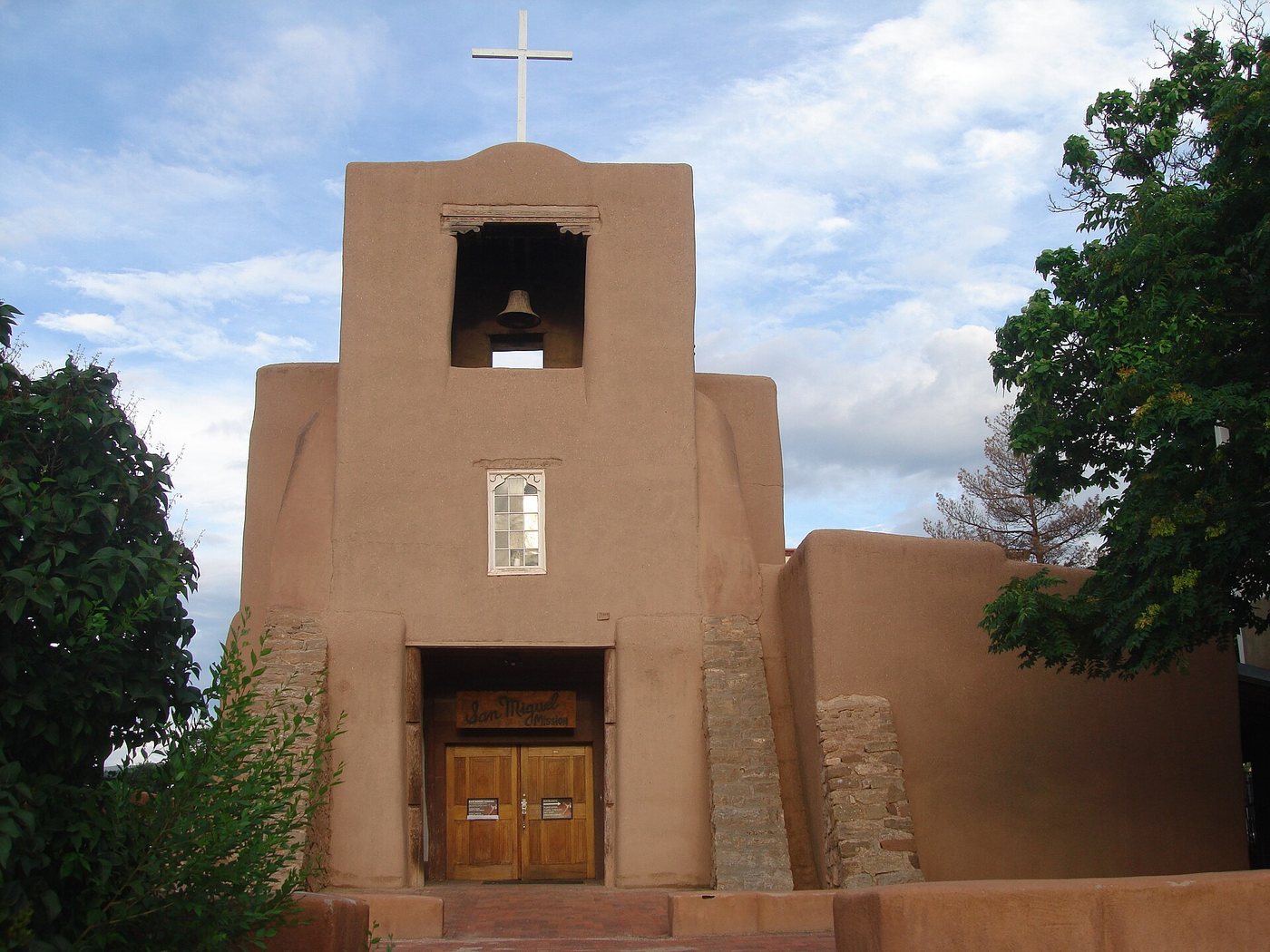
San Miguel Chapel is often approached through a claim about being the oldest church. A more revealing question is how an adobe religious building survives for centuries. Its history includes damaged roofs, replaced towers, repaired walls and changing finishes. Those interventions are part of the chapel’s history, not evidence that its age is meaningless.
A chapel in Barrio de Analco
The chapel’s own history places its origins around 1610 and associates its construction with Tlaxcalan people in the Barrio de Analco. It also acknowledges the earlier Tewa setting. As with many early buildings, precise claims about the first construction must be separated from the age of visible components.
The roof burned during the Pueblo Revolt of 1680. Rebuilding in 1710 restored the chapel to use, while the altar screen dates to a later eighteenth-century campaign. A visitor standing inside is therefore looking at contributions from different periods rather than a complete room preserved from a single founding year.
Repair changes the appearance
A storm damaged the tower in 1872, and later nineteenth-century work altered the building’s support and exterior form. More recent conservation in 2010–2014 removed cement-based material and repaired adobe. This is a particularly useful reminder that maintenance choices can affect the survival of an earthen building.
An adobe wall is not an inert object that can simply be left alone. Its protective surfaces, drainage and compatible repairs matter. The chapel’s rounded edges and patched surfaces should be understood within that history of care, rather than judged against the expectation that an old building must be untouched to be significant.
Separate the objects’ stories
The chapel’s bell is associated with several legends, but its own historical account notes uncertainty about the bell’s origins. Repeating a dramatic story as established fact would obscure that uncertainty. The altar screen, bell and walls each deserve their own chronology.
Inside, the relatively compact room makes the relationship between entrance, worship space and altar especially clear. The decorated focal point does not require a huge interior to organize attention. If visiting during an opening for the public, allow that religious purpose to determine your behavior. Use the chapel’s current visitor information for access, and keep the distinction between documented history and attractive folklore in any notes or photographs you share.
.jpg)


