Pike Place Market began in 1907 as a place where farmers could sell directly to customers. It developed into a dense collection of buildings on Seattle’s hillside, with food businesses, crafts, housing and services sharing the district. Its survival was not inevitable. A major preservation campaign and a 1971 public vote changed the future of the market and helped establish the framework under which it continues to operate.
Direct selling shaped the beginning
The early market connected regional farmers with urban customers at a time of concern about food prices and intermediaries. Opening day in August 1907 established a public trading place rather than a single privately curated restaurant collection.
As the market grew, buildings and routes adapted to a sloping site. The result is not one simple hall. Passages, stairs and levels connect businesses that may be close on a map but separated vertically. This spatial complexity reflects development over time rather than a single unified shopping-center plan.
The familiar image is only an entrance
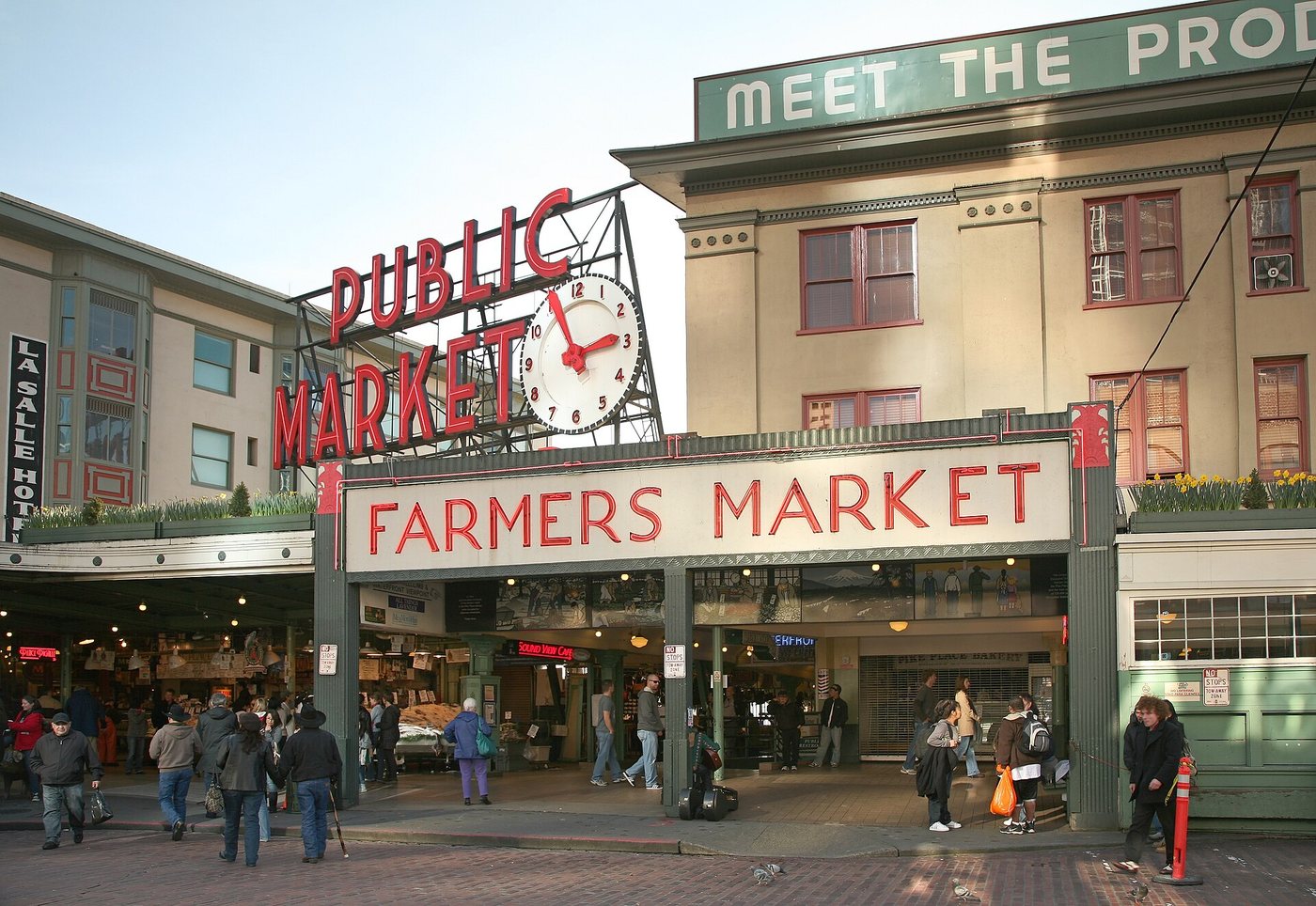
The public-market sign and clock provide a recognizable symbol, but much of the district lies beyond that view. Food stalls and produce stands coexist with other shops and uses. The lower levels and side passages reveal a larger physical system than the most photographed street frontage suggests.
Different businesses also operate on different rhythms. A farmer’s day stall, a permanent shop and a restaurant do not necessarily share identical hours or space requirements. The market’s collective identity depends on those distinct operations rather than on a single schedule imposed across every doorway.
Preservation was a political choice
Urban-renewal proposals threatened to replace much of the district with a different development. Some proposed uses sounded similar to those already present—commerce, housing and pedestrian space—but the physical scale and displacement consequences would have been very different.
Preservation advocates organized for years before voters approved an initiative in November 1971. The measure established a historic district and a process for reviewing changes. It protected more than a sign or a handful of picturesque stalls; it recognized the value of an existing urban place.
In 1973, the city created the Pike Place Market Preservation and Development Authority. Its responsibilities included managing and rehabilitating property while sustaining market activity. The institution made preservation an ongoing administrative task rather than a one-time declaration that the buildings were saved.
A neighborhood as well as a destination
Housing and social services are part of the market’s wider community. The Market Foundation’s history emphasizes support for people who live and work in the district, including affordable housing. These functions may be less visible to a visitor focused on food, but they are central to the place’s continuity.
This broader role changes how the market should be understood. Its buildings are not merely containers for tourist spending. They support livelihoods, homes and networks of assistance. Protecting the district’s character therefore involves more than retaining an architectural appearance.
Pike Place’s history offers a specific lesson about urban preservation: a place can be maintained through change when its working relationships are treated as part of what matters. The ongoing market is neither an untouched remnant of 1907 nor a wholly new attraction behind an old facade. It is the result of repeated decisions about buildings, businesses and community.