
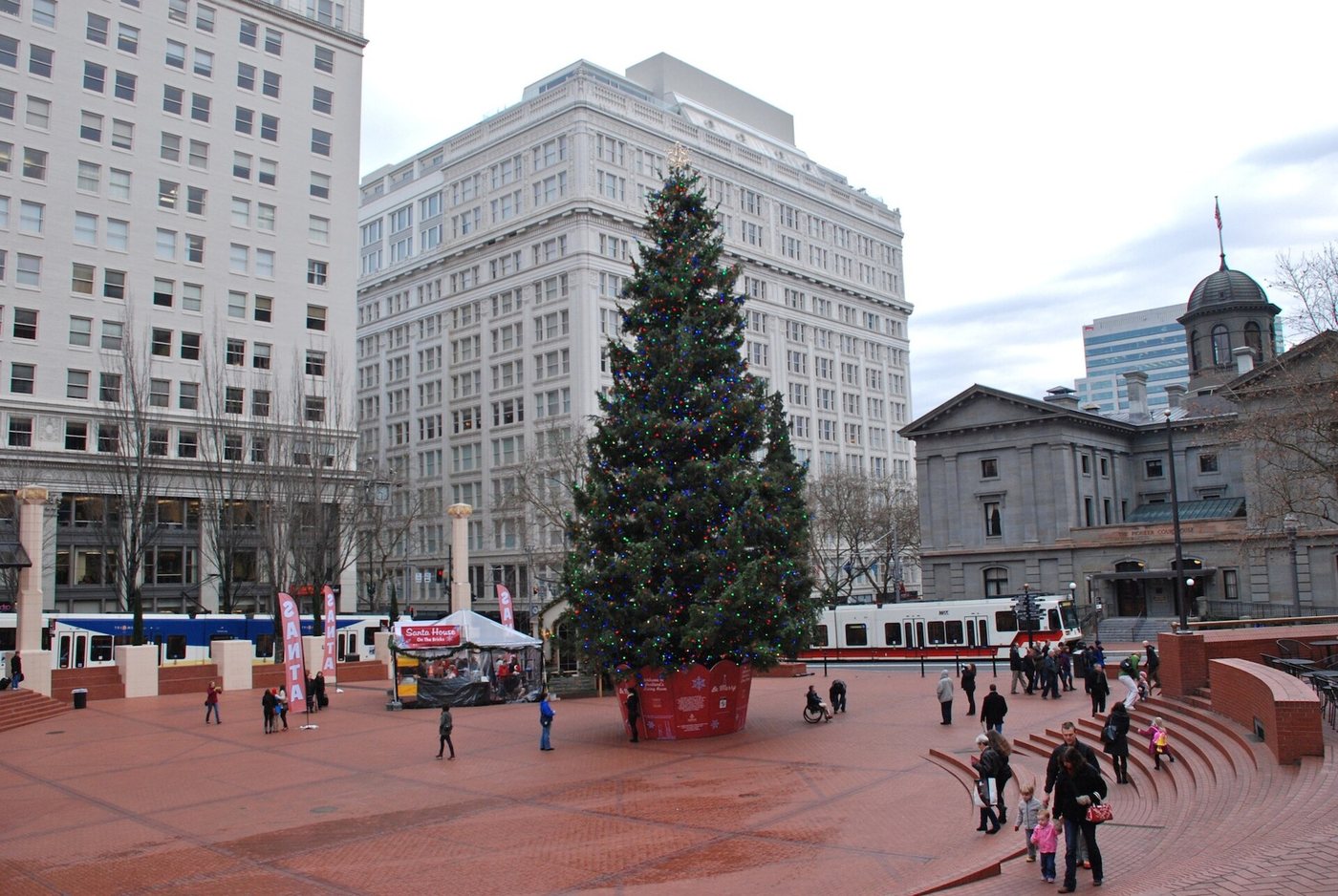
Pioneer Courthouse Square opened in 1984 on a downtown Portland block previously occupied by a hotel and then parking. Its brick terraces and central open area provide a place for gathering within the street grid. The square’s history is a specific example of a city choosing public open space instead of expanding a parking structure.
A block with successive uses
The Portland Hotel occupied the site from 1890 until 1951. After its demolition, the block became parking associated with Meier & Frank. A later proposal for a much larger parking garage met opposition and helped stimulate a broader discussion about downtown planning.
The city acquired the block in 1979. A design competition followed, and a team led by Portland architect Will Martin was selected. The resulting square was therefore the product of planning, negotiation and design review rather than a spontaneous gap in development.
Brickwork and terraces support gathering
The square’s stepped areas act as seating and define spaces of different sizes. They allow people to watch an event or simply occupy an edge while others cross the open ground. Columns, a fountain and other features give the space recognizable points without filling every part of it.
Engraved bricks also record a fundraising campaign. Friends of Pioneer Courthouse Square raised substantial support by selling personalized bricks to help complete the project. The paving thus carries evidence of public participation as well as performing its ordinary role as a walking surface.
A public place within a transport network
The square is integrated with downtown transit and stands across from the historic courthouse that gives it its name. The courthouse and square are distinct places, with different histories and functions. The open space takes its identity partly from that relationship without being merely the courthouse’s forecourt.
Events change the square’s atmosphere, but the terraces and routes also serve daily use between programmed occasions. A public square needs to work when no large audience is present. Pioneer Courthouse Square’s lasting significance lies in the conversion of a central block into ground that people can enter, cross and occupy without a commercial transaction.

.jpg)

.jpg)