
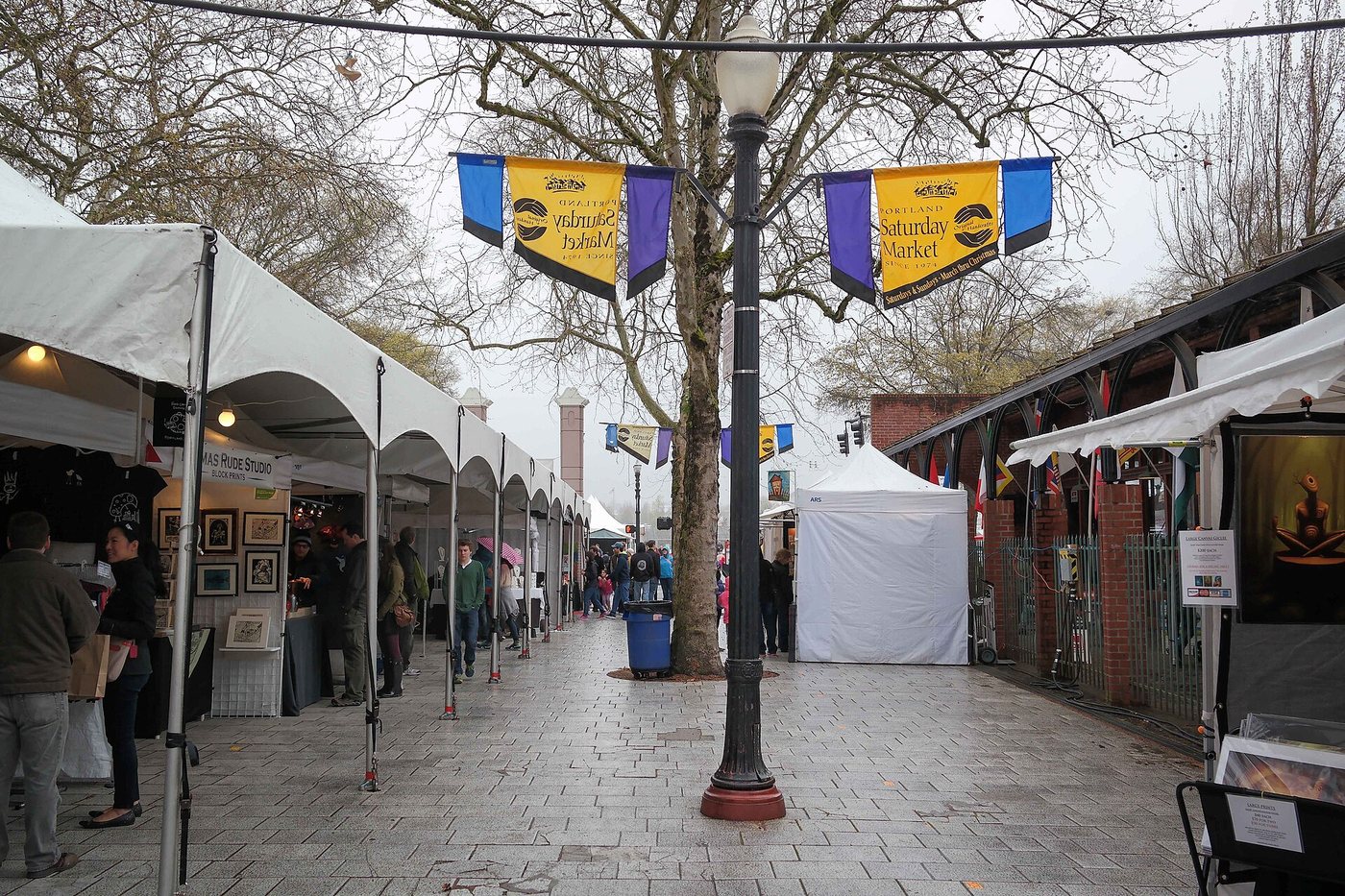
Portland Saturday Market is an outdoor arts-and-crafts market, not simply a farmers market held on a weekend. Founded in 1974, it developed around the idea that makers should have a place to sell directly to customers. Its history combines creative work with the practical questions of governance, booth placement and finding a durable home in downtown Portland.
Two artists proposed a different outlet
Sheri Teasdale and Andrea Scharf developed the idea after selling at Eugene’s Saturday Market. They sought a comparable opportunity in Portland, where artists and craftspeople could reach customers without establishing separate shops. The organization was structured for the benefit of its members, who would retain the proceeds from their own sales while sharing responsibility for the market.
This beginning distinguishes the market from a conventional collection of leased retail units. Its purpose was to create an economic outlet for people making things, with member participation built into the organization.
A temporary layout became an organized market
The first location was a parking lot associated with the Naito family. Early vendors arranged themselves with relatively little formal structure. As participation grew, rules about arrival and a marked booth plan became necessary to manage competing needs.
That ordinary operational history explains much about how markets function. A successful gathering requires clear aisles, predictable spaces and a way to prevent one stall from blocking another. The appearance of informality depends on organization behind it.
The market moved toward the waterfront
The market relocated beneath the Burnside Bridge in 1976 and later moved into its waterfront home in 2009. These changes connected its growth with the redevelopment of Old Town and the public river edge. The location changed, but direct contact between maker and customer remained central.
A craft market offers an opportunity to ask how an object was made, what material it uses and how it should be cared for. Those conversations are more specific than treating every stall as an interchangeable souvenir shop.
The operating calendar is seasonal and should be established from the market itself. The historical point is independent of a particular Saturday’s lineup: Portland created a shared commercial setting in which individual makers could reach an audience while remaining part of a collective organization.


.jpg)
