
Portland’s Old Town Chinatown is often described as a single historic neighborhood, but several kinds of history overlap within it. Older commercial architecture, Chinese community institutions and the history of Japantown occupy related yet distinct geographies. The formal Skidmore–Old Town and New Chinatown/Japantown historic districts also have different boundaries. Understanding those distinctions makes the neighborhood easier to read.
A port and railway setting
The area developed within Portland’s commercial and transport center. Buildings served trade, lodging and businesses associated with a growing port city. Their significance is therefore not limited to decorative style; they also record the practical relationship between waterfront commerce and nearby streets.
Chinese residents and businesses formed communities under conditions of discrimination and restrictive immigration policy. Chinatown provided economic and social connections that extended beyond the people living within a few blocks. Its institutions served a wider regional population as well as immediate neighbors.
Chinatown and Japantown have related but different histories
The New Chinatown/Japantown Historic District recognizes buildings associated with both communities. Its official period of significance, 1880–1943, encompasses several decades of change rather than one architectural moment. The district was listed on the National Register in 1989.
Japanese American households and businesses suffered a severe rupture in 1942, when residents were forced from their homes and confined first at the Portland Assembly Center and then at incarceration camps. That event changed the neighborhood through government action, not through an ordinary commercial transition.
Chinese exclusion and Japanese American incarceration were different policies with different histories. They should not be merged into a vague account of hardship. Each shaped who could arrive, form households, own or operate businesses and remain in the city.
Historic boundaries do not define a whole community
The New Chinatown/Japantown district overlaps part of the Skidmore–Old Town district, whose significance includes earlier commercial architecture. A building can therefore participate in more than one historical account. Formal boundaries help administer preservation, but they cannot contain every social network associated with the neighborhood.
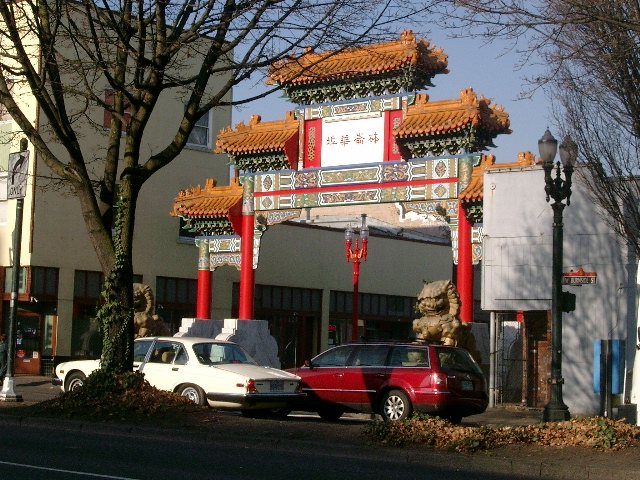
The Chinatown gateway is another example of different dates coexisting. It is a later commemorative feature, not evidence that every adjacent building was originally constructed with a visibly Chinese architectural identity. Cultural significance can reside in use, ownership and association even when a facade resembles other commercial buildings of its period.
Preservation involves inhabited buildings
City planning documents have addressed historic rehabilitation alongside housing, services and economic activity. These concerns are connected: a preserved building still needs a viable use, and a neighborhood’s continuity depends on more than exterior appearance.
The district should therefore be approached through documented histories and the institutions that interpret them, rather than expectations of a uniformly themed visitor quarter. Its value lies in the overlapping evidence of commerce, migration, exclusion and community life. Some of that evidence is visible in buildings; other parts require records and stories to explain what the streets no longer show.

.jpg)
