
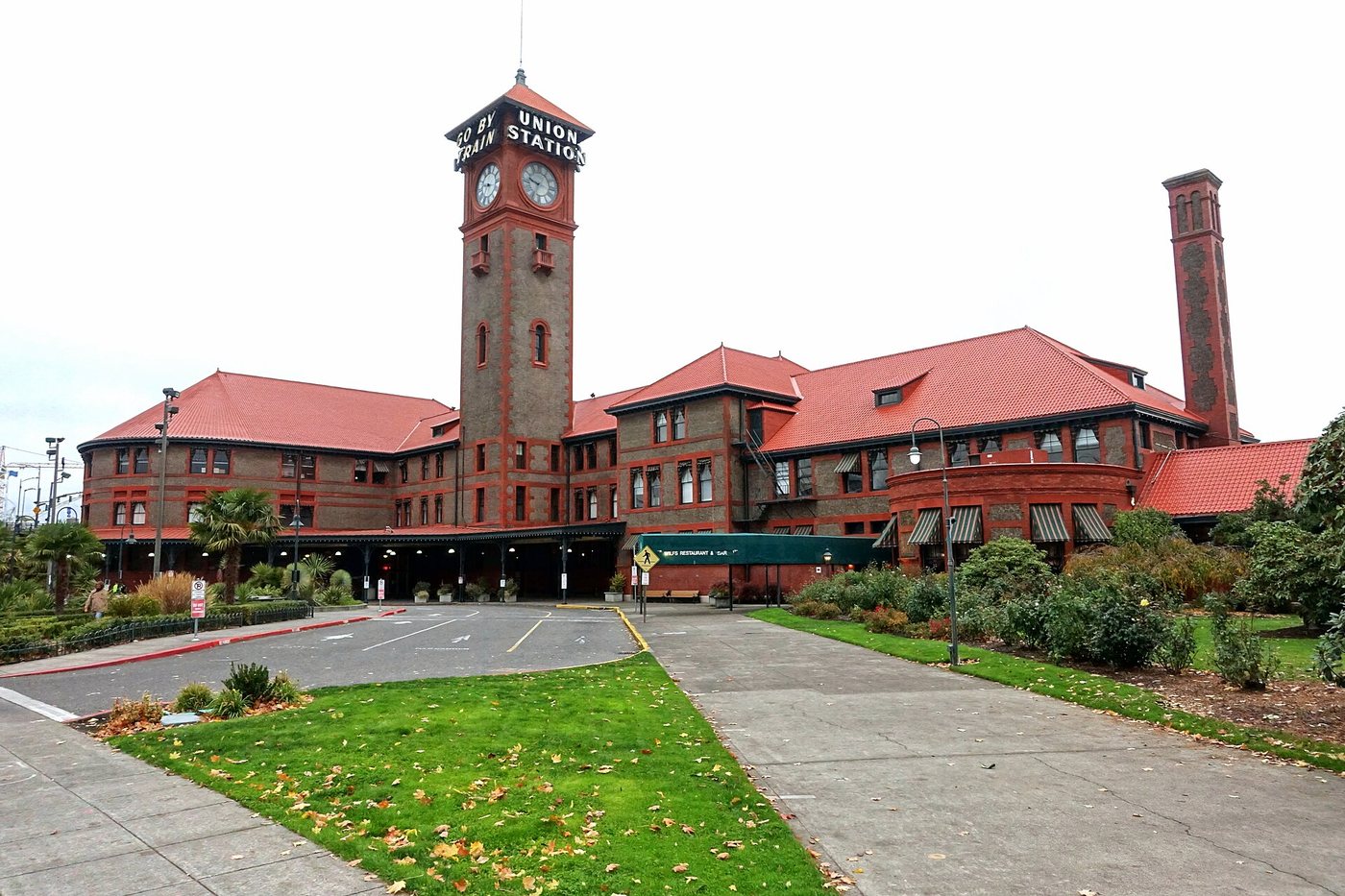
Portland Union Station opened in 1896 and remains a working passenger station. Its clock tower provides a recognizable marker, while the lower building accommodates the more ordinary processes of waiting, ticketing and reaching trains. The station’s appearance combines original construction with major later alterations, so it should not be read as a completely unchanged nineteenth-century interior.
A tower marks the railway address
The tower rises above a building of brick and terra-cotta detail. Its clock gives the station a visible relationship with time, an essential concern in railway travel. The contrast between a tall marker and a long, lower passenger building allows it to work at both city and platform scales.
The neon signs encouraging people to travel by train were installed in 1948. They are now part of the station’s familiar image, but they belong to a later period than the tower itself. Their message also reveals that railway travel needed promotion in a changing transport market.
The waiting hall was substantially revised
Between 1927 and 1930, the interior underwent a major redesign. Columns and a mezzanine were removed to open the waiting hall, and marble finishes were added. Dormers brought additional daylight into the building.
These changes altered how the station was experienced without ending its original use. A passenger hall needs to accommodate crowds, luggage and clear routes, so revising the interior can be part of keeping a historic station functional. The result contains several periods of railway design within one building.
Continued use gives preservation a purpose
Public acquisition in the 1980s was followed by rehabilitation, including work on decorative ceilings and the roof. The surrounding former rail-yard land also changed, introducing other urban uses near the station.
The building’s value as a landmark is strengthened by the fact that people still arrive and depart here. An architectural visit should therefore respect the needs of passengers and staff. The clock tower can be appreciated from outside, while interior access follows the operation of a transport facility.
Union Station illustrates a durable form of adaptation: its rooms and setting have changed, but the central act of connecting the city with passenger rail remains. The tower and signs are symbols of that role, while the waiting room makes it tangible at the scale of a journey.

.jpg)
.jpg)