
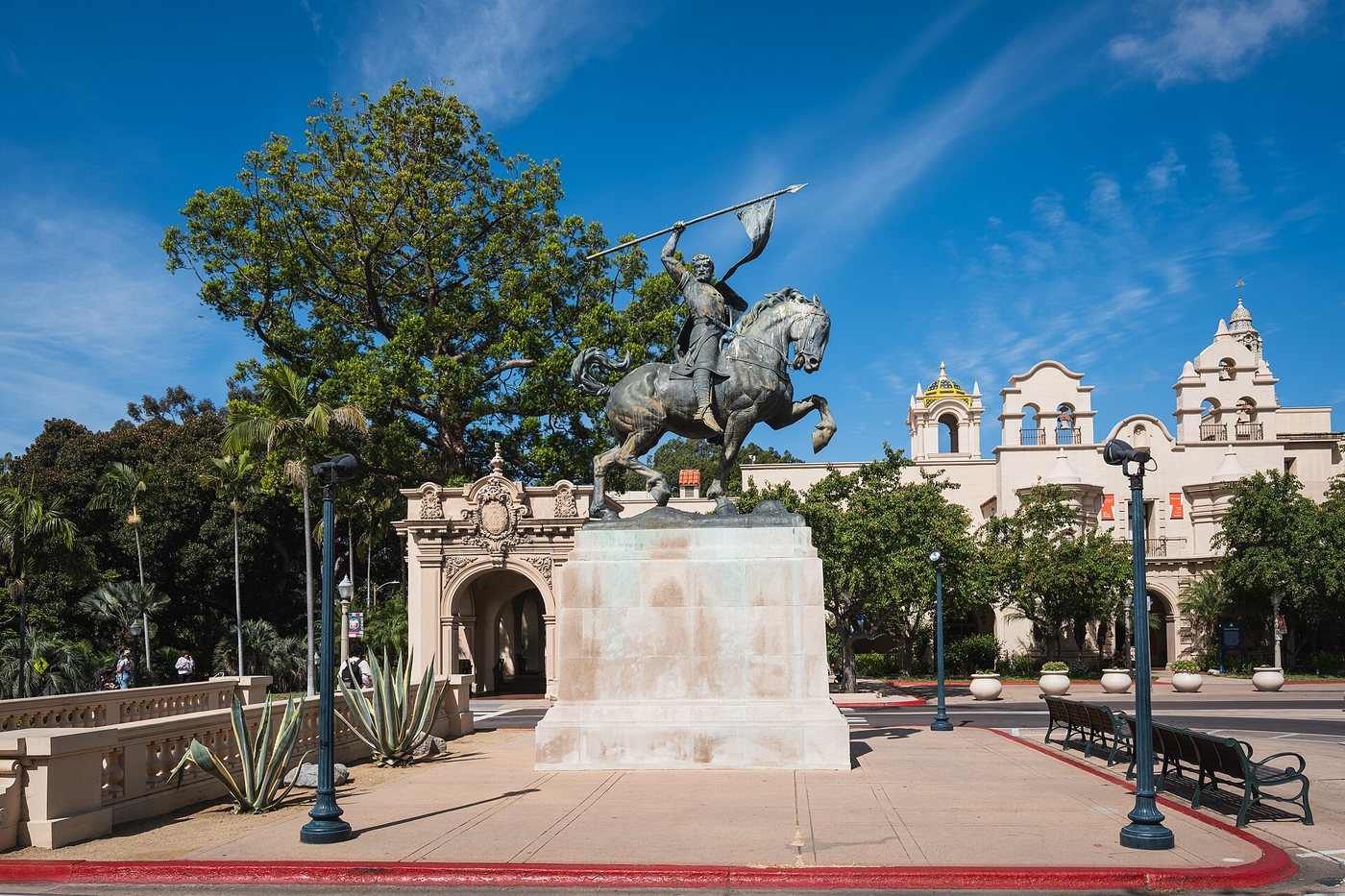
Plaza de Panama is a central open space within Balboa Park’s architectural core. Its significance lies partly in the views it creates between surrounding buildings, but the plaza also has a history of changing circulation and use. The space served the park’s expositions as pedestrian ground, later accommodated vehicles and parking, and has been the subject of repeated efforts to recover a stronger public-space role.
An exposition room outdoors
During the 1915–1916 and 1935–1936 expositions, the plaza accommodated pedestrians, bands, exhibits and gatherings. Buildings around its edges gave the open ground enclosure without making it an interior room. The relationship between facades and open space was part of the exposition experience.
The surrounding architecture does not all date from the same campaign. The San Diego Museum of Art opened in 1926 on the site of an earlier exposition building. Other institutions and structures arrived later, so the apparent unity of the setting contains several periods of construction.
Reconstruction preserved parts of the image
The House of Charm and House of Hospitality are important elements on the plaza’s southern side, but their present structures include substantial 1990s reconstruction. Their appearance maintains relationships established by earlier buildings while their material histories differ from an untouched original.
That distinction matters when interpreting Balboa Park. A coherent architectural setting can survive through replacement and reconstruction, but it should not be described as though every wall has remained unchanged since 1915. The plaza’s continuity is partly spatial and visual.
Parking changed what the center could do
Parking was introduced after the first exposition. Cars used ground that had served as an open gathering place, changing both circulation and the relationship between buildings. Debates about the plaza therefore concern more than traffic convenience; they concern what kind of public space the center of the park should provide.
The plaza can be read as a meeting point between routes and institutions. Its usefulness depends on being able to cross, pause and recognize the surrounding entrances. A visit focused on only one museum can miss that larger composition.
Understanding the plaza through its successive uses reveals how park design continues after major buildings are completed. The open ground between landmarks can change the experience of the entire ensemble, even when the skyline remains familiar.

,_Embarcadero_--_2012_--_5503.jpg)
