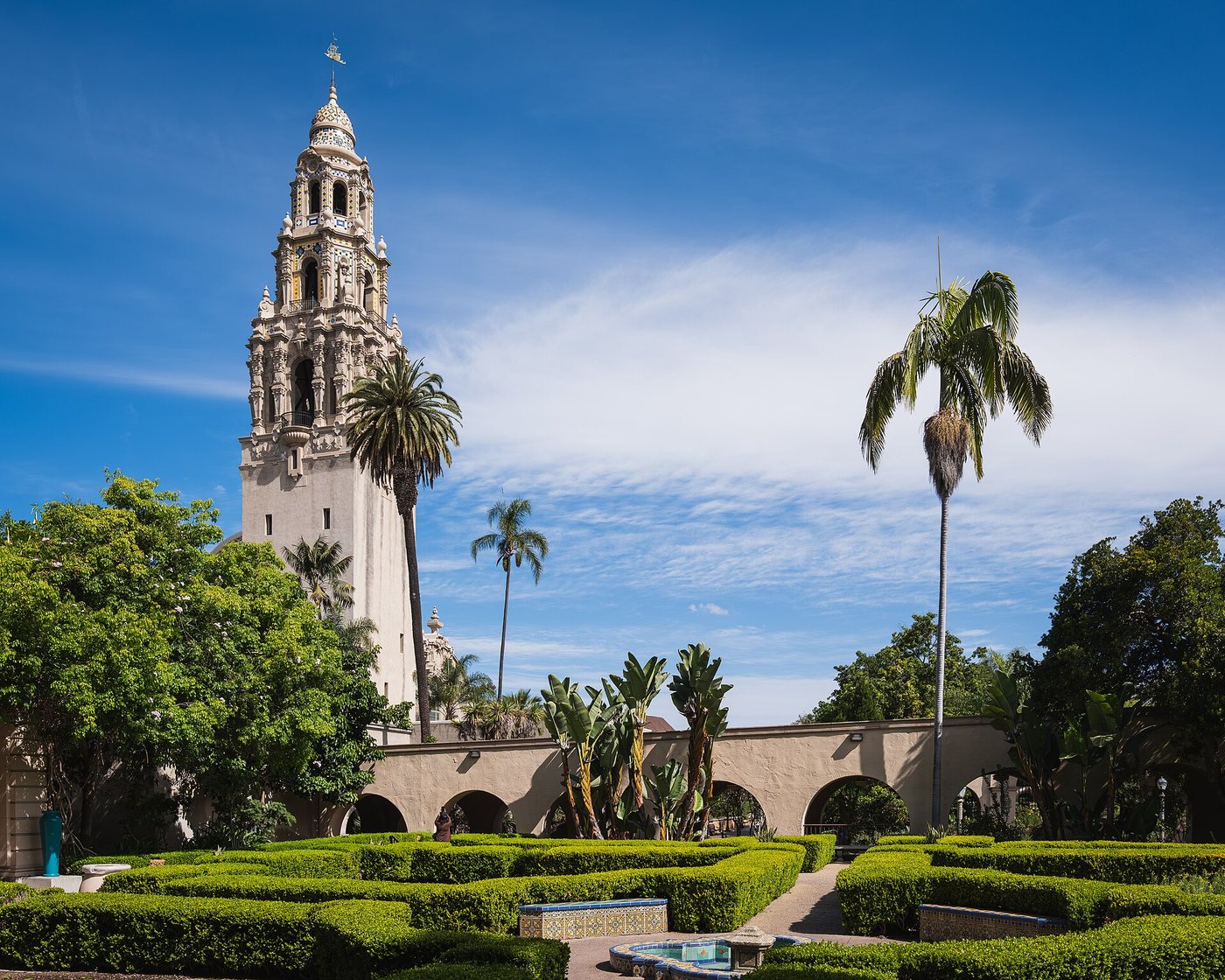
The California Tower rises above the Museum of Us in Balboa Park, marking the western end of the park’s central architectural area. Built for the 1915 Panama-California Exposition, it belongs to a composition designed by Bertram Goodhue. Its role is partly symbolic: the tower gives a dispersed landscape of gardens, plazas and exhibition buildings a conspicuous vertical reference.
An exposition created a lasting image
The 1915 exposition helped establish the architectural character now strongly associated with Balboa Park. Goodhue drew on Spanish architectural references, using elaborate ornament and a carefully composed relationship between tower, dome and lower buildings.
The tower’s design is therefore a twentieth-century interpretation of historical forms, not a surviving colonial structure. That distinction is fundamental. Its appearance helped shape later ideas about Southern California architecture, but it was created for a modern exposition with civic and promotional ambitions.
Height works with the surrounding buildings
The tower is most legible when seen with the lower museum building and dome. The different forms balance one another: the tower marks height, the dome creates a broader rounded volume, and the lower walls establish a connection with the ground.
From farther away, the tower serves as an orientation point within the park. At closer range, ornament and openings become more apparent. The building therefore operates at two scales, as a skyline marker and as part of a detailed architectural entrance sequence.
Looking up and looking out are different experiences
The tower can be understood from the surrounding public spaces without entering it. An ascent is a separate museum-managed activity, with access through the museum and its own arrangements. The route should not be assumed to function like an unrestricted park stairway.
The view from a tower reverses the normal relationship between landmark and landscape. From below, the tower helps locate the museum; from above, the park’s paths, buildings and surrounding city become the subject. That change of perspective explains why towers often acquire a visitor role beyond their original architectural purpose.
The California Tower’s significance remains tied to the exposition ensemble. Its lasting presence records how a temporary event could establish an architectural identity that continued long after the fair itself had ended.