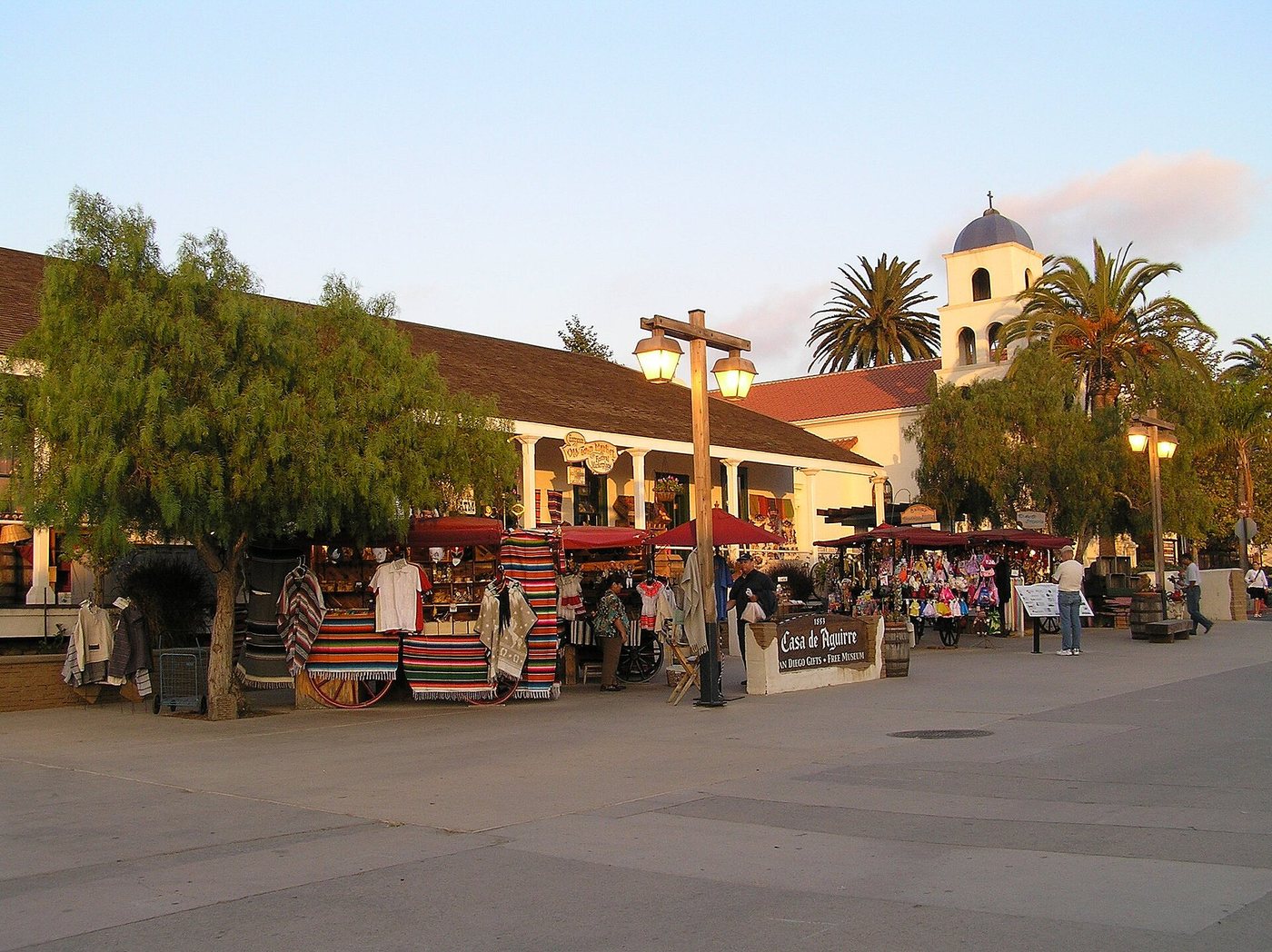
Old Town San Diego State Historic Park brings together buildings and interpretation associated with the community that developed below Presidio Hill. Its focus includes the Mexican and early United States periods, but the place also has a much longer Kumeyaay history. Some structures survive from the nineteenth century; others are reconstructions or heavily restored buildings. Recognizing those differences makes the park more informative than treating it as a single preserved townscape.
The land had a history before colonization
Kumeyaay communities lived along the San Diego River and used a wider region extending between coast and mountains. The village of Kosa’aay is part of the history associated with the Old Town area. Spanish colonization introduced a presidio and mission in 1769, bringing profound changes to land use, labor and political authority.
The mission system depended on Indigenous labor and imposed new conditions on Native communities. This history belongs within the account of settlement, rather than being treated as a separate introductory episode that ended when colonial buildings appeared.
Houses developed below the hill
In the early nineteenth century, residences developed below Presidio Hill. Adobe was an important building material, using earth rather than relying on an abundant supply of timber. The town’s arrangement developed over time around the plaza and nearby routes.
Mexico’s independence from Spain and the later United States takeover changed the political setting. Buildings and households continued through these transitions, but their legal and economic circumstances did not remain identical. The park’s interpretation spans these changes instead of representing one day in the past.
Surviving fabric and reconstructed form
Casa de Estudillo originated in the 1820s and was restored in the early twentieth century by Hazel Waterman. That restoration is itself significant, associated with growing interest in California’s Spanish and Mexican architectural past. The building visible today therefore carries both an early history and a later preservation history.
Other buildings have been reconstructed using archaeological and documentary evidence. A reconstructed structure can help explain spatial relationships and building types, but it should not be confused with original material surviving in place. The distinction affects what conclusions can be drawn from a wall, roof or room.
The plaza also connects buildings with different functions: houses, commerce and civic activity. Its open ground helps explain how a small settlement operated, while museum interpretation adds details that architecture alone cannot supply.
Interpretation has expanded
In 2021, California State Parks opened a gathering area honoring Kumeyaay culture and continuing connections with the river and Old Town. The project replaced a former transportation-agency office complex and was developed with Kumeyaay participation. Its interpretive elements include multiple languages and cultural references selected through that collaboration.
This addition demonstrates that a historic park’s story can change as interpretation becomes more inclusive and better grounded. The nineteenth-century buildings remain important, but they no longer need to carry the whole account. Old Town can be read as a place of Indigenous continuity, colonial disruption, changing government and later preservation, all occupying related ground.