
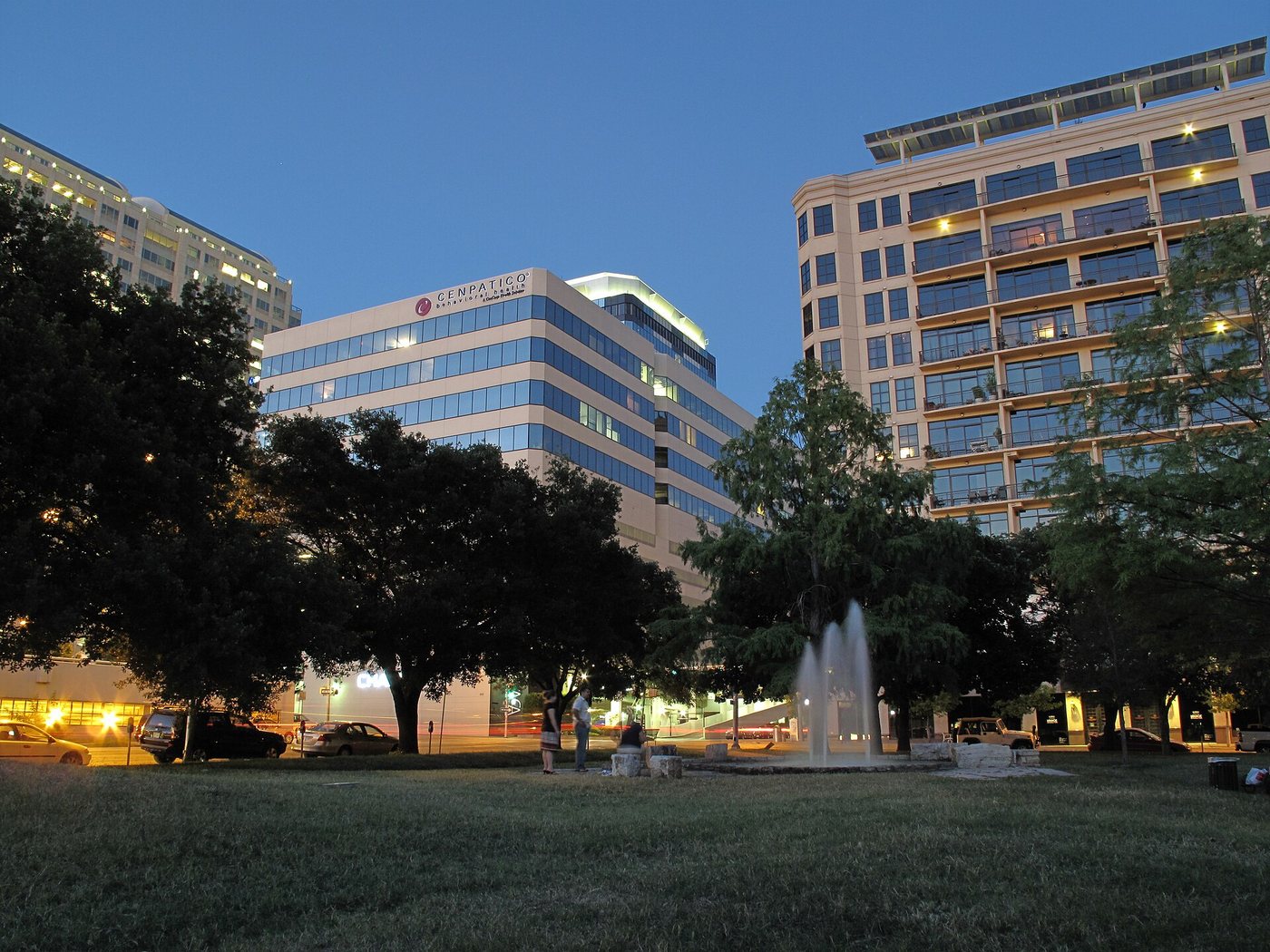
Republic Square shows that drawing a park on a city plan does not guarantee a permanent park-like landscape. The space originated in Austin’s early layout, became important to a Mexican and Mexican American neighborhood, spent years as a parking lot and was later reclaimed for public recreation. Its history is therefore about use and access as much as design.
A public square in the 1839 plan
Edwin Waller’s plan reserved a central Capitol square and four smaller public squares. The land now called Republic Square belonged to that structure. Austin’s early land auction also connects the place with the process of turning the planned capital into privately owned lots and public streets.
The square did not always receive the attention implied by its formal designation. City interpretive material notes that Austin’s early public spaces were used for storage and other expedient purposes. A reservation on paper protected a possibility, but the quality of the public place still depended on investment and everyday choices.
The surrounding community gave it meaning
The city’s master plan documents the neighborhood known as Mexico from the late nineteenth century. Mexican and Mexican American residents, businesses and social organizations formed a community around the square, which was also called Mexico Park. Our Lady of Guadalupe Church and its associated school belonged to that nearby setting.
The plan draws on oral history as well as maps. That is important because the disappearance of a building does not erase the relationships that once made a neighborhood. A modern skyline can conceal an earlier geography of homes, shops, worship and celebration. The square offers a surviving point around which that geography can be explained.
Parking was a phase, not the final outcome
From the mid-twentieth century into the early 1970s, the space served as a parking lot. Efforts beginning in the 1970s returned it to park use, and a later partnership produced the 2017 redesign. Republic Square’s current landscape is thus the result of recovery and reinvestment, not uninterrupted preservation of a nineteenth-century garden.
The distinction matters when assessing urban open space. A small downtown parcel can serve very different constituencies depending on whether it accommodates parked vehicles, informal sitting, markets or events. The ground has not moved, but its public value and daily experience change with those decisions.
The square as a reference point
Spend time at the edge as well as beneath the trees. The contrast between a small public square and the scale of surrounding development makes its persistence visible. Read the interpretation about the earlier neighborhood before treating the park only as a convenient pause between downtown destinations.
Any scheduled event is one use of the square, not its entire purpose. On an ordinary day, the arrangement of paths, shade and sitting places shows how it supports people who are passing through, waiting or spending time without a programmed activity.
.jpg)

.jpg)