
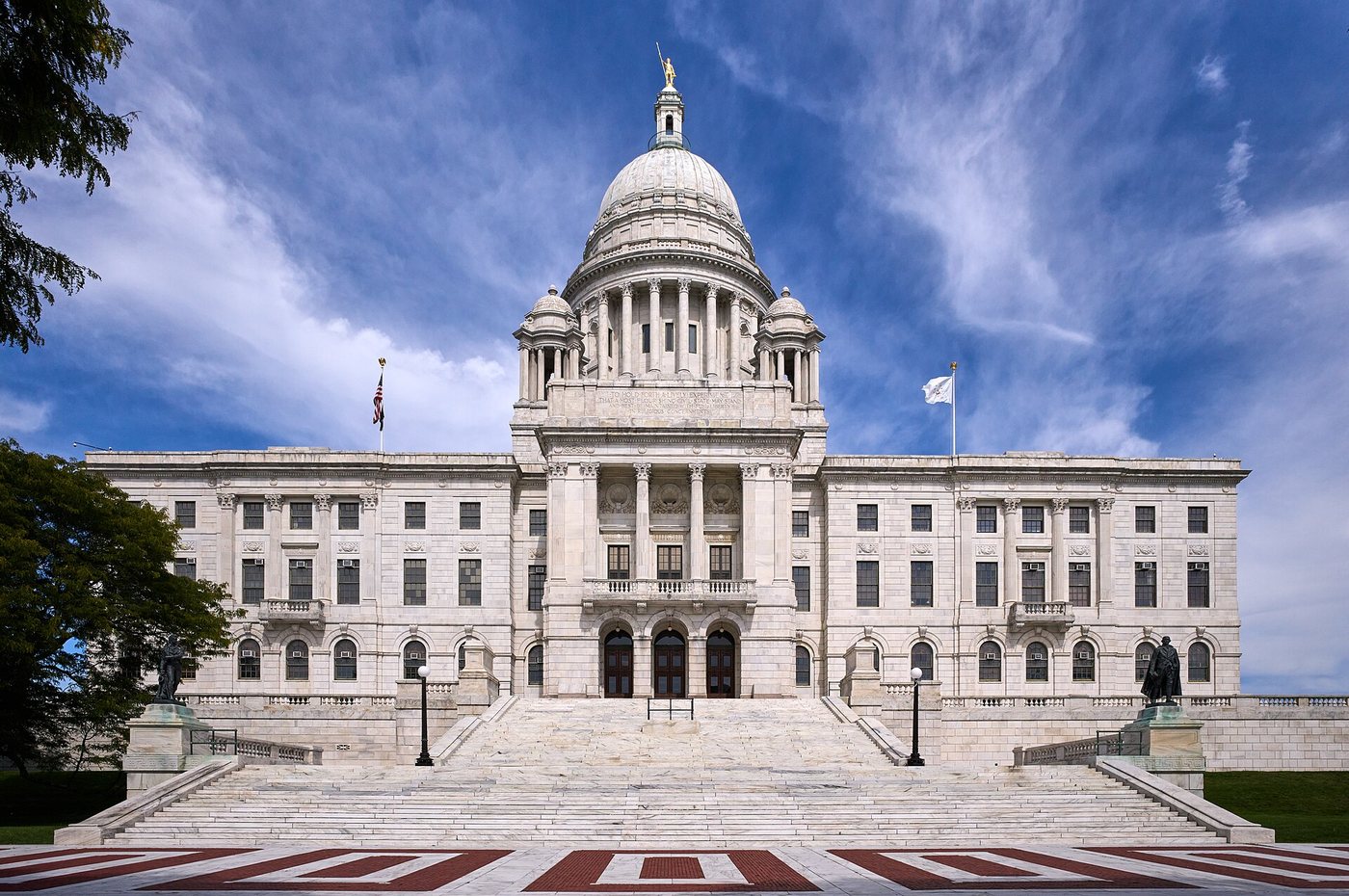
The Rhode Island State House is recognizable from several parts of downtown because its dome rises above an open hillside setting. Approaching on foot changes the view from a skyline marker to a sequence of lawns, entrances and interior spaces. The building’s role as a seat of government gives those architectural choices a specific purpose.
A state building above the city
McKim, Mead & White designed the State House, which was built between 1895 and 1904. White Georgia marble and a large self-supporting marble dome establish its distinctive appearance. The broad setting allows the building to be seen as a complete composition rather than only as a facade within a continuous street wall.
The dome organizes the exterior around a central point. Wings and repeated windows give the building breadth, while the upper silhouette marks its position from farther away. This combination allows a large administrative building to remain recognizable at different distances.
The statue known as the Independent Man crowns the dome. It belongs to a broader program of symbols through which the building presents ideas about Rhode Island. Such imagery is part of the architecture’s public message, even for people who never enter.
The rotunda gathers several kinds of symbolism
The state’s self-guided brochure identifies murals, allegorical figures and inscriptions around the rotunda. These combine references to history with abstract ideas such as justice and education. The high central space gives the images a common setting while allowing visitors to encounter them from different levels.
Rather than attempting to memorize every decorative feature, follow one theme. Compare how an idea appears in words, a figure or a historical scene. The different forms make visible the choices involved in representing a state within its government building.
Documents give the symbols a historical anchor
The Royal Charter Museum includes the 1663 charter, a document central to Rhode Island’s colonial history and its account of religious liberty. Its presence adds a different kind of evidence from the architectural decoration: a surviving record whose wording and historical context can be examined.
A charter, a mural and a later statehouse are not products of the same period. Reading them together requires attention to chronology. The building presents earlier history through a design created at the turn of the twentieth century, while contemporary interpretation explains those layers to visitors.
Government continues around the visitor route
The State House accommodates the executive and legislative work of Rhode Island. Tour arrangements and public access operate within that working setting. Use the Department of State’s current visitor guidance to plan an interior visit and distinguish an architectural tour from attendance at a particular government proceeding.
The state offers guided, self-guided and virtual resources. These provide different ways to connect the spaces with their functions. The building becomes more understandable when its grand rooms are considered alongside the offices, chambers, records and daily procedures that make it a seat of government.
-L1001135.jpg)
