Baltimore City Hall presents government through a carefully composed facade, a central dome and a prominent position on Holliday Street. Its public significance is easy to recognize from outside. Interior access, however, depends on the building’s continuing administrative role and the arrangements for a particular visit.
An architectural address for city government
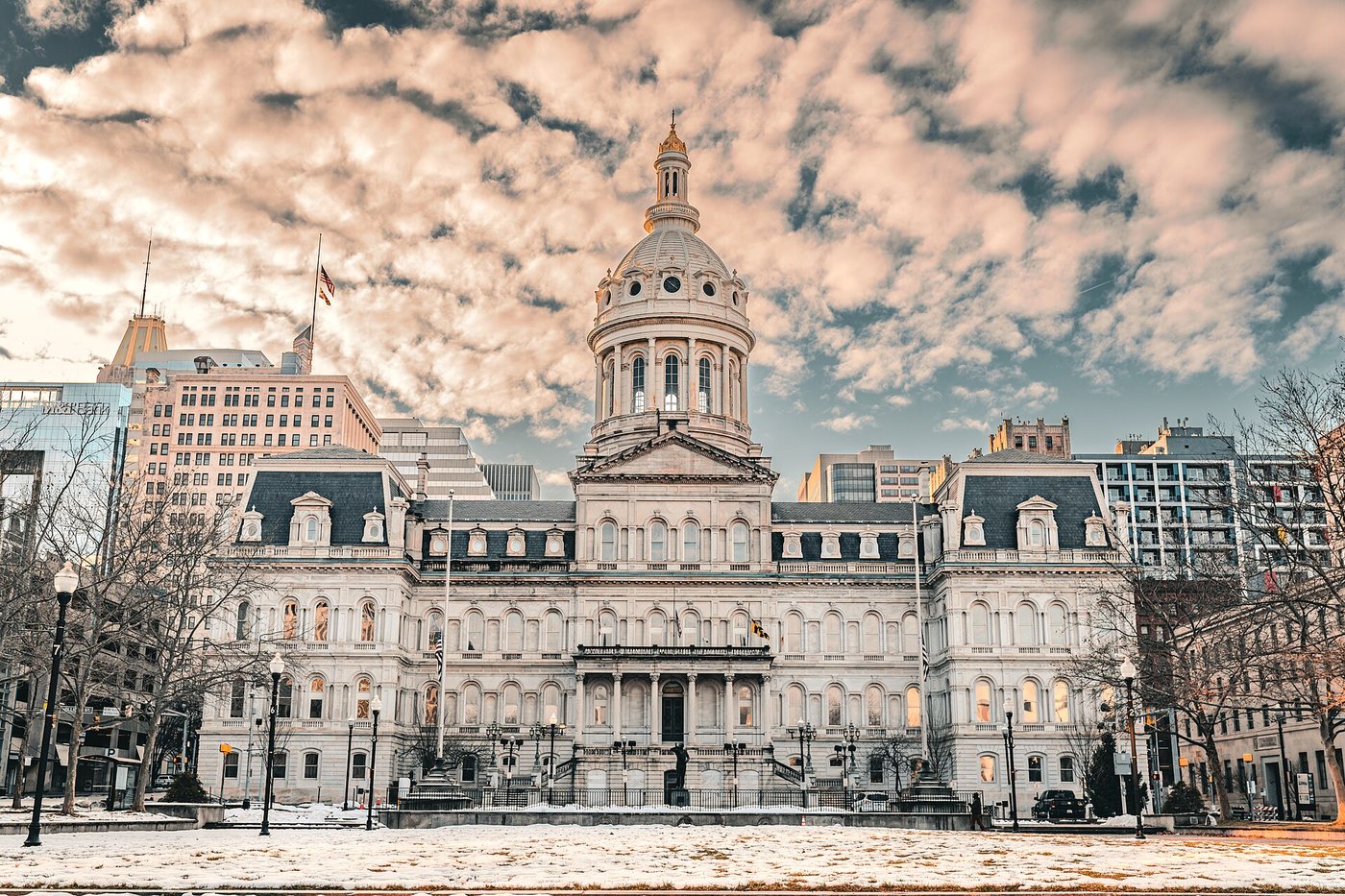
The Maryland State Archives records the dedication of the present City Hall in 1875 and identifies George A. Frederick as its architect. It replaced the earlier municipal premises in the former Peale Museum building. The new structure gave city government a larger and more conspicuous architectural address.
The facade can be read in layers: a substantial base, repeated upper-level openings and the dome rising above the center. Repetition connects the many rooms inside to one overall public image. The central emphasis helps a pedestrian distinguish the building from the surrounding street frontage.
The exterior also offers a way to compare civic scale with ordinary street movement. Stand far enough away to see the whole composition, then examine how an entrance meets the sidewalk. The same building has to be legible as a city landmark and usable by an individual arriving for a specific purpose.
A landmark with working rules of access
Baltimore’s published administrative guidance states that City Hall tours must be arranged in advance through the responsible city office. It also distinguishes tour access from the use of assembly rooms and other government spaces. A visually open entrance should not be interpreted as permission to wander through every interior.
If the purpose is an appointment or public meeting, use the current instructions from the relevant office. If the purpose is architecture, consult the city’s tour arrangements. Keeping these purposes separate avoids turning a historical visit into an unplanned attempt to access working areas.
An exterior-only visit can still be informative. Compare the dome’s role in the skyline with the rhythm of windows and entrances at street level. The building’s public identity is expressed across those scales, while its ongoing use explains why visiting it differs from entering a museum dedicated entirely to architectural display.