
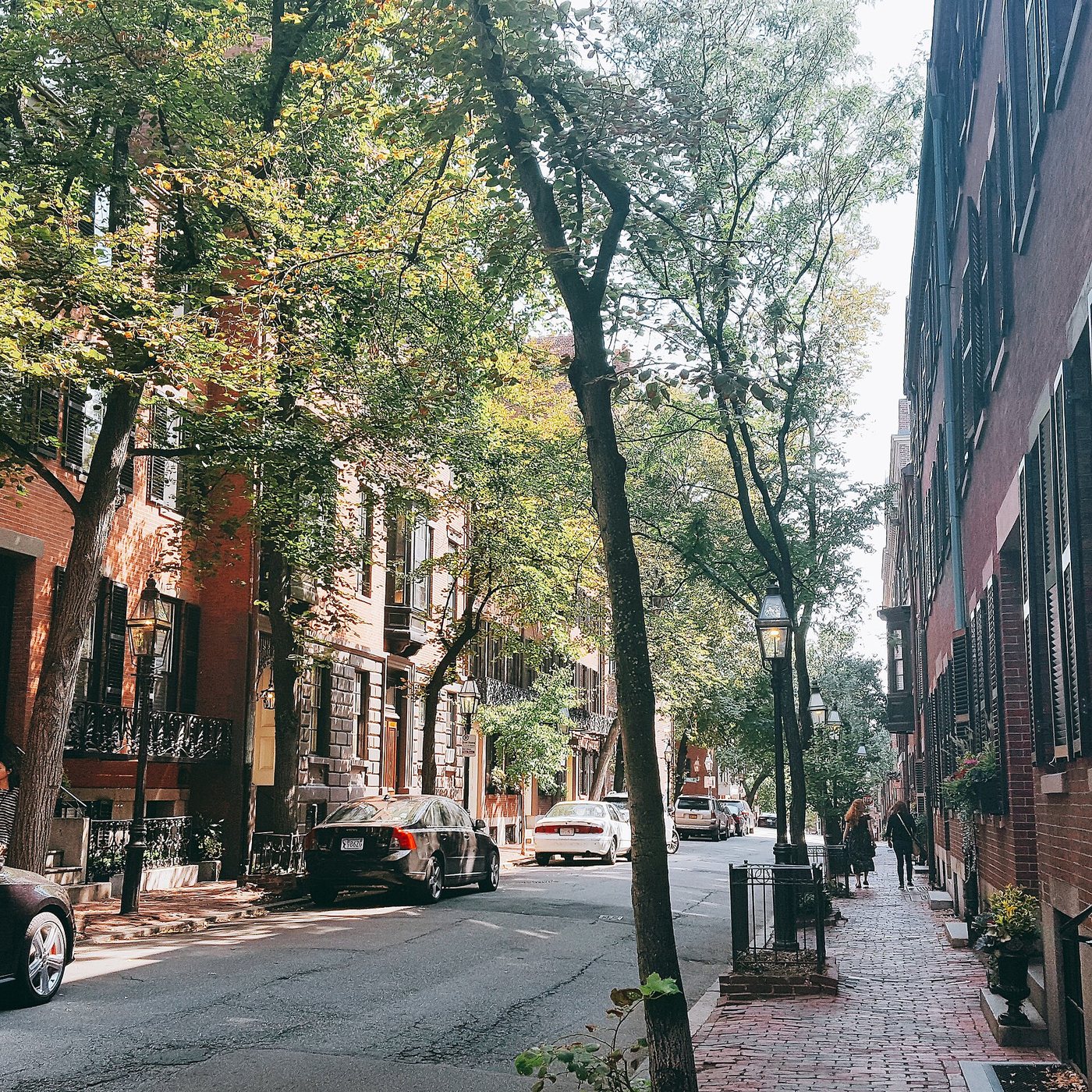
Beacon Hill is frequently represented by a brick lane, a polished doorway and a gas-style street lamp. Those details are real parts of its streetscape, but the neighborhood’s history is broader than that familiar image. Its slopes accommodated wealthy households, artisans, immigrants and a free Black community whose institutions were central to abolition and the struggle for equal education.
The hill was reshaped as well as built upon
The name comes from a warning beacon erected on the high ground in the seventeenth century. The landscape was once part of a group of three peaks, and substantial portions were later cut down to provide fill for Boston’s expanding land area. The surviving slope is therefore not an untouched natural feature around which the city simply grew.
The south side, overlooking Boston Common, became associated with elite residential development. The Mount Vernon Proprietors acquired land and developed houses in an area increasingly attractive to wealthy residents. On the north and west slopes, a different mix of working- and middle-class households established itself. The contrast was social and economic as well as topographic.
This matters when walking through the district. A change in street character may reflect differences in development and occupancy, not merely a designer’s choice of attractive brickwork. A single photographed lane cannot stand for all the communities that lived on the hill.
Black institutions and the work of reform
The National Park Service’s Black Heritage Trail connects sites associated with Boston’s nineteenth-century Black community. Its subjects include the abolition movement, the Underground Railroad and campaigns for equal rights and access to education. These were organized activities rooted in homes, meeting places and institutions within the neighborhood.
The African Meeting House and the Abiel Smith School, interpreted by the Museum of African American History, give this story physical anchors. A meeting house could support religious life while also providing space for public discussion and organizing. A school building makes educational segregation and the campaign against it tangible in a way that a general description of reform cannot.
The trail also connects to the Robert Gould Shaw and Massachusetts 54th Regiment Memorial beside Boston Common. That memorial relates the neighborhood’s history to military service during the Civil War. Its position near the State House places questions of citizenship and recognition within the city’s civic landscape.
Many other trail stops are private residences. Their significance lies partly in what residents did there, not in their availability as visitor interiors. The National Park Service specifically asks visitors to respect this distinction.
A walk shaped by slope and surface
The Black Heritage Trail is approximately a mile and a half, but distance alone is not a full measure of the route. The National Park Service notes steep hills and uneven brick or paved sidewalks. Someone choosing a short, lower-effort visit may prefer to concentrate on one institution and a few nearby streets rather than attempt every stop.
Use the current official route rather than assuming a visible brick line belongs to this trail. Boston has several heritage routes, and the Black Heritage Trail has its own sequence of sites. Construction can also affect a connection between stops.
Residential details reward attention from the sidewalk: door surrounds, roof shapes, basement entrances and the way houses meet a sloping street. They should be considered alongside the neighborhood’s social history. A graceful doorway might have belonged to a household whose circumstances changed repeatedly; an ordinary-looking house may have been associated with significant organizing work.
The strongest reading of Beacon Hill holds both kinds of evidence together. Architecture shows how space was arranged, while the history of its residents explains what people did within that space. Neither the picturesque image nor a list of famous addresses is sufficient on its own.

_-_%22North_End_Nights%22.jpg)
.jpg)
