Bryant Park is a small landscape with unusually strong edges. The New York Public Library closes its eastern side, while surrounding streets and tall buildings keep Midtown in view. Its central lawn can look like the main attraction, but the perimeter explains how the park functions: entrances, paths, chairs and places to stop connect an open green space to a dense business district.
Opening the park to the street
The park’s modern history includes a major reconstruction followed by reopening in April 1992. The Bryant Park Corporation’s account identifies improved entrances and visibility, repaired paths and lighting, planting, and new concessions among the changes. The work addressed how people reached the park and what they could do once inside, alongside the condition of the grounds themselves.
That is a useful distinction when looking at a city park. A landscape can contain healthy trees yet feel detached from the street if entrances are obscure or edges block the view. At Bryant Park, compare an approach from a sidewalk with the experience of sitting inside. Seeing where paths lead makes the interior legible before someone commits to entering it.
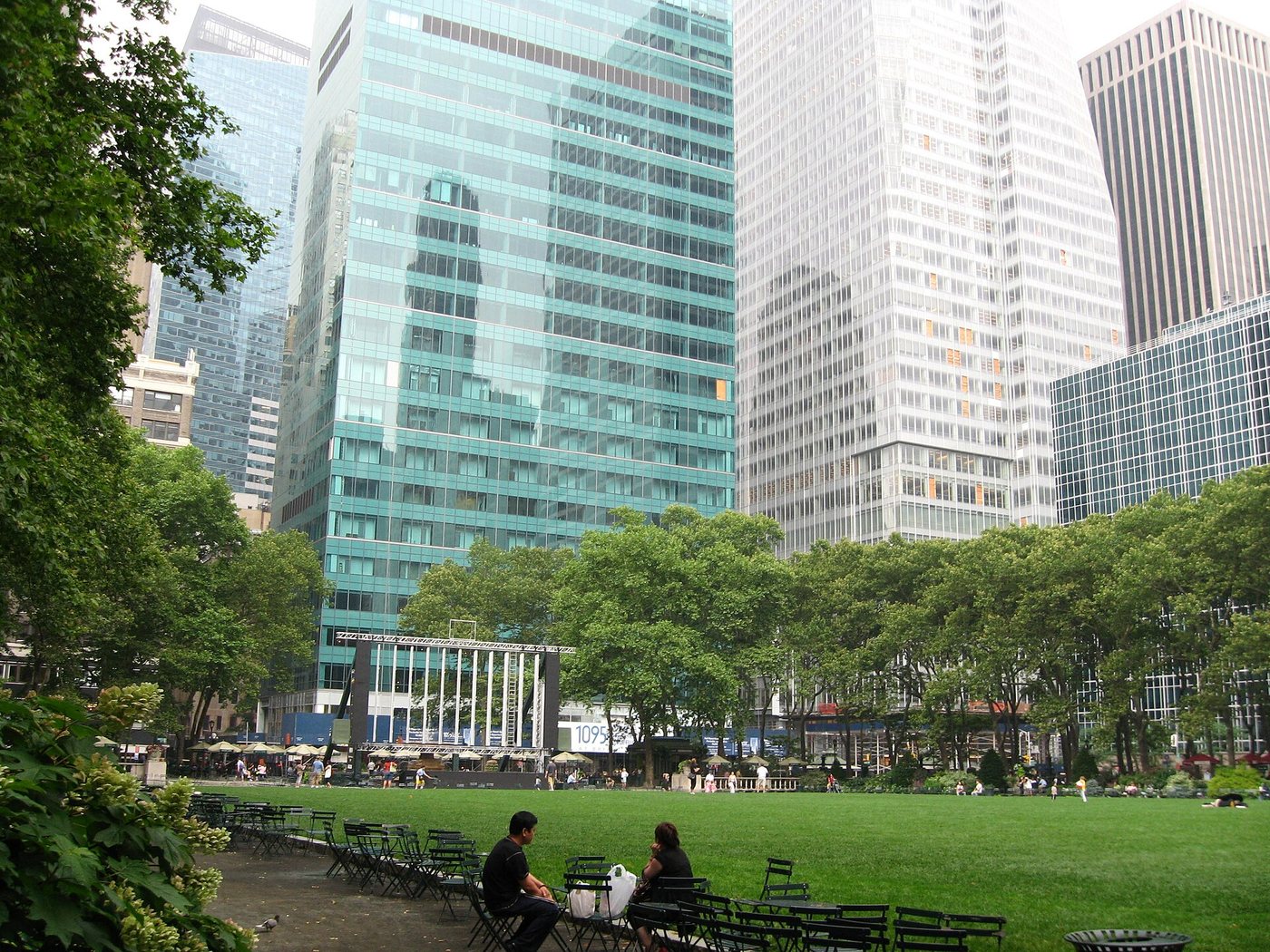
Movable chairs allow small decisions that a fixed bench cannot: sitting alone or with a group, turning toward the lawn, or shifting a few feet toward shade. These modest choices are part of the design’s everyday operation. The arrangement of people changes even while the outline of the park stays the same.
The library is more than a backdrop
The library building opened in 1911 on the site of the old Croton Reservoir. Bryant Park’s history therefore links public recreation with two different forms of city infrastructure: water supply and the storage and circulation of knowledge. The terrace behind the library also changes the ground level, giving the east edge a different character from the street-facing sides.
A view across the lawn compresses several scales into one scene. Chairs and planting belong to the scale of a person, the library to a civic institution, and the surrounding towers to a much larger commercial city. Notice how the lower building holds a visual edge without hiding the skyline completely.
Seasonal installations and scheduled events can alter access to the lawn and the distribution of seating. Consult the park’s own calendar if a specific activity is the reason for visiting. Otherwise, a short circuit of the paths is enough to compare its edges and understand why an apparently simple rectangle of green can support many different uses.