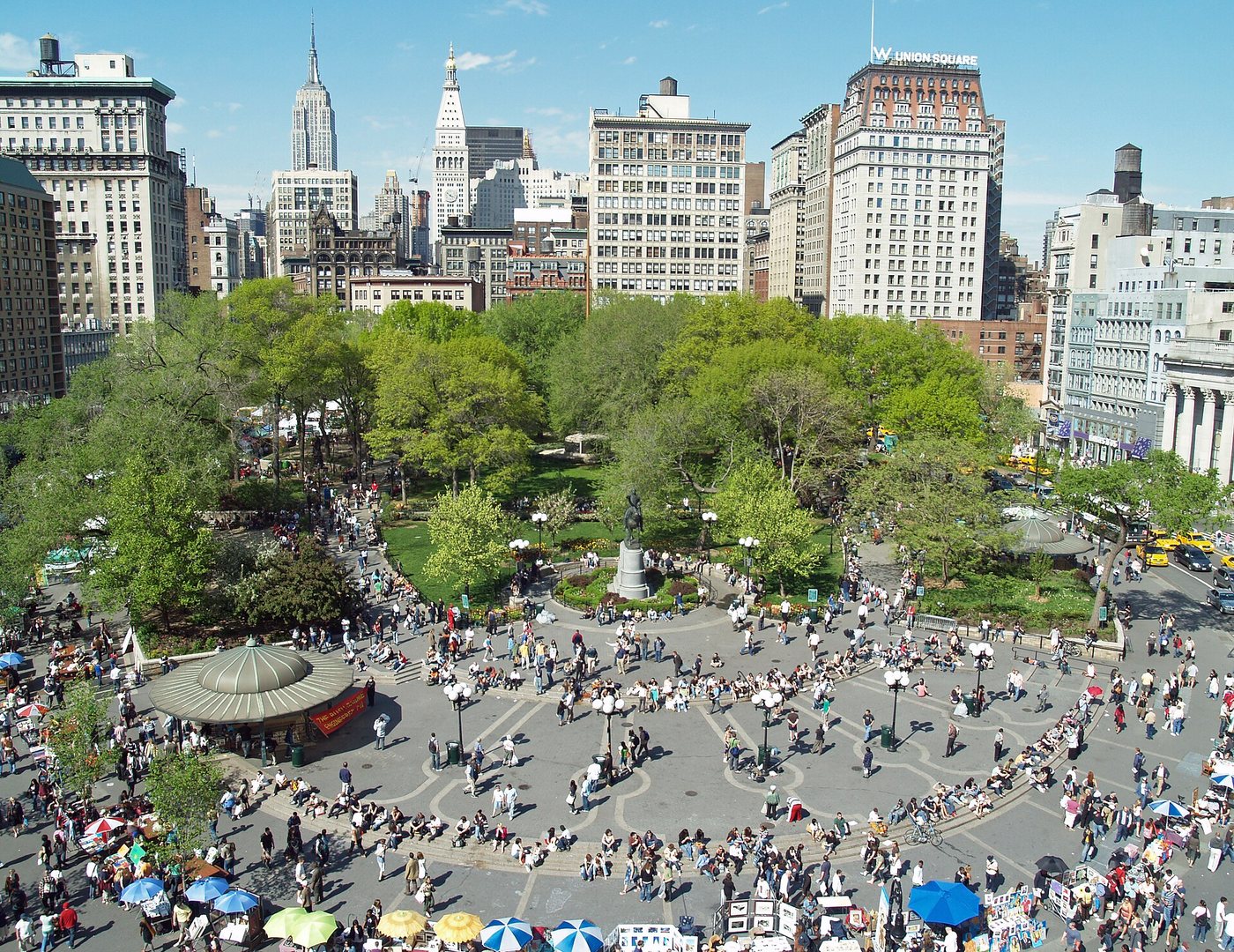
Union Square sits at a meeting of routes rather than at the center of a perfectly regular street block. That distinction explains both its name and much of its character. Broadway meets the older line of the Bowery road here, interrupting Manhattan’s grid. The resulting space has supported planted grounds, political gatherings, market stalls and the everyday business of moving through the city.
A name rooted in the street plan
The union in Union Square originally referred to roads, not to the American Civil War or a labor organization. NYC Parks identifies those routes as Bloomingdale Road, now Broadway, and Bowery Road, now Fourth Avenue. Their junction preceded the park that opened in 1839. Early paths and planting drew on London’s residential squares, with an enclosed oval and a central fountain added in 1842.
This history makes the surrounding street pattern worth examining before concentrating on individual statues. A square need not be square in outline: the name can describe a shared urban place rather than a geometric figure. At Union Square, the spaces where people enter and circulate belong to the story as much as the landscaped interior. The park was later substantially rebuilt for an underground subway concourse in 1928–29. Movement below the ground helped reshape the landscape above it.
Public assembly gives the park another meaning
Union Square became associated with labor activism after it had already acquired its name. On September 5, 1882, workers taking part in the first Labor Day parade passed a reviewing stand here. The park’s later recognition as a National Historic Landmark acknowledged a much broader history of political expression, extending beyond a single procession.
A public gathering place depends on more than an open area large enough to hold a crowd. It also needs visibility, routes of arrival and a recognizable address within the city. Union Square brings those qualities together. Its history therefore offers a way to think about civic space: a place originally arranged for recreation can acquire additional meanings through the people who use it.
The monuments introduce another layer. Figures commemorated in the park and the crowds that have assembled around them do not represent one unified account of the past. Looking at both helps avoid treating the square as either a quiet memorial garden or solely a stage for demonstrations. It has accommodated several kinds of public life, sometimes at the same time.
Market days reconnect the city with a region
GrowNYC’s Greenmarket program began in 1976, and Union Square became one of its early locations that year. The market connects a Manhattan public space to farms and food producers across the Northeast. GrowNYC describes its markets as producer-only: participating sellers grow, raise, catch, bake or otherwise produce the goods they are permitted to sell under the program’s rules.
That distinction changes how to browse. A stall is not simply another shop with a permanent selection. Harvests, season and producer attendance shape what is available. Questions about an unfamiliar apple variety or a crop’s growing season can reveal something about the landscape beyond the city, as well as about the food on the table.
For a visit centered on the market, consult GrowNYC’s current Union Square listing before setting out; market operations and individual attendance can change. For a visit centered on the park, leave room to observe the differences between its perimeter and interior. Moving shoppers, people pausing on benches and pedestrians crossing toward another street each reveal a different use of the same small piece of Manhattan.